

Unique Wall Art for Living Room: The Uncompromising Standard of Fine Art

Most walls are dead space. They are filled with placeholders that signal a total lack of intent. If you settle for generic prints, you are settling for a sterile environment. Your home shouldn't look like a showroom. It should look like a reflection of your standards. You've likely felt the frustration of searching for unique wall art for living room only to find mass-produced canvases that lose their soul the moment they're unboxed. You aren't looking for decoration. You're looking for an edge.
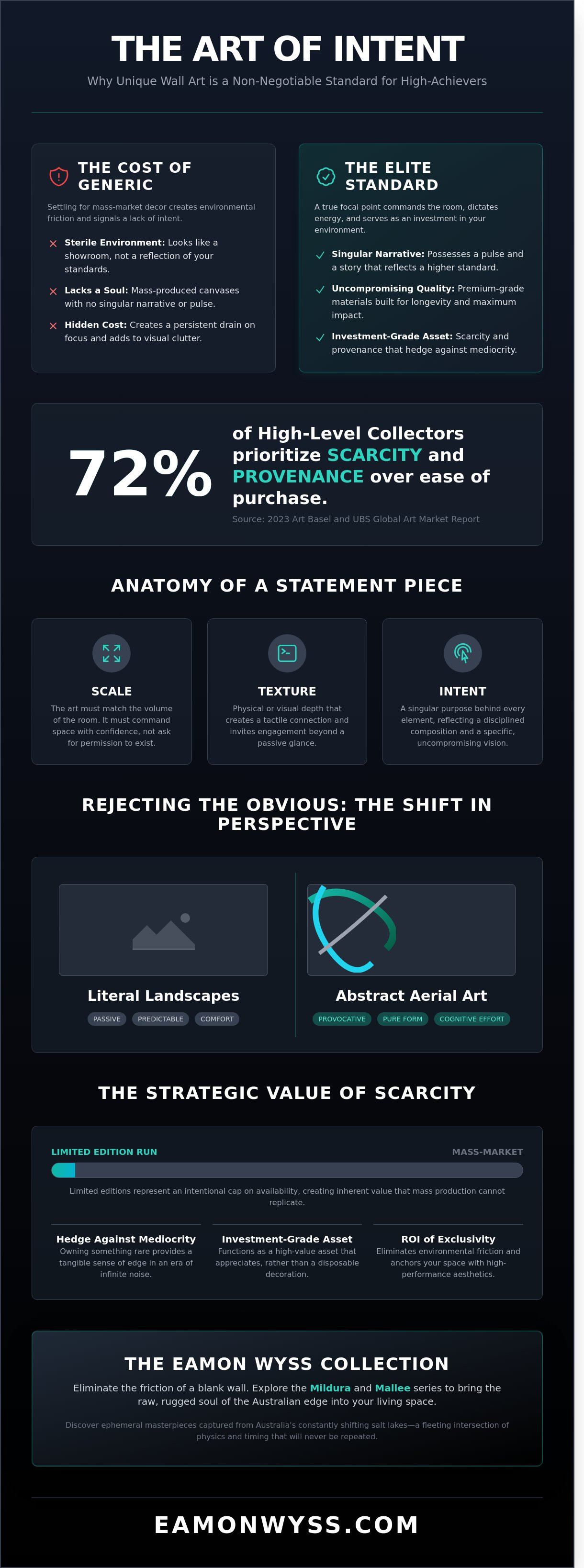
The 2023 Art Basel and UBS Global Art Market Report notes that 72% of high-level collectors prioritize scarcity and provenance over ease of purchase. You deserve that same standard in your private space. This article reveals how to move beyond generic decor and secure a focal point that defines your environment with elite-level abstract aerial art. We will break down the mechanics of scarcity, the psychology of perspective; and the exact steps to ensure your art remains a high-value asset that never looks cheap.
Key Takeaways
- Stop settling for generic decor. Treat unique wall art for living room as a non-negotiable standard that defines the high-stakes theatre of your life.
- Shift your perspective from literal landscapes to the elite discipline of aerial abstraction. Discover the ephemeral power of Australia's salt lakes captured as uncompromising modern masterpieces.
- Demand maximum impact from your physical assets. Learn why premium-grade materials are the only acceptable choice for those who refuse to compromise on longevity.
- Hedge against mediocrity by curating scarcity. Understand the strategic value of limited edition runs and how to identify art that functions as an investment-grade asset.
- Eliminate the friction of a blank wall. Explore the Mildura and Mallee series to bring the raw, rugged soul of the Australian edge into your living space.
The Focal Point: Why Unique Wall Art is a Standard, Not a Choice
Your living room is the primary theatre of your life. It's the arena where you decompress, strategize, and host. The stakes are high. Every element within these four walls either contributes to your clarity or adds to the clutter. Choosing unique wall art for living room environments isn't a design preference. It's a commitment to a higher standard of living. Mediocrity in your surroundings breeds mediocrity in your mindset. You don't need more things; you need better things.
Unique wall art is defined by two factors: a singular narrative and uncompromising production standards. It's the difference between a soul-less print and a piece that possesses a pulse. Throughout the history of art, the most influential works have served as psychological anchors. They don't just sit on a wall. They command the room. They dictate the energy of the space rather than seeking permission to exist within it.
Generic decor carries a hidden cost. It creates environmental friction. When you settle for "safe" choices from big-box retailers, you're surrounding yourself with the echoes of mass production. Your brain recognizes the lack of intent. This creates a subtle, persistent drain on your focus. Stop filling space. Start commanding attention. A true focal point eliminates the noise and provides a visual destination that grounds the entire room.
The Anatomy of a Statement Piece
A statement piece requires scale, texture, and a specific "stop-and-stare" factor. It must disrupt the visual flow of the room to force engagement. Abstract art is a powerful tool here. It demands an active mind rather than a passive glance. It's an invitation to think. This reflects Eamon Wyss's philosophy, which prioritises the raw truth of the land over fleeting decorative trends. This approach isn't about matching a color palette. It's about capturing a frequency that resonates with the elite performer.
- Scale: The art must match the volume of the room. Small art in a large space signals a lack of confidence.
- Texture: Physical or visual depth creates a tactile connection that digital prints cannot replicate.
- Intent: Every brushstroke or shutter click must serve a singular purpose.
Eliminating the Noise of Mass-Market Decor
There's a massive gulf between an "image" and an "artwork." An image is a commodity. An artwork is an investment in your environment. Unique pieces act as the ultimate anchor for interior design, allowing the rest of the room to fall into place. When the art is strong, the furniture only needs to support it. This creates a streamlined, high-performance aesthetic.
The ROI of exclusivity is real. Scarcity matters. In an era of infinite digital noise, owning something rare provides a tangible sense of edge. High-achievers don't tolerate friction in their workflows, and they shouldn't tolerate it in their homes. Choose unique wall art for living room spaces that reflects your own drive for excellence. Anything less is just wallpaper.
Decoding the Edge: Abstract Aerial Art as a Modern Masterpiece
Literal landscapes are passive. They ask nothing of you. They provide a comfortable, predictable view that requires zero cognitive effort. For the high-achiever, comfort is a trap. The shift toward aerial abstraction represents a rejection of the obvious. It moves beyond the postcard view and into the realm of pure form, texture, and intent. This is the new standard for unique wall art for living room environments that aim to provoke rather than placate.
Australia's salt lakes are the ultimate testing ground for this philosophy. These are not static features. They are ephemeral canvases that exist in a state of constant flux, often transformed by a single rain event or a 24-hour shift in wind direction. Capturing these moments requires more than a camera; it requires a relentless pursuit of the "Edge." This is the precise point where nature’s chaotic erosion meets the artist's disciplined composition. It is why abstract salt lake aerial prints represent the pinnacle of modern photography. They don't just show a place. They document a fleeting intersection of physics and timing that will never be repeated.
Stripping Away the Noise
Drone photography at an altitude of 400 feet changes the internal dialogue. At this height, the visual friction of the Mallee scrub disappears. What remains is the truth of the land: the geometric patterns of salt crusts and the visceral scars of ancient watercourses. This transition from raw data to fine art is a matter of uncompromising composition. Every line must serve a purpose. Every void must hold weight.
These pieces resonate with those who value clarity in their professional and personal lives. Research in environmental psychology indicates that the visual structure of a room directly impacts cognitive load and emotional regulation. By choosing unique wall art for living room spaces that emphasize order within chaos, you create a sanctuary for high-level focus. You eliminate the mental clutter that mediocrity thrives on.
The Story of the Land
The Australian landscape is brutal. It doesn't care about your aesthetic preferences. To capture its essence, the artist must endure a disciplined hunt, often spending 5 hours in 40-degree heat to find a single frame that meets the standard. This isn't luck. It is the result of extreme ownership over the craft. Most people miss these details because they lack the patience to look. They see a dry lake; the artist sees a narrative of resilience.
Integrating abstract art inspired by nature into your home links your space to this raw, uncompromising power. It serves as a daily reminder that beauty is often found in the harshest conditions. If you are ready to stop settling for generic decor, explore the latest new prints to find a piece that reflects your own standards of excellence.
Material Standards: Canvas vs. Fine Art Paper for the Living Room
Art is a physical asset. The medium you choose determines the longevity of that asset. In a living room, where light, temperature, and activity fluctuate, the material is the first line of defense against mediocrity. Eamon Wyss operates on a foundation of uncompromising quality. This isn't about decoration; it's about elite standards. Every piece is produced using premium-grade materials designed to withstand the friction of time. When you select unique wall art for living room spaces, you aren't just buying a visual. You are acquiring a manufactured standard that must hold its integrity for 75 to 100 years.
The tactile difference between gallery-wrapped canvas and framed fine art paper is significant. One offers raw, textured presence. The other provides clinical, high-definition clarity. Choosing between them requires an understanding of your environment's lighting and your personal performance goals for the space. To secure investment-grade art, you must look past the image and inspect the substrate. If the material fails, the art fails. There is no middle ground.
The Case for Premium Canvas
Canvas offers a rugged, painting-like texture that demands attention. It's built for durability. High-end 450gsm poly-cotton blends provide a structural edge that paper cannot match. For large-scale installations, limited edition canvas prints are the superior choice. They eliminate the barrier of glass. This removes glare entirely, ensuring your unique wall art for living room viewing is perfect from every angle. Without a reflective surface, the connection between the viewer and the work is direct and unfiltered.
The Precision of Fine Art Paper
Some compositions demand the crispness of 310gsm archival paper. This medium excels in capturing micro-details and deep tonal ranges. It's a discipline of precision. Archival standards ensure these prints resist yellowing and fading, even in bright rooms. Framing becomes the protective shell. It guards the edge of the print and creates a sophisticated, curated look. When the goal is absolute depth and sharp contrast, fine art paper is the elite choice. It requires more care, but the visual payoff is undeniable.
Visibility is non-negotiable. If your art is obscured by reflections from a window or a lamp, the investment is wasted. Eliminating glare is a strategic move. Canvas absorbs light. Framed paper, when paired with high-quality acrylic or glass, protects the ink. Both paths lead to the same result: a space that reflects a higher standard of living. Choose the medium that fits your light. Don't settle for less than archival excellence.
Curating Scarcity: How to Select Investment-Grade Art
Stop buying fillers. Start acquiring assets. Most people treat wall decor as an afterthought, a way to occupy empty space. This is a mistake. Scarcity isn't a marketing trick; it's the ultimate hedge against mediocrity. When you choose unique wall art for living room environments, you're deciding between a mass-produced commodity and a limited-run asset. Open editions flood the market and carry zero long-term value. Limited editions create a hard ceiling on supply, ensuring your piece remains rare. This scarcity is what separates a decorated room from a curated one.
The Collector’s Mindset
Transitioning from a consumer to a patron requires a shift in standards. You aren't just shopping for a color palette. You're investing in art prints that represent a specific moment in an artist's evolution. A collection should be a roadmap of your own growth and discipline. Demand rarity. Focus on pieces that challenge the viewer rather than those that simply blend into the background. Your walls should reflect a high-performance lifestyle, not a catalog page.
Sizing for Maximum Impact
Scale is where most collectors fail. They buy small, creating visual friction and making the room feel cluttered. Follow the 60/40 rule for elite placement. Your art should cover roughly 60% to 75% of the available wall space that isn't already occupied by furniture. If your sofa spans 2.4 meters, your art needs to command at least 1.5 meters of that horizontal plane. Anything less looks like a postage stamp on a billboard. Explore the Abstractions Collection for large-format pieces that provide the necessary gravity for a high-stakes living space.
- The Anchor Effect: Large pieces stabilize a room’s energy.
- Avoid the "Gallery Gap": Don't hang pieces too high; the center point should sit 145 centimeters from the floor.
- Negative Space: Use the remaining 40% of the wall to let the work breathe.
Verification is the final pillar of a serious collection. A signature isn't just ink. It's a mark of accountability. Every investment-grade piece must come with a Certificate of Authenticity (COA). This document tracks the edition number and confirms the work’s origin. It’s the difference between a decorative print and a documented piece of unique wall art for living room history. Without a COA, you have a picture. With one, you have provenance. Hold your acquisitions to this uncompromising standard.
The Eamon Wyss Collection: Bringing the Australian Edge Home
Your living room is the arena where your standards are visible to the world. It isn't a place for passive decoration. It's a space for establishing dominance in your environment. The latest Limited Edition New Prints represent the current peak of this vision. These works aren't mass-produced fillers. They're high-performance assets for your home. The Mildura and Mallee series bring the raw, uncompromising soul of regional Victoria into a global context. This is unique wall art for living room environments that demand more than the status quo. It's about bringing the grit of the 3500-square-kilometer Mallee region into your private domain.
The Australian landscape is brutal and beautiful. It requires a specific level of discipline to capture its essence. By integrating these pieces, you aren't just hanging a picture; you're importing a standard of rugged credibility. Every print is a reminder that the edge is where growth happens. Don't settle for art that whispers. Choose art that commands attention and forces a shift in perspective.
Featured Series: Dreamscapes and Salt Lakes
The Dreamscapes collection isn't for the timid. It functions as a psychological anchor. These pieces act as windows into an abstract reality where clarity meets chaos. They provide a visual escape that maintains its intensity. For high-end interiors, 100 percent of these works can be tailored through bespoke sizing requests. If your space requires a specific dimension to maintain its edge, the standard is perfection. This is unique wall art for living room owners who refuse to compromise on scale or impact. Each piece in the Salt Lakes series captures the crystalline precision of the Australian interior, offering a level of detail that rewards constant observation.
Securing Your Piece
Acquisition is a matter of execution. The process on eamonwyss.com is designed to eliminate friction. Once you commit to a piece, the logistics are handled with the same precision as the art itself. You can expect a seamless experience from selection to installation. Consider these points regarding the acquisition process:
- Elite Packaging: Every piece is secured using industry-leading materials to ensure it arrives in pristine condition.
- Global Reach: Worldwide shipping is standard. The distance between the Australian desert and your home is irrelevant.
- Direct Access: You are engaging directly with the artist’s vision, removing the noise of traditional gallery gatekeeping.
Stop decorating. That's a habit of the mediocre. Start commanding your space. The margin between a room that feels "nice" and one that feels "elite" is found in the choices you make on your walls. Own your environment. Secure your edge.
Claim the Elite Edge
Your living space reflects your internal standards. Mediocrity is the enemy. Choosing unique wall art for living room environments is a strategic move to eliminate aesthetic friction. It's about presence. It's about power. Abstract aerial art provides the clarity required to transform a standard room into an elite sanctuary. You now understand the difference between temporary trends and investment-grade assets. Standards over feelings. Always.
Eamon Wyss prints represent an uncompromising commitment to quality. These works have earned their place in the Mildura Arts Centre and Brunswick Street Gallery. Each piece arrives as a limited edition run, verified by a signed certificate of authenticity. We utilize premium archival materials built to endure for 100+ years. This isn't just decor; it's a legacy. High-achievers don't wait for inspiration; they curate their surroundings to demand peak performance. The margin between good and elite is thin. Own that margin.
Secure your Limited Edition Focal Point from the New Prints Collection
Build a home that matches your ambition. You've earned the right to an uncompromising view.
Frequently Asked Questions
What makes wall art unique for a living room?
Unique art is defined by rarity and a sharp departure from mass-market repetition found in big-box retail. It avoids the 10,000 unit production runs that saturate common households. True unique wall art for living room spaces demands a singular perspective that creates friction with the status quo. It represents the 1 percent of work that survives a rigorous curation process. Choose pieces that capture a specific moment or a distinct geographic coordinate.
Is canvas or paper better for a living room with lots of natural light?
Canvas is the superior choice for high-light environments because it lacks the reflective glass required for paper prints. Glare on traditional glass can obscure 40 percent of the visual detail during peak daylight hours. Canvas absorbs light rather than bouncing it. This ensures your investment remains visible from every angle in the room. It’s a matter of tactical utility. Paper requires expensive museum glass to achieve similar results.
How do I choose the right size of art for my sofa wall?
Your art should occupy between 60 percent and 75 percent of the available width above your sofa. A 2 meter sofa requires a piece or a gallery set measuring at least 1.2 meters wide. Anything smaller creates a visual imbalance that signals a lack of intent. Position the bottom edge 20 centimeters above the sofa back. Precision in scale is the difference between a decorated room and a curated, elite space.
What is the difference between limited edition and open edition prints?
Limited edition prints are restricted to a specific number of copies, such as a run of 50 or 100, while open editions have no production ceiling. Once a limited run sells out, it never returns to the market. This scarcity creates inherent value. Open editions are commodities. If you want the edge, you buy the limited run. It’s a commitment to exclusivity. You own a fraction of a finite resource.
Why is abstract aerial photography considered fine art?
Abstract aerial photography is fine art because it utilizes perspective to challenge human perception and spatial awareness. It transforms the 3D world into a 2D composition of texture and form. According to the 1917 shift in art theory, the artist's intent and the unique perspective define the work. It’s not just a photo. It’s a calculated extraction of geometry from chaos. It demands a higher level of engagement from the viewer.
How do I know if an art print is investment-grade?
Investment-grade prints must feature archival materials with a 100 year permanence rating and a verifiable provenance. Look for Hahnemühle or Canson papers used by 95 percent of top-tier galleries. Your unique wall art for living room acquires value when it’s backed by a signed certificate of authenticity. Track the artist's exhibition history. Growth in secondary market demand is the ultimate metric of an investment-grade asset.
Does Eamon Wyss provide worldwide shipping for large canvas prints?
Eamon Wyss provides worldwide shipping to over 50 countries using a network of elite logistics partners. Every large-scale canvas is crated with industrial-grade protection to eliminate the risk of transit damage. Delivery timelines typically range from 7 to 14 business days depending on your specific global coordinate. We don’t compromise on the security of the work. Your art arrives ready for immediate installation without friction.
How should I light my unique wall art for maximum impact?
Use dedicated LED picture lights with a Color Rendering Index of 95 or higher to reveal the true depth of the pigments. Position the light source at a 30 degree angle to minimize shadows and glare. This technical setup ensures the work commands the room even after sunset. Standard ceiling fixtures are insufficient. They wash out the detail. High-performance lighting is a non-negotiable requirement for an elite display.
Leave a comment