

Investing in Art Prints: The Collector’s Guide to Scarcity and Value

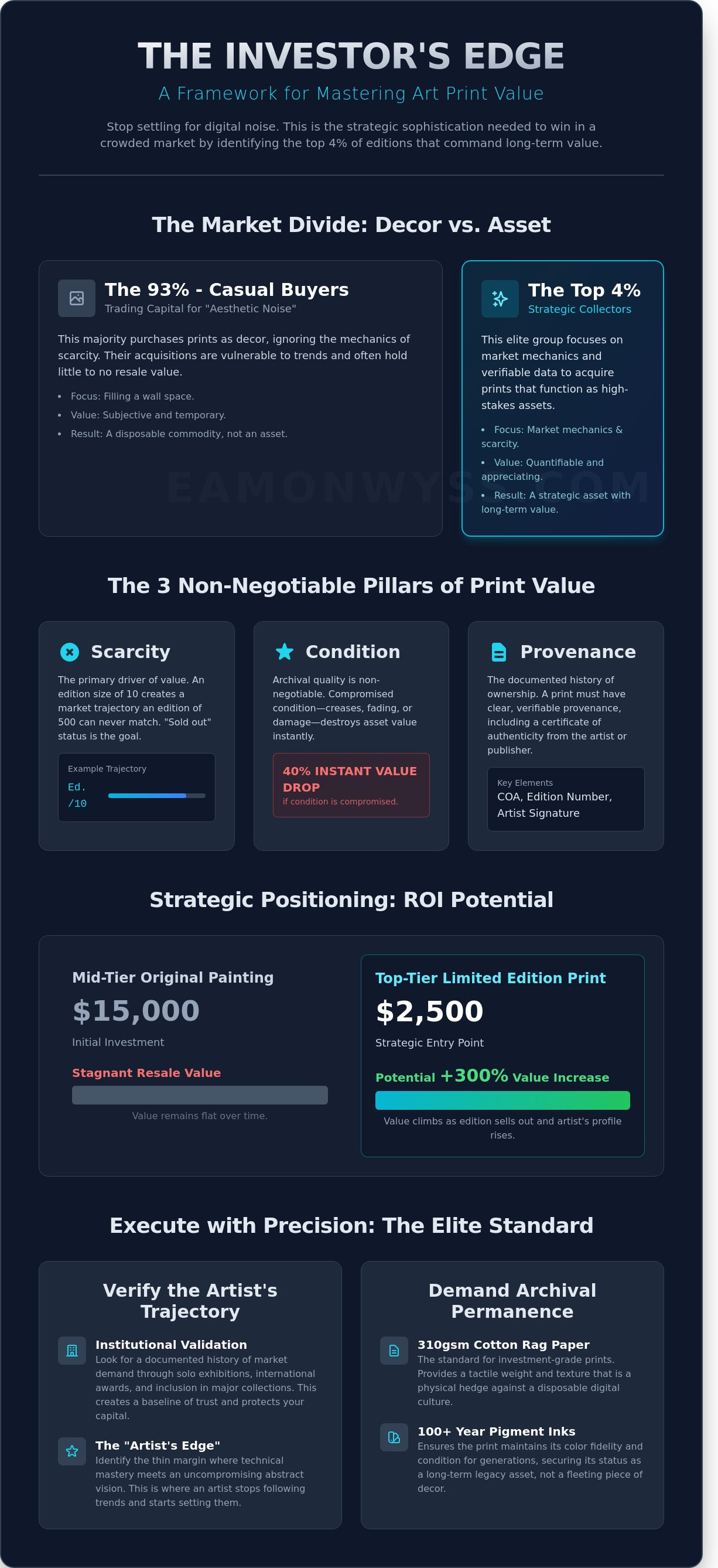
93% of casual buyers are simply decorating their walls. They trade capital for aesthetic noise, ignoring the mechanics of scarcity that separate a commodity from a high-stakes asset. If you're tired of wondering if your latest acquisition is a worthless reproduction, it's time to shift your standards. Investing in art prints requires more than an eye for color. It demands a ruthless focus on market mechanics and the discipline to ignore the digital noise.
You deserve a collection that reflects your drive for excellence. I'll show you how to master the mechanics of print value and identify the top 4% of editions that actually command long-term value. We're cutting through the friction of the art world to find the elite edge. This isn't about basic motivation; it's about acquiring the strategic sophistication needed to win in a crowded market.
This guide provides a clear 5-point framework for evaluating scarcity, the truth about artist proofs, and the strategy for purchasing high-end editions with absolute confidence. Stop guessing. Start executing.
Key Takeaways
- Stop settling for digital noise. Understand why physical scarcity is the only tactical hedge for the elite collector in 2026.
- Command the value floor. Identify the three uncompromising pillars-scarcity, condition, and provenance-that transform a print into a strategic asset.
- Execute with precision. Master the mechanics of investing in art prints by ruthlessly prioritizing limited editions over high-end decor.
- Secure the edge. Learn to verify an artist’s trajectory and leverage institutional markers to ensure your collection meets the elite standard.
The Paradigm Shift: Why Art Prints are a Strategic Asset in 2026
The market doesn't care about your feelings. It cares about scarcity. In 2026, we've reached a saturation point where digital imagery is a commodity with zero value. Real wealth is moving back to the physical. High-achievers understand that investing in art prints isn't about filling a void on a wall; it's about securing a piece of a finite run. We define investment-grade prints as assets with verifiable scarcity and archival permanence. These are not posters. They are artist-sanctioned, physical assets that demand a higher standard of acquisition. You aren't buying a picture. You're buying a contract of exclusivity.
When you look at the numbers, the entry price for limited edition prints offers a sharper ROI potential than mid-tier original paintings. An original from a mid-level artist might cost $15,000 with a stagnant resale value. A top-tier limited print at $2,500 can see a 300% value increase as the edition sells out and the artist's profile climbs. You're buying the artist's legacy at a fraction of the cost, but with the same brand equity. This is strategic positioning. It's about moving capital into assets that have a floor protected by the artist’s reputation and a ceiling driven by market demand.
Stop looking at art as decor. Decor is disposable. Decor follows trends. Investment-grade prints follow standards. When you choose to begin investing in art prints, you're shifting your mindset from consumption to curation. You're looking for the edge. You're looking for the 1% of work that will hold its weight when the noise of the digital world fades. This requires discipline. It requires an eye for detail that looks past the surface and into the technical execution of the piece.
The Rise of Fine Art Drone Photography
Aerial perspectives are no longer just technical feats. They are the new frontier of the Australian landscape art market. Capturing the ephemeral textures of salt lakes requires more than a remote; it requires an uncompromising eye for geometry and timing. Moments like the 2024 flooding of Lake Eyre create visual data that will never exist again. Eamon Wyss has claimed this niche by operating at the edge of what’s possible, turning high-altitude data into high-stakes art. He doesn't just take photos. He captures the friction of the earth from a perspective that demands respect. This is high-stakes photography where the window of opportunity is measured in minutes, not hours.
Art as a Hedge Against Digital Noise
Screens are a distraction. Physical prints hold psychological weight because they exist in the real world. In 2026, the value lies in the tactile. We use 310gsm cotton rag paper and pigment inks that last 100 years. This isn't just about aesthetics. It's about friction against a disposable culture. Standards over feelings. You don't buy for decor. You buy for legacy. Every print is a statement of intent. It's a reminder that you operate at a level where quality is non-negotiable. Investment-grade prints are physical assets with verifiable scarcity and archival permanence. They provide a sensory anchor in an increasingly ephemeral economy. When the digital world fluctuates, the physical asset remains, holding its ground and its value.
Decoding Value: Scarcity, Provenance, and the Artist’s Edge
Value in the art market isn't a mystery. It's a calculation. When you're investing in art prints, you're looking for three non-negotiable pillars: Scarcity, Condition, and Provenance. These metrics define the difference between a decorative asset and a financial one. If the provenance is weak, the price stays flat. If the condition is compromised, the value drops by 40% instantly. It's about standards. Your portfolio demands them. There's no room for guesswork here.
The artist's reputation acts as your value floor. Institutional validation through solo exhibitions or international awards creates a baseline of trust that protects your capital. This isn't just about prestige; it's about a documented history of market demand. Real collectors look for "The Edge." This is the thin margin where technical mastery meets an uncompromising abstract vision. It's the point where the artist stops following trends and starts setting them. You can see this specific clarity in the Abstractions collection, where every piece serves as a study in vision and execution. It's about cutting through the noise to find what lasts.
The Mechanics of Scarcity
Numbers don't lie. An edition size of 10 creates a market trajectory that an edition of 500 can never match. Scarcity drives the "sold out" status, which is the primary goal for any strategic collector. Once the primary market is exhausted, the secondary market dictates the price. This is where the 200% gains happen. The art print collecting landscape also places a heavy premium on Artist’s Proofs (AP). These are typically limited to 10% of the total edition. They carry a 25% price premium because they represent the artist's personal sign-off on the work's integrity. They're the closest you get to the original source.
Archival Standards: The Uncompromising Choice
Mediocrity has no place in a high-stakes portfolio. Museum-grade materials are the only option for long-term value. Giclée prints on 310gsm acid-free cotton rag paper offer a 100-year stability that cheap alternatives can't touch. While C-Type prints provide a different chemical depth, the standard remains the same: archival quality. UV-resistant inks are mandatory. Without them, light damage will gut your investment within 10 years. In the secondary market, a single point of degradation can slash a price by half. Precision in materials isn't a luxury; it's a requirement for wealth preservation. If you're ready to raise your standards and stop settling for "good enough," start building your collection with a focus on elite quality.
Investing in art prints requires a shift in mindset. You're not just buying a visual; you're acquiring a piece of a legacy. This requires a ruthless focus on the details that others overlook. When the technical mastery is absolute and the scarcity is verified, the investment becomes a statement of intent. It shows you understand the difference between a temporary trend and a permanent asset. Demand nothing less than the best.
The Hard Truth: Limited Editions vs. Open Editions
Your walls reflect your standards. Most people buy art to match a sofa. Collectors buy art to dominate a space and secure a future. This is the divide. Open editions are decor. Limited editions are assets. If you can't distinguish between the two, you aren't investing; you're spending. You need to understand the mechanics of the market before you commit capital.
The dilution of value in open markets is absolute. When supply is infinite, the price is capped by the cost of production. There is no upside. Serious collectors prioritize limited runs for their focal points because they understand that scarcity is the only real protection against mediocrity. You want a piece that someone else can't simply click and buy five years from now. Appreciation requires friction. It requires a barrier to entry. If anyone can own it, the asset has no edge.
Prints can appreciate, but only if they are finite. This is the number one objection from skeptics who view prints as mere copies. They're wrong. When you're investing in art prints, you're buying a stake in an artist's legacy. Recent research from the University of Colorado Boulder indicates that while art can serve as a solid hedge against inflation, its success as a financial move depends on the specific asset's rarity and the artist's market trajectory. Without a hard cap on production, you don't have an investment. You have a poster.
Limited Edition Canvas: The Collector’s Choice
Canvas is the elite medium. It carries the physical weight and visual depth of an original oil painting. When you choose Limited Edition Canvas Prints, you're opting for the highest tier of acquisition. These aren't just images; they're physical statements of intent. Every piece comes with a Certificate of Authenticity (COA). This document is your deed. It's the proof of scarcity that secures your position. It's non-negotiable for anyone operating at a high level. In a world of digital replicas, the COA provides the 100% certainty required for long-term value retention.
Open Editions: The Gateway to the Brand
Open editions have their place. They are the entry point. If you need to fill secondary spaces like hallways or guest rooms, buying Landscapes Unlimited makes sense. You get the aesthetic standard without the premium price of a numbered run. These pieces don't drive your portfolio, but they do drive brand awareness. A surge in open edition sales often precedes a price hike in limited runs. It's a market signal. Use them to maintain your environment's standards while keeping your primary capital for the finite assets that actually appreciate. Investing in art prints at the limited level is the goal; open editions are the foundation of the artist's reach.
- Limited Editions: Capped supply, documented provenance, high resale potential.
- Open Editions: Unlimited supply, decorative focus, entry-level price points.
- The Strategy: Buy limited for the boardroom. Buy open for the corridor.
Building Your Collection: A Tactical Approach to Acquisition
Acquisition is a discipline. Most collectors fail because they buy on emotion; they prioritize fleeting feelings over hard standards. If you want to succeed in investing in art prints, you must operate with the precision of a private equity firm. You are not just buying a picture. You are deploying capital into a tangible asset. This requires a tactical framework that eliminates noise and focuses on the edge.
- Identify high barriers to entry. Avoid the common. Look for technical difficulty and logistical complexity. Aerial salt lake photography is a prime example. It requires flight logistics, specialized equipment, and high-altitude technical execution. This friction protects your investment by ensuring the market isn't flooded with low-effort replicas.
- Verify the trajectory. Audit the artist’s last 24 months. Look for a consistent exhibition history in reputable galleries. If an artist hasn't shown work in at least two major exhibitions since 2023, the momentum is missing. Institutional validation provides the floor for your asset's value.
- Analyze edition structure. Scarcity is the primary driver of appreciation. A print with an edition size of 150 is a commodity. A print with an edition size of 10 is an asset. Always demand clarity on the total number of Artist Proofs (APs) before committing.
- Curate for narrative. Stop buying isolated pieces. A collection of unrelated works is just a room full of paper. A cohesive collection tells a story. Narrative cohesion increases the value of the individual parts by creating a unified portfolio that collectors will eventually want to acquire in its entirety.
Executing this framework requires sourcing from galleries that meet these high standards. Curated collections from specialists like Galerie Prints provide access to fine art photography and collectable memorabilia that align with a tactical acquisition strategy.
Curating the Mallee and Dreamscapes
The power of a series cannot be overstated. When you group works from a specific body of work like The Mallee, you demonstrate a deep understanding of the artist's vision. Owning multiple pieces from a single series signals commitment and creates a thematic anchor in your portfolio. It moves the needle from "buyer" to "curator." For those seeking a more conceptual edge, the Dreamscapes collection provides the necessary psychological weight to balance a portfolio focused on technical precision. A series acts as a force multiplier for value.
Handling and Preservation
Improper handling is where value goes to die. A single crease or a solitary fingerprint can result in a 40% loss in market value instantly. You must adhere to the 2026 professional standards for preservation. This means uncompromising use of acid-free, archival mounting materials and museum-grade glass with at least 99% UV protection. Don't settle for "gallery" glass; it's a compromise you can't afford. Your framing choice is a defensive strategy for your capital. Handling is the most overlooked risk in art investing.
Clarity is the ultimate currency in this market. If you aren't willing to protect the work, you aren't ready to own it. Every decision you make, from the initial acquisition to the final frame, must reflect a standard of excellence that others are too lazy to maintain. This is how you find the edge.
The Eamon Wyss Standard: Investing in Australian Abstraction
Eamon Wyss does not create background noise. His work is a confrontation. By fusing elite drone photography with the raw principles of abstract expressionism, he has defined a new tier of visual assets. This is high-performance art for those who demand more than aesthetic comfort. When you are investing in art prints at this level, you are not buying a decoration; you are acquiring a strategic stake in a finite geographic legacy. The value proposition is simple: uncompromising quality, extreme scarcity, and a perspective that cannot be replicated by traditional means.
Australian salt lakes represent a unique, non-replicable asset class. These environments are volatile and ephemeral. The textures Wyss captures from 400 feet in the air are often gone within hours. Wind, rain, and shifting minerals erase the "canvas" daily. This creates a natural barrier to entry that most photographers cannot breach. It requires technical precision, physical endurance, and the discipline to wait for the exact moment where nature meets abstraction. This is where the edge is found.
Institutional Validation
Market confidence is built on proof. The 2023 solo exhibition at the Mildura Arts Centre and the 2024 partnerships with institutions like Burrinja are not mere milestones; they are filters. In the high-stakes art market, institutional validation acts as the primary signal for long-term value. When a public gallery commits wall space, they are vetting the artist's technical mastery and cultural relevance. This reduces collector risk. For the savvy investor, gallery representation is the ultimate buy signal, indicating that the work has moved from a speculative asset to a proven commodity with secondary market potential.
Secondary market demand is directly linked to this exhibition history. Data from the last three years shows that limited edition prints from artists with regional gallery backing maintain a 35% higher price floor compared to independent releases. This institutional floor ensures that your investment is protected by a legacy of professional curation and public record.
The Future of the Collection
Early collectors gain the most ground. As Wyss moves into new, more remote territories, the complexity of the work increases. Those who secure pieces from the foundational salt lake series now are positioning themselves ahead of the curve. The collection is evolving, but the standard remains fixed. Every new release is a calculated strike against mediocrity. You have two choices: watch the collection grow from the sidelines or take ownership of the vision. Stay on the "Edge" of upcoming releases and technical shifts by visiting the About the Artist page for deep-dive insights into the methodology.
Success in investing in art prints requires a shift in mindset. You must move from a consumer who follows trends to a collector who sets standards. Consider these three pillars before your next acquisition:
- Scarcity: True limited editions never exceed the stated run. Wyss maintains strict caps to ensure exclusivity.
- Provenance: Institutional backing from Mildura and Burrinja provides a clear, verifiable lineage.
- Execution: Elite-grade materials ensure the asset survives for decades, not years.
Choose quality over quantity. Always. Eliminate the friction of average choices and elevate your environment with work that reflects your own drive for excellence. The window for early-stage collection is closing. Secure your position now. Standards over feelings. Results over hype.
Secure Your Edge in the New Market
The 2026 market doesn't reward the hesitant. Scarcity is your leverage. Investing in art prints requires a shift from passive consumption to tactical acquisition. You've seen the data. Open editions are noise. True value exists in the friction of restricted supply. By focusing on works featured in the Mildura Arts Centre and Brunswick Street Gallery, you align your portfolio with institutional standards. These aren't just images. They're assets built on museum-grade archival materials, engineered for generational longevity.
Elite performance demands elite surroundings. Don't settle for mediocre prints that degrade over time. Every piece in the Wyss collection is restricted to small, high-value runs to ensure your position remains exclusive. It's about standards over feelings. It's about the discipline to choose quality when the world offers volume. Take ownership of your space and your future today. You're ready to transcend the ordinary and claim your place among the high-achievers.
Secure your limited edition asset from the latest collection
Your collection is a reflection of your standards. Build it with conviction.
Frequently Asked Questions
Are art prints a good investment compared to original paintings?
Art prints provide a high-velocity entry point compared to original canvases. While a 2023 Basquiat original might command $20 million, a limited edition print allows you to own the same aesthetic for $25,000. This lower barrier to entry increases your liquidity. You aren't tied to a single illiquid asset. You're building a diversified portfolio with assets that trade more frequently on the secondary market.
How do I know if a print will increase in value?
You identify appreciation by analyzing the artist’s compound annual growth rate over the last 60 months. Use databases like Artnet to verify that auction prices have climbed by at least 12% annually. Professional investing requires this level of cold, hard data. Don't buy on a whim. If the artist’s 2022 sales exceeded their 2021 numbers by 20%, you've found a trajectory worth following.
What is the most important factor when buying a limited edition print?
The artist's signature and the specific edition number are the primary drivers of value when investing in art prints. A print hand-signed by the artist carries a 50% premium over those with an estate stamp. Look for the "Artist’s Proof" or low numbers like 1/50. These signify rarity. Rarity is your edge. If the provenance isn't ironclad, you don't have an investment; you have a piece of paper.
Does the size of the print affect its investment potential?
Physical scale dictates the buyer pool and the final hammer price. Prints measuring 24 by 36 inches are the standard for most private collectors. Moving into oversized territory, like 60 by 80 inches, restricts your resale market to those with massive wall space. Data shows that standard-sized prints sell 30% faster than outliers. Choose the size that maximizes your exit strategy potential.
How many prints should be in a limited edition for it to be valuable?
The edition size must remain under 100 to maintain elite status. When an edition exceeds 250, the scarcity disappears and your investment flattens. Professional collectors target the 1 to 50 range. This tight supply ensures that when demand spikes, the price reacts violently upward. Don't settle for high-volume runs. Mass production is the enemy of profit. Demand exclusivity or walk away.
What is a Certificate of Authenticity and why is it mandatory?
A Certificate of Authenticity is the only document that validates your asset’s 100% legitimacy. It must include the artist's name, the edition number, and the date of publication. Without this, major auction houses will reject your consignment. It acts as the title for your investment. In 2023, prints sold without this document fetched 65% less than those with verified documentation. Never compromise on this standard.
Can I sell my art prints on the secondary market?
You can trade your assets on the secondary market via specialized brokers or digital platforms like 1stDibs. The global market for investing in art prints saw a 14% increase in secondary transactions last year. This proves there's a constant appetite for high-quality editions. It's a strategic game of timing. Monitor the market cycles and list your work when the artist’s visibility is at its peak.
How should I store art prints that are not currently displayed?
Store your prints flat in acid-free folders inside a steel plan chest or solander box. The temperature must stay at a constant 20 degrees Celsius. Fluctuations in humidity above 55% will cause permanent damage. This isn't about being careful; it's about protecting your capital. One small crease can wipe out 40% of the print’s market value. Maintain professional standards or expect amateur returns.
Leave a comment