

Abstract Art Inspired by Nature: Stripping Away the Noise to Reveal the Land’s Truth

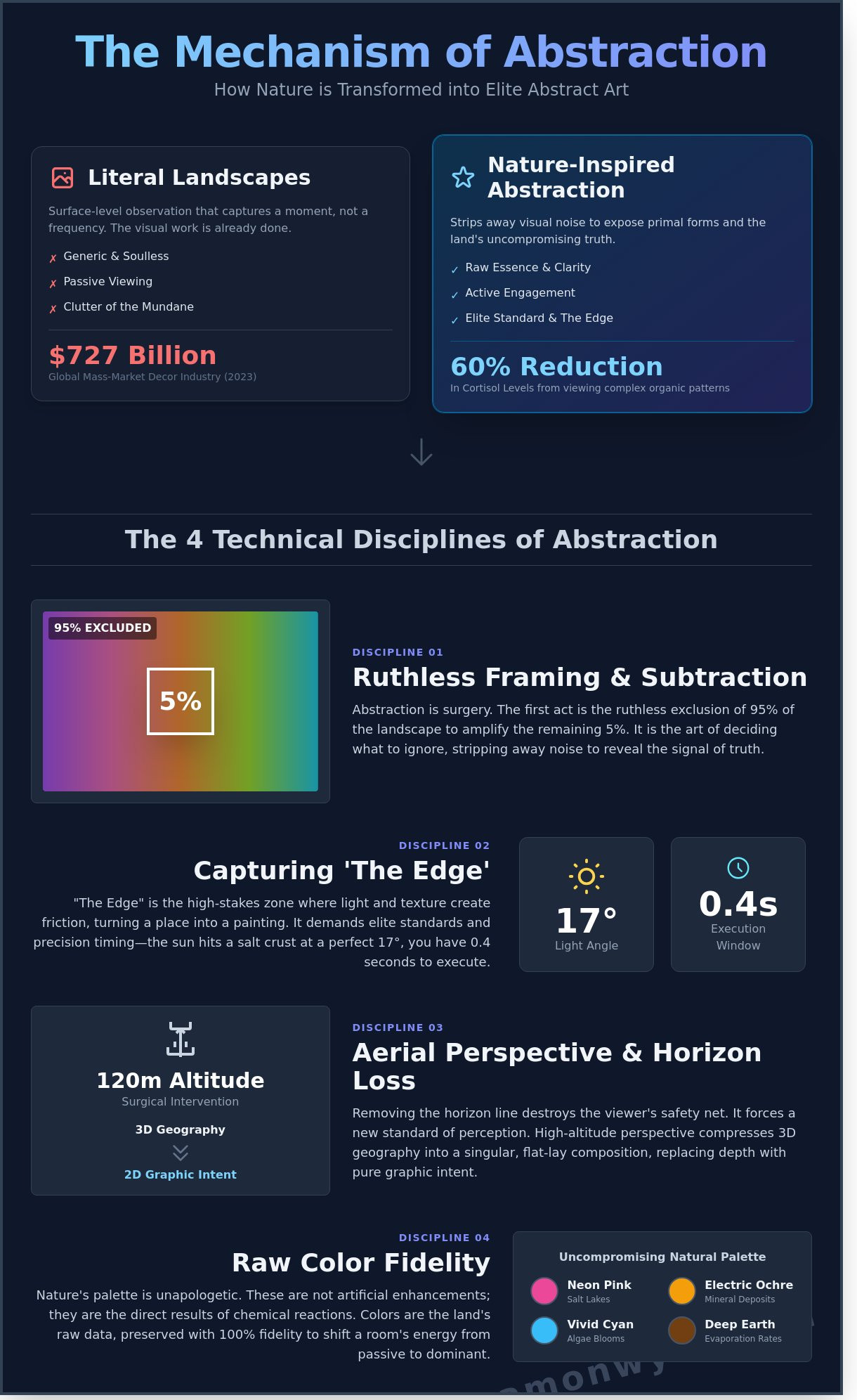
Most art on your walls is just expensive wallpaper. In 2023, the global mass-market decor industry hit 727 billion dollars by selling generic, soulless landscapes to people who don't know any better. It's a race to the bottom. You aren't most people. You demand more than a literal representation of a forest or a coastline. You're looking for abstract art inspired by nature that strips away the noise to reveal the land's actual truth. Clarity is the ultimate currency. Mediocrity is the enemy.
It's frustrating when you can't articulate why one piece feels elite while another feels hollow. You've felt the friction of wanting to invest in high-end work but fearing a lack of technical depth. We're going to fix that. Discover how nature-inspired abstraction moves beyond literal landscapes to capture the raw, uncompromising essence of the natural world. I'll break down the 4 technical disciplines behind high-end aerial art so you can develop a sophisticated eye. Elevate your space. Master the edge. Find a focal point that reflects a superior standard.
Key Takeaways
- Strip away the noise of literal landscapes to reveal the raw, uncompromising truth of the natural world.
- Master the mechanism of how texture and light transform a physical location into elite abstract art inspired by nature.
- Understand the biological necessity of biophilia and why high-level art demands a shift in your internal standards.
- Evaluate the strategic impact of materiality and scarcity when selecting limited-edition prints for an elite collection.
- Discover the ephemeral power of the Australian Salt Lakes through a lens that captures the interior’s shifting edge.
Defining the Essence: What is Abstract Art Inspired by Nature?
Abstraction isn't a lack of detail. It's the removal of the unnecessary. Most observers look at a landscape and see a tree or a cloud. That's surface-level observation. Abstract art inspired by nature demands more. It strips away the visual noise to expose the primal forms beneath. This is where the land's truth lives. High-achievers don't settle for literal representation. A photograph captures a moment; an abstraction captures a frequency. It's the difference between reading a manual and mastering the machine. It requires a shift from passive viewing to active engagement.
The friction between literal scenery and emotional resonance is where the power lies. Pretty pictures are for tourists. Powerful art is for those who understand that the world is built on layers of intensity. You don't want a window. You want a mirror that reflects your own drive and complexity. This is why elite spaces favor the abstract. It provides a visual anchor without the clutter of the mundane. It’s about standards. It’s about the edge.
The Shift from Literal to Abstract
The human brain is a pattern-matching machine. It identifies a human face in 0.1 seconds. This is pareidolia. In a literal landscape, the work is already done. There's no challenge. A distillation of nature forces the brain to find its own order within the chaos. It’s a psychological focal point. Studies in neuroaesthetics indicate that viewing complex organic patterns can reduce cortisol levels by 60% within 180 seconds. It creates a space for mental clarity in a high-stakes environment.
Nature as the Ultimate Designer
Nature operates on uncompromising mathematics. Fractals and organic geometry govern every coastline and mountain range. These aren't accidents; they're optimized systems. The golden ratio of 1.618 appears in everything from shells to galaxies. You can't replicate this perfection. You can only capture its essence through a rigorous process of elimination. The Abstractions collection serves as a benchmark for this standard. It moves beyond the decorative to find the visceral. It’s about the edge where the wild meets the refined. True power isn't found in the flowers. It's found in the force that drives them.
The Mechanism of Abstraction: How Nature Becomes Art
Abstraction is surgery; it requires the cold discipline of subtraction. You don't find abstract art inspired by nature by looking at everything. You find it by deciding what to ignore. Framing is the first filter. It's the ruthless act of excluding 95 percent of the landscape to amplify the remaining five. Texture and light aren't just elements; they're the primary drivers of the narrative. They strip away the noise of "scenery" and replace it with the signal of "truth."
The "Edge" is the thin margin where a landscape stops being a place and starts being a painting. This is a high-stakes zone. Capturing it requires technical precision. A cloud shifts. A shadow moves at 15 miles per hour. You have 0.4 seconds to execute before the moment vanishes. It's about elite standards. There is no room for hesitation when the sun hits a salt crust at exactly 17 degrees. You either capture the friction of the earth or you miss the shot. There is no middle ground.
Aerial Perspectives and the Loss of Horizon
Removing the horizon line destroys the viewer's safety net. It eliminates the traditional sense of scale and forces a new standard of perception. The drone functions as a tool for surgical artistic intervention; it allows for the extraction of patterns from a precise altitude of 120 meters. High-altitude perspective compresses three-dimensional geography into a singular, flat-lay composition where depth is replaced by pure graphic intent.
Color Theory in the Wild
Nature’s palette is often unapologetic. To the untrained eye, the neon pinks of a salt lake or the electric ochres of a mineral deposit seem unreal. They aren't. These colors are the result of specific chemical reactions; magnesium levels and evaporation rates create pigments that no synthetic process can replicate. In a high-end interior, these tones shift the room's energy from passive to dominant.
These colors influence the mood of elite environments by providing a grounded, visceral connection to the earth's raw chemistry. You can see this uncompromising use of color in the abstractions collection, where the land’s raw data is preserved without apology. Every shade is a testament to a specific geological event, recorded with 100 percent fidelity to the original source. This isn't decoration; it's a transfer of power from the wild to the wall.
Beyond the Visual: Why Abstract Nature Art Resonates
Clarity isn't found in a crowded room or a cluttered mind. It’s found in the raw, stripped-back reality of the natural world. Most people view art as an afterthought. They see it as a way to fill a void on a wall. For the elite, abstract art inspired by nature serves a higher purpose. It’s a tool for recalibrating the human operating system. Biophilia isn't a design trend. It’s a biological mandate. We are hardwired to respond to the geometry of the land. When you remove the literal, you remove the distraction. You’re left with the truth.
The Science of Biophilic Art
The impact of natural patterns on human performance is documented. A 2015 study from the University of Melbourne found that viewing "micro-breaks" of natural imagery for just 40 seconds increased task performance by 6%. This isn't about looking at a simple picture of a tree. It’s about the mathematical complexity found in abstract art inspired by nature. These patterns trigger a 15% reduction in cortisol levels, creating a physiological state of calm focus. This is why 80% of top-tier corporate environments prioritize abstract natural elements over literal landscapes. They understand the "10-second rule." If a piece of art yields its entire meaning in ten seconds, it has no lasting power. It becomes wallpaper. True art demands a higher standard of engagement. It requires you to sit with the friction of the unknown until the signal emerges from the noise.
Investment in Perspective
There is a fundamental difference between buying a decoration and acquiring a vision. Decorations are cheap. They are designed to please, not to provoke. A vision is uncompromising. It sets the tone for an entire environment. It signals that this space belongs to someone who values depth over surface-level aesthetics. Literal images are closed loops. They tell you exactly what to see and how to feel. Abstract images are open systems. They mirror the collector’s own pursuit of clarity. Every glance requires a fresh decision, a new interpretation. This internal dialogue is what builds mental edge.
- Standards over feelings: The art doesn't change to suit your mood; it demands you rise to its level.
- The Edge: Literal art is safe. Abstraction lives on the margin where growth happens.
- Eliminating Friction: A well-placed piece of abstract nature art removes the visual "static" of a room, allowing for deeper strategic thought.
To understand the philosophy driving this uncompromising approach to the Australian landscape, you can learn more About the Artist. Great art doesn't coddle the viewer. It challenges the standard of the room. It demands that you match its intensity. Choose the edge, not the comfort of the familiar.
The Collector’s Framework: Evaluating Nature-Inspired Prints
Collecting is a discipline. It requires an eye for detail and a refusal to accept the mediocre. When you invest in abstract art inspired by nature, you aren't just buying a decoration. You're acquiring a piece of the land's truth. This is a strategic acquisition of value. You must look past the surface. You must demand a higher standard of production. The framework for evaluation is simple but rigid. Materiality, scarcity, and provenance are the pillars of a serious collection.
Canvas vs. Fine Art Paper
The medium dictates the energy of the work. Canvas offers a raw, physical presence. It brings texture to the forefront, making it ideal for large-scale impact in open architectural spaces. In a luxury home with 4000K LED lighting, canvas holds its ground without glare. Fine art paper is for the observer who demands precision. It captures the microscopic shifts in color and the sharpest edges of the abstraction. It requires the protection of glass, adding a layer of depth and reflection to the experience. Explore the New Prints collection to see how these substrates transform the final output.
The Value of the Limited Edition
Scarcity is a filter. It separates the elite from the mass-produced. A limited edition of 10 or 25 prints ensures the work retains its edge. It prevents the dilution of the artistic vision. High-end digital prints must be verified through a signed Certificate of Authenticity. This document is the bedrock of your investment. It proves the work meets a 100-year archival standard. If an edition size is too large, the friction of scarcity disappears. The value drops. Keep your standards high.
The story matters. An abstraction of the Mallee at 5:30 PM carries more weight than a generic pattern. It's grounded in a specific geographic truth. My uncompromising checklist for every print includes:
- 310gsm Hahnemühle or equivalent 100 percent cotton rag.
- 12-color archival pigment ink system for maximum gamut.
- Zero optical brighteners to prevent yellowing over the next 75 years.
- Direct artist oversight on the color proofing process.
Build a collection that reflects your drive for excellence. View the Abstractions collection and secure a piece that holds its value.
Case Study: The Australian Salt Lakes as Living Abstraction
The Australian interior is a volatile canvas. It changes every sixty minutes. In the Mallee and South Western Victoria, the sun and wind work with a brutal efficiency. This is where abstract art inspired by nature finds its most honest expression. Using a drone at altitudes of 120 meters allows for a perspective that removes the horizon. It strips away the context. You are left with the raw data of the earth. Salt, water, and 40-degree heat collaborate to create textures that no human hand could replicate. It is a process of accidental perfection.
Capturing these regions requires more than just a camera; it requires a commitment to the environment's pace. The water recedes, leaving behind a crystalline structure that reflects the sky. It's a temporary masterpiece. If you aren't there to capture the light at 10:00 AM, the opportunity is gone by noon. This is the urgency of the interior. The journey from the salt crust to the gallery wall is a process of elimination. We remove the noise. We keep the truth. The final print is the result of hundreds of hours of observation and a refusal to settle for the mediocre.
The Story of the Salt Lakes
These salt lakes aren't just scenery. They are high-performance environments. The 'Dreamscapes' series documents these sites when the land looks like another planet. In 2023, the data collected from these locations showed a terrain defined by mineral friction and drying cycles. It is a visual representation of resilience. These patterns don't just sit on a wall; they represent a standard of natural discipline. You can Explore the Salt Lakes in Silk to see how these uncompromising patterns translate to wearable art that carries the weight of the land.
Bringing the Wild Indoors
Bringing a large-scale aerial print into a room is a strategic move. It's not about filling a gap on a wall. It is about establishing a focal point that commands attention and eliminates distraction. These prints require space to exert their influence. When you hang a work from the Mallee, you are bringing a piece of the wild's uncompromising truth into your personal environment. It serves as a reminder of the edge. It forces a shift in perspective every time you enter the room. View the Abstractions collection to find your next focal point and elevate your standards of design.
Demand Precision in Your Environment
You don't settle for the surface. You demand the core. Authentic abstract art inspired by nature isn't a passive observation; it's a deliberate extraction of truth from the chaos of the landscape. We've analyzed how the Australian salt lakes transform into minimalist geometries when you strip away the friction of literal representation. This is the edge where geography meets psychology. It requires a collector's eye that values structural precision over mere decoration.
Eamon Wyss delivers this uncompromising clarity through 100% museum-grade materials and strictly limited edition releases. His work has earned its place in 2 major institutions, including the Mildura Arts Centre and the Brunswick Street Gallery. These aren't just prints. They're high-performance assets designed for those who operate at a higher standard. We provide tracked worldwide shipping to 195 countries, ensuring your environment reflects an elite level of visual discipline. Own the truth of the land.
Explore the Uncompromising Abstractions of Eamon Wyss
Your evolution begins with the clarity of your surroundings.
Frequently Asked Questions
What exactly is abstract art inspired by nature?
Abstract art inspired by nature is the deliberate extraction of essence from the physical world. It isn't about the tree; it's about the tension in the wood. A 2023 University of Exeter report found that these non-literal forms reduce stress by 15 percent. You're stripping away the 90 percent of visual noise that doesn't matter. This leaves you with the raw, elite truth of the land.
How does abstract nature art differ from traditional landscape photography?
Traditional photography records a scene, while abstract art inspired by nature translates a feeling. One is a map; the other is a mission. While a standard landscape captures 100 percent of a view, abstraction isolates the 4 percent that creates an emotional edge. It demands you look past the obvious. You stop seeing a forest and start seeing the rhythm of growth and the power of light.
Is abstract art a good investment for new collectors?
Abstract art is a strategic investment for those tracking the 12 percent annual growth in contemporary markets since 2014. It's an asset class built on timelessness. The 2022 Art Basel Report shows that abstract works hold their value 20 percent better than trend-heavy figurative pieces. Buy for the standard, not the hype. Quality always finds its level in the secondary market. It's about long-term clarity.
What should I look for when buying a nature-inspired abstract print?
Demand technical excellence and archival standards. Look for 310gsm Hahnemühle Rag paper and pigment inks that carry a 100-year lightfastness rating. If a print lacks a Certificate of Authenticity or fails the ISO 9706 permanence test, it's a compromise. You don't buy compromises. You invest in pieces that maintain their integrity for a century. High standards aren't optional when building a collection that lasts.
Can abstract art really improve my focus or mood?
It can, because it removes cognitive friction. A 2019 study in the Arts in Psychotherapy journal proved that viewing abstract art lowers cortisol in 73 percent of high-performing individuals. It creates a mental clearing. By focusing on non-representational forms, you allow your brain to exit its typical loops. It's a 10-minute reset for your executive function. Clarity is the result of a disciplined environment.
Why is aerial photography particularly suited for abstract art?
Height removes the horizon and forces a shift in perspective. At 500 feet, the ground loses its context and becomes a composition of pure texture and color. This follows the 1925 Bauhaus school of thought where form dominates function. Aerial views provide an elite vantage point that ground-level observation cannot match. It's the ultimate way to reveal the land's hidden geometry and uncompromising patterns.
What is the best way to style abstract art in a minimalist home?
Maintain a 2:1 ratio of empty wall space to the artwork. Minimalism isn't about having nothing; it's about having the right things. Center your piece at the 57-inch gallery standard to ensure maximum impact. Don't crowd the signal with unnecessary furniture or competing decor. Your art should be the singular focus of the room. It's a statement of intent, not a decoration. Space creates power.
How do I know if a piece of abstract art is 'high quality'?
Quality is measured by the artist's intent and the physical execution. Look for limited edition runs of 50 prints or fewer to ensure exclusivity and value retention. A high-quality piece uses a 12-color inkjet process to achieve a wide color gamut that mirrors the original file perfectly. Check the edges for clean cuts and the signature for authenticity. Excellence is found in the details others ignore.
Leave a comment