

Australian Landscape Photographers: Defining the Uncompromising Standard of Fine Art

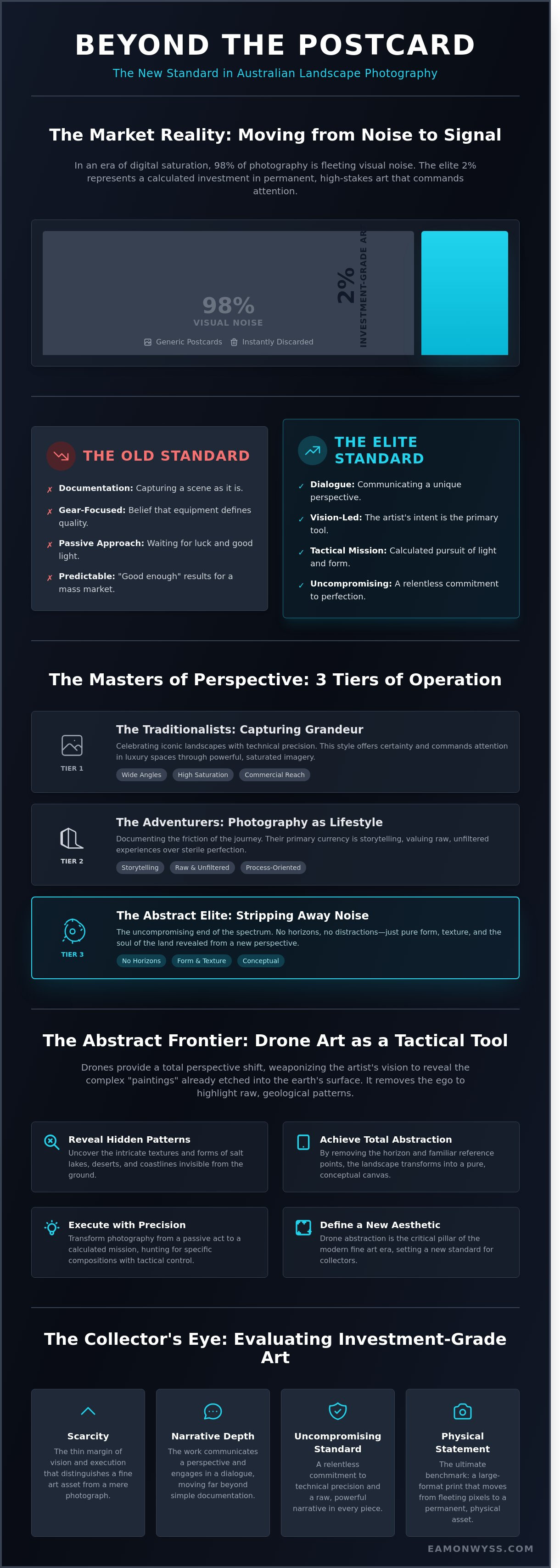
Most landscape photography is visual noise. It's a collection of generic postcards masquerading as fine art. In an era where 98% of digital captures are discarded within seconds, the standard for what constitutes an investment-grade piece has collapsed. You're tired of the saturated market of "pretty" photos that fail to command attention in a luxury space. You understand that true art shouldn't just fill a wall; it should challenge the observer. Finding elite australian landscape photographers who prioritize abstract narrative over simple documentation is now the only way to secure a piece that reflects a high-performance lifestyle.
This is about the 2% who operate at the edge. You'll discover the visionaries moving beyond traditional scenery into the world of uncompromising aerial abstraction. We're stripping away the friction of mediocre choices. By the end of this analysis, you'll identify the specific artists defining the new standard of fine art. You'll gain the clarity needed to select a work that serves as a silent, powerful anchor in your environment. It's time to elevate your surroundings to match your internal standards.
Key Takeaways
- Redefine your standard of excellence by moving beyond mere documentation to the elite vision shared by top australian landscape photographers.
- Categorize the masters of perspective to understand how scale and commercial reach separate the traditionalists from the abstract elite.
- Weaponize the drone as a tactical tool for a total perspective shift, revealing the complex "paintings" already etched into the earth's surface.
- Learn to evaluate investment-grade art by identifying the thin margin of scarcity that distinguishes a fine art asset from a mere photograph.
- Follow the narrative of "The Edge" to see how high-achievers find clarity and voice in the raw, uncompromising abstraction of the Australian landscape.
The Elite Standard of Australian Landscape Photographers
In 2026, the gear is irrelevant. High-end sensors and mirrorless tech are now commodities. The edge doesn't come from a spec sheet; it comes from vision. Elite Australian landscape photographers don't just capture scenes. They execute tactical missions. We've seen a definitive shift from passive "tourist" photography to a disciplined, fine art approach. This isn't about stumbling upon a sunset. It's about a calculated pursuit of light and form.
Australia's geography is a filter. It weeds out the weak. With over 7.6 million square kilometers of terrain, much of it hostile, the land demands a specialized approach. You can't fake the grit required to shoot in 45-degree heat or navigate the isolation of the outback. This environment forces an uncompromising standard on the artist. To produce work that resonates, you must move beyond the surface. You must understand the rhythm of the land before you press the shutter.
Beyond the Postcard: Why Standards Matter
"Good enough" is a death sentence for fine art. Mediocrity thrives in the middle ground where effort is moderate and results are predictable. To reach the elite level, discipline is the only currency that matters. You don't wait for luck. You hunt the ephemeral light of the Mallee or the shifting textures of salt lakes with mathematical precision. This level of operation requires a refusal to settle for anything less than perfection. The Elite Standard is a relentless commitment to technical precision and raw narrative.
The Role of the Artist in 2026
The role of the artist has evolved from documentation to dialogue. We aren't just showing you a location; we're communicating a perspective. Masters like Ken Duncan proved decades ago that the Australian light is a unique beast. Today's abstract masters take that foundation and push it further. They strip away the literal to find the soul of the land. This is why fine art drone photography in Australia has become a critical pillar of the modern era. It provides a vantage point that removes the human ego and highlights the earth's raw patterns.
In a world drowning in digital noise, the physical print remains the ultimate benchmark of quality. A 60-inch acrylic print isn't just decor. It's a statement of standards. It demands space and commands attention. It represents a shift from fleeting pixels to permanent, high-stakes art. For the serious collector, these prints are the bridge between a digital concept and a physical reality that lasts for generations.
The Masters of Perspective: A Roundup of Styles
Perspective is a choice. Mediocrity accepts the default view. Elite australian landscape photographers hunt for the edge. We divide the field into three operational tiers: The Traditionalists, The Adventurers, and The Abstract Elite. Each demands a different level of discipline. The best australian landscape photographers understand that style is a manifestation of standards.
Ken Duncan redefined the commercial reach of the Australian outback in the 1980s. He scaled the panorama to fit the boardroom, turning the landscape into a high-stakes asset. Mieke Boynton operates on a different frequency. She pioneered the 'listening' side of the craft. Her aerial work doesn't just look; it observes the geological pulse. It’s about finding the rhythm in the salt and the sand.
The Traditionalists: Capturing the Grandeur
Wide angles. High saturation. These artists celebrate the iconic outback with technical ruthlessness. This style remains a staple for luxury spaces because it offers certainty. It commands attention without apology. It’s about presence. If you want to set a high standard in a physical space, explore Landscapes Unlimited Prints.
The Adventurers: Photography as a Lifestyle
This isn't about the gallery. It’s about the dirt. These photographers bring the 'van life' ethos to the lens. They document the friction of the journey. Storytelling is their primary currency. They favor raw, unfiltered experiences over sterile perfection. It’s a lifestyle of constant movement. They value the process as much as the result.
The Abstract Elite: Stripping Away the Noise
This is the uncompromising end of the spectrum. No horizons. No distractions. Just form and texture. This conceptual shift was a focal point of the Photography & Place exhibition at the Art Gallery of NSW. Abstract work is the ultimate choice for high-end interior design. It reduces the landscape to its essential components. It removes the noise. It forces a focus on the 1% of detail that actually matters. If you're looking for clarity, abstract compositions provide the sharpest edge.
The Abstract Frontier: Why Drone Art is the New Edge
The drone is not a toy. It is a precision tool for a total perspective shift. Most people use it to capture a wider version of what they already see. That is a failure of imagination. For elite australian landscape photographers, the drone is a vehicle for uncompromising abstraction. It removes the ground-level bias. It strips away the horizon. This is about seeing the earth as a canvas rather than a destination. While traditional masters like Ken Duncan set the benchmark for panoramic excellence, the new frontier is vertical. This is drone art photography at its most lethal; a perspective that demands a complete rewrite of your visual standards.
Aerial Abstraction: Painting with the Earth
Salt lakes are not just geographical features. They are fine art paintings already existing on the earth's surface. Finding these patterns requires more than luck. It requires a technical discipline that leaves no room for error. Shooting from a fixed altitude of 400 feet demands absolute clarity and zero vibration. At this height, the land reveals its secrets. "The drone allows us to see the land without the friction of human perspective." This process isn't about documentation. It is about extraction. We extract the geometry, the salt-crusted textures, and the bleeding colors that are invisible from the sand. It is a hunt for the elite composition.
The Ephemeral Nature of the Australian Interior
The desert is obsessed with change. Salt lakes are the ultimate subject for an artist who values the edge. They are temporary. Water enters, stays for a moment, and evaporates; it leaves behind a transient signature of minerals. The stakes are "Now or Never." A 15 percent shift in moisture can destroy a composition in less than 24 hours. There is no second chance. This urgency defines the Abstractions Collection. To capture these moments, you must operate with the speed of a high-level consultant and the endurance of an athlete. Australian landscape photographers who settle for the static will never reach this level. Clarity is the only currency here. Mediocrity is the enemy of the ephemeral.
The Collector’s Eye: Evaluating Investment-Grade Art
Most people buy decorations. Collectors buy assets. There is a massive gap between a generic snapshot and a piece of fine art. When you evaluate the work of elite australian landscape photographers, you aren't just looking at a view. You're looking at a disciplined execution of vision. Investment-grade art demands three things: uncompromising material quality, a proven artist reputation, and narrative depth that challenges the viewer. By 2026, the market for tangible, scarce assets is projected to tighten significantly as digital fatigue peaks. Mediocrity will lose value. Excellence will appreciate. You must understand the mechanics of Investing in Art Prints to see how value is built through intentional scarcity.
Scarcity and Value: The Limited Edition Standard
Open editions are for the masses. Limited editions are for those who demand an edge. A limited print run, capped at 10 or 50, creates an immediate floor for value retention. It protects your capital from market dilution. If an image is infinite, its value is zero. High-achievers understand that scarcity equals power. Browse the New Prints Collection to see how strict editioning maintains the integrity of the work. It's a binary choice. You either own a piece of a finite legacy or you own a commodity. Standards over feelings; the numbers don't lie when the edition sells out.
Material Integrity: Canvas vs. Fine Art Paper
Never settle for "good enough." Museum-grade materials are the only standard. Cotton rag paper offers a tactile, deep matte finish that absorbs light. It is perfect for the raw, brutal textures found in the work of top-tier australian landscape photographers. Canvas provides a visceral, physical presence that removes the barrier of glass, allowing the landscape to breathe. The medium dictates the emotional response. Cheap materials degrade in 12 years. Acid-free, archival substrates last 100. That's the difference between a temporary purchase and a permanent legacy. Every choice in the production process is a choice between longevity and decay.
Ownership is a statement of your standards. Do not compromise on the quality of your environment.
Secure your limited edition acquisition today.
The Eamon Wyss Standard: Abstraction Without Compromise
Eamon Wyss doesn't capture scenery. He hunts the Edge. This is the precise point where the physical world dissolves into pure abstraction. For this Melbourne artist, the salt lakes of the Mallee became a proving ground in 2018. It wasn't about the view. It was about the friction between water, salt, and sky. Most australian landscape photographers seek the perfect sunset. Wyss seeks the perfect standard. He strips away the noise of the horizon until only the raw texture remains.
The work is built on a foundation of extreme ownership. Every print is a result of a ruthless process. If the light isn't elite, the shot doesn't happen. If the print quality lacks bite, it's destroyed. This is "Standards over Feelings" in practice. It's a refusal to accept mediocrity in a world saturated with average imagery. His art isn't designed to comfort you. It's designed to provoke a shift in your own standards. It demands your attention through its sheer clarity and uncompromising execution.
The Mallee and Beyond: A Local Focus with Global Appeal
Victoria's geography is a masterclass in texture. Wyss leverages deep local knowledge of the Mallee region to produce world-class art that resonates in London as much as it does in Melbourne. You can see this discipline in The Mallee Collection. The transition from wall art to wearable art was a logical evolution for a brand focused on excellence. He transforms a high-resolution photograph into a 100% silk accessory using a 4-point color-calibration process. This ensures the 16.7 million colors of the salt lake remain intact on the fabric. It's a way to carry the Edge with you.
Own the Edge: Starting Your Collection
Collecting Eamon Wyss art requires a shift in perspective. Don't look for a landmark. Look for the emotion of the abstraction. Choose the piece that creates the most friction in your space. Among australian landscape photographers, Wyss stands apart by offering a direct connection to the rawest parts of the continent. The logistics are handled with the same precision as the photography. Worldwide shipping is streamlined to ensure the work reaches your door without compromise. This is for the collector who demands more than decoration. It's for those who value the elite.
Own the Standard of Elite Perspective
Art isn't just about filling a void on a wall; it's about defining the space you inhabit. The elite circle of australian landscape photographers has moved beyond simple representation to embrace a standard of raw, uncompromising abstraction. You've seen how drone technology has pushed the frontier of perspective, turning the earth's geometry into a high-stakes investment. This isn't decoration. It's a statement of discipline and clarity.
The Eamon Wyss standard ensures your collection meets the most rigorous requirements of the gallery world. These works have been featured in the Brunswick Street Gallery, proving their merit in competitive, high-pressure environments. Every print utilizes museum-grade archival materials to ensure the edge of the image remains sharp for decades. We eliminate friction in the acquisition process with worldwide carbon-neutral shipping, ensuring your focus stays on the art, not the logistics.
Don't settle for the middle ground. Elevate your environment with a piece that reflects your own drive for excellence. Secure Your Limited Edition Abstract Print and own a vision that refuses to compromise. You're ready for the next level.
Frequently Asked Questions
What makes Australian landscape photographers unique compared to others?
Australian landscape photographers are defined by their ability to master the harshest light on the planet. This continent contains 10% of the world's biodiversity, requiring a level of technical discipline that average shooters can't match. It's about surviving 40 degree heat to capture 1 second of perfect light. You don't just take a photo; you earn it through endurance and precision.
Is drone photography considered fine art in the collector's market?
Drone photography is absolutely fine art when the execution meets elite standards. Since 2019, major international galleries have increased their aerial photography inventory by 22%. The tool is irrelevant; the perspective is everything. If the composition commands attention and the print quality lasts 100 years, it's an asset. Mediocrity hides in the traditional; the edge is found in the new.
How do I know if a landscape print is a good investment?
You determine investment value through scarcity and technical specifications. Verify the print uses Hahnemühle paper or similar archival stock with a 200 year rating. Look for editions capped at 10 or 25 units. When supply is strictly limited, the secondary market value typically sees a 5% to 8% annual appreciation. Don't buy for feelings; buy for the standard of the craft.
What is the difference between abstract and traditional landscape photography?
Traditional landscape photography documents a location while abstract photography isolates its soul. Traditional work relies on the 1/3 rule and clear horizons to orient the viewer. Abstract work strips away the context to focus on 100% texture and color. It's the difference between seeing a forest and feeling the vertical rhythm of the timber. One is a map; the other is an emotion.
Why are limited edition prints more expensive than open editions?
Limited edition prints command higher prices because they represent a finite asset. An open edition has zero scarcity, meaning its value is capped at the cost of production. A limited run of 5 prints creates an immediate supply-demand imbalance. In the high-end art market, 90% of value comes from the fact that no one else can own what you have. Exclusivity isn't a luxury; it's a requirement.
How should I display abstract aerial art in a modern home?
Display abstract aerial art as a singular focal point with at least 30 centimeters of breathing room on all sides. Use 5000K LED lighting to ensure the colors remain true to the artist's intent. Large scale works, typically those over 120 centimeters wide, require a minimalist frame to eliminate visual friction. Your home is a gallery, not a storage unit. Treat the space with the respect the art demands.
What are the best locations in Australia for landscape photography?
The Kimberley region and the 1,100 kilometer coastline of Western Australia offer the most uncompromising subjects. Locations like Shark Bay provide a color palette of deep ochre and turquoise that you won't find anywhere else. Over 500 professional photographers trek to the Bungle Bungles every season to test their skills against the ancient geography. These environments demand elite preparation and zero excuses.
Can I buy Australian landscape art from overseas?
You can acquire world-class art from australian landscape photographers regardless of your physical coordinates. Most top-tier galleries use DHL or specialized art couriers to provide 100% insured, door-to-door delivery within 14 days. Global logistics have eliminated the friction of distance. If you want the best work, the ocean between you and the artist is a minor detail, not a barrier.
Leave a comment