
Drone Art Photography: Elevating Perspective into Uncompromising Fine Art

Most aerial imagery is nothing more than visual noise, a repetitive loop of generic sunsets that lack the weight of true authority. You've seen the same soft beach shots 1,000 times. They're visual filler. They don't command a room; they disappear into the background. True drone art photography requires more than a flight controller and a clear day. It demands a ruthless eye for abstract geometry and the discipline to find order in the chaos of the landscape. This is about power, not postcards.
You recognize that a high-stakes environment requires a focal point reflecting your own standards. Mediocrity isn't an option. You're about to discover how elite perspectives transcend mere pictures to become a sophisticated investment in abstract storytelling and scarce assets. We'll examine the technical rigors of the 400-foot ceiling and the 100-year archival standards that separate high-performance art from digital waste. It's time to find your edge and command the space you inhabit.
Key Takeaways
- Understand the critical distinction between a basic aerial snapshot and elite drone art photography that commands attention through intentional abstraction.
- Recognize how Australia’s salt lakes provide a raw, ephemeral canvas for creating sophisticated, painting-like narratives that challenge the viewer’s perspective.
- Learn the uncompromising technical standards and archival requirements necessary to preserve the long-term value and impact of fine art investments.
- Discover how to strategically curate large-format abstract pieces to ensure the artwork dictates the standard of your environment rather than merely decorating it.
- Shift your perspective from passive observation to active discipline by embracing the "Standards over Feelings" philosophy in art selection.
Defining the Edge: What Separates Drone Art Photography from Aerial Imagery
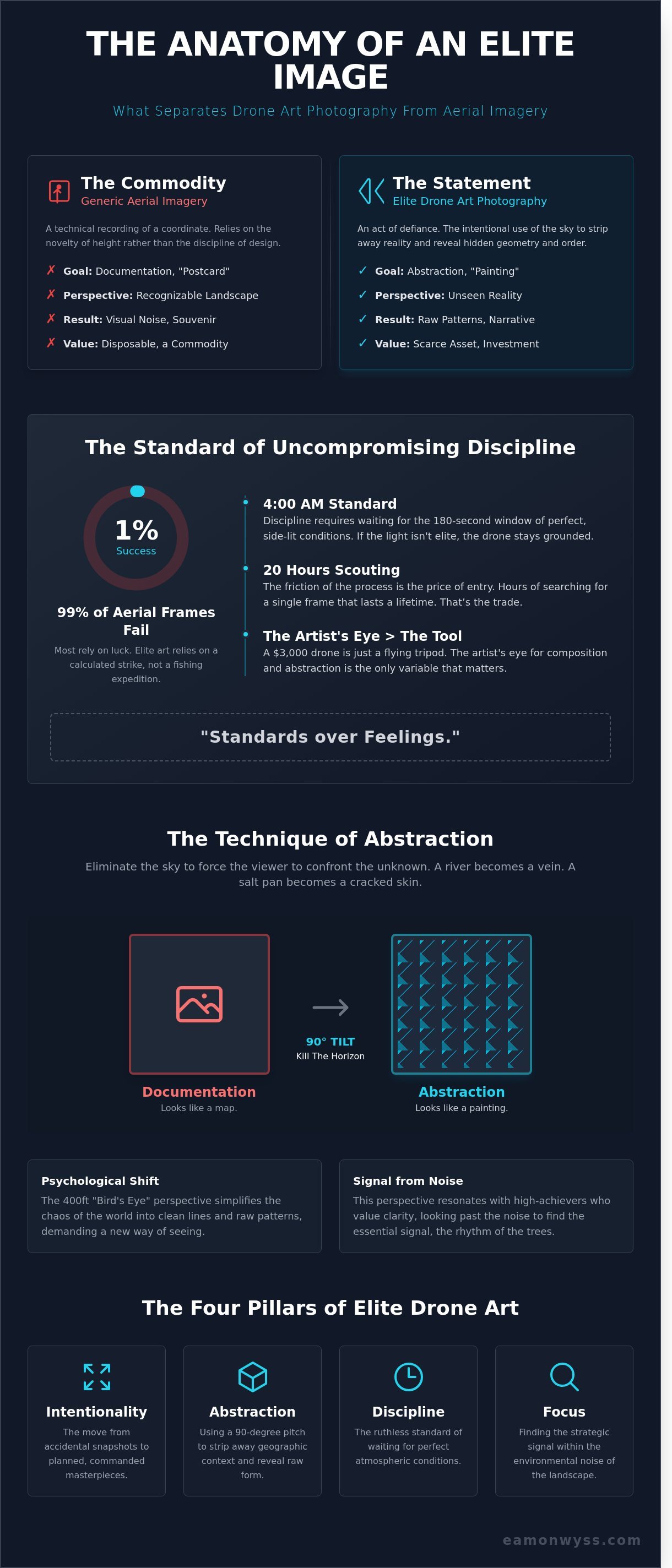
Aerial imagery is a commodity. It’s a technical recording of a coordinate. Drone art photography is an act of defiance. It is the intentional use of the sky to strip away reality and reveal something hidden. Most pilots are tourists. They capture snapshots to prove they were there. Artists capture narratives to prove they see what others miss. The difference is the standard of composition. It’s the wide gap between a 10 dollar postcard and a 10,000 dollar fine art print. One is a souvenir; the other is a statement.
Fine art requires a total rejection of the horizon. When you tilt the camera to 90 degrees, you remove the safety of context. You kill the "pretty" sunset and replace it with raw patterns. Visceral textures. Shadows that look like ink. This is where the real work begins. We have moved light years beyond the 166-year history of aerial photography. We aren't documenting the earth anymore; we’re reinterpreting it through a lens of abstraction. If the image looks like a map, you’ve failed. If it looks like a painting, you’ve found the edge.
The Standard of Intentionality
99% of aerial frames fail the fine art test. They are lazy. They rely on the novelty of height rather than the discipline of design. Fine art demands a 4:00 AM start and a refusal to settle for "good enough" conditions. It requires waiting for a 180-second window of side-lit perfection where the shadows create depth. Standards over feelings. If the light isn't elite, the drone stays grounded. Drone art photography is the uncompromising intersection of high-tier technology and abstract expressionism. It is a calculated strike, not a fishing expedition. You don't hope for a shot; you command it into existence.
From Documentation to Abstraction
Stop looking at the land. Start looking at the form. When you eliminate the sky, you force the viewer to confront the unknown. A river becomes a vein. A salt pan becomes a cracked skin. This "Bird’s Eye" perspective triggers a psychological shift in the viewer. It demands a strategic view from 400 feet that simplifies the chaos of the world into clean lines. This is exactly why abstract aerials resonate with high-achievers. These individuals value clarity. They understand that elite performance requires looking past the noise to find the signal. They don't want a picture of a forest; they want the rhythm of the trees.
The gadget is secondary. A 3,000 dollar drone is just a flying tripod. It’s a tool, not a talent. The artist’s eye is the only variable that matters in the pursuit of drone art photography. You don't buy an edge; you build one through the uncompromising pursuit of a unique frame. Every shot must be a deliberate choice. Every composition must be a command that directs the viewer’s eye. The friction of the process is the price of entry. You might spend 20 hours scouting for one frame that lasts a lifetime. That’s the trade. Mediocrity is the enemy, and the sky is the most unforgiving canvas we have.
- Intentionality: The move from accidental snapshots to planned masterpieces.
- Abstraction: Using a 90-degree pitch to strip away geographic context.
- Discipline: The 4:00 AM standard of waiting for perfect atmospheric conditions.
- Focus: Finding the strategic signal within the environmental noise.
The Narrative of Abstraction: Translating Australia’s Ephemeral Landscapes
The ground perspective is a limited view. It hides the truth of the land. To see the real narrative of the Australian interior, you must go vertical. This is where drone art photography separates the hobbyist from the elite. It’s not about capturing a wide shot. It’s about isolating the friction between elements. In the Mallee and South Western Victoria, the landscape offers a brutal, beautiful canvas. Salt lakes. Receding water lines. Mineral deposits. These aren’t just geographic features. They are the brushstrokes of a high-stakes environmental drama.
From 120 meters up, the literal world vanishes. The salt crusts of the Wimmera region don't look like dirt. They look like oil on canvas. This is the "unseen" reality. You can't see the intricate fracturing of a drying lake bed while standing on its edge. You only see it when you commit to the top-down perspective. This shift in standards reveals textures that feel more like a dream than a map. It’s a pursuit of the edge. It’s where the physical world meets the psychological. During the high-rainfall period of 2022, these lakes transformed into vibrant, toxic-looking palettes of pink and teal. This wasn't a fluke. It was a peak performance by the Earth itself.
The Salt Lake Series: A Case Study in Form
Finding these ephemeral lakes requires more than a map. It requires obsession. Most photographers wait for the perfect light. We hunt for the perfect texture. The Abstractions collection serves as a benchmark for this discipline. It focuses on the salt lakes of the Victorian interior as a study in pure form. This is fine art aerial photography at its most uncompromising. We don't settle for "pretty." We look for the geometric tension between the receding water and the encroaching salt. These landscapes are the ultimate subject because they change in 48 hours. You either capture the moment or you fail. There is no middle ground.
Storytelling without Subjects
Most people need a human subject to feel an emotion. That’s a weakness. In drone art photography, the story is told through the language of minerals and drought. The narrative is written in the iron-rich reds and the magnesium whites. These colors don't just exist. They represent time. A deep red stain in a dry basin tells a story of a five-year evaporation cycle. A sharp teal line indicates a sudden influx of mineral-heavy runoff from a 2023 storm. This is how you identify a narrative in an abstract piece:
- The Tension of Contrast: Look for where the wet mud meets the dry crust. That’s the conflict.
- The Weight of Texture: Heavy, cracked surfaces suggest endurance. Smooth, liquid surfaces suggest transition.
- The Rhythm of Repetition: Patterns in the sand or salt indicate the persistent force of the wind.
The transition from a literal landscape to an emotional resonance happens when you stop looking for "the lake" and start looking for the feeling of isolation. It’s about the raw discipline of the land. If you want to understand how these textures translate into a physical space, you can explore the gallery to see the standard of work required to bridge that gap. We don't document. We provoke. Every frame is a demand for the viewer to raise their standards of perception. This is the elite level of the craft. No distractions. No soft edges. Just the raw, uncompromising truth of the Australian landscape.
Uncompromising Quality: Standards for Collecting Fine Art Drone Prints
Feelings are fleeting. Standards are permanent. When you invest in drone art photography, you aren't just buying a visual; you're acquiring a physical asset. If the material choice is weak, the artwork is a liability. Serious collectors prioritize archival integrity over aesthetic impulse. This means demanding museum-grade substrates and pigment-based inks that resist UV degradation for 100 to 200 years. Mediocrity fades. High-level performance endures.
The technical execution of the print must match the precision of the flight. Using Epson UltraChrome PRO12 pigment inks ensures a color gamut that captures the raw data of the sensor without compromise. Academics at the National College of Art and Design contribute to Defining the genre of drone art by emphasizing the shift from simple aerial capture to high-stakes material permanence. If the print won't outlast the collector, it isn't fine art. It's a temporary decoration. You need the edge that only professional-grade archival materials provide.
Canvas vs. Fine Art Paper
Material choice dictates the friction between the artwork and your environment. Canvas offers a visceral, tactile presence. It eliminates the barrier of glass, allowing the texture to dominate the room. Fine art paper, specifically 310gsm cotton rag, provides a level of micro-detail that demands closer inspection. Your choice depends on the specific energy of your space and your willingness to manage reflections.
| Feature | Fine Art Canvas | Fine Art Paper |
|---|---|---|
| Texture | Heavy, organic weave | Smooth or subtle grain |
| Protection | UV Protective Varnish | Requires UV Glass/Acrylic |
| Presentation | Framed or Gallery Wrap | Traditional Matte and Frame |
| Longevity | 100+ Years | 200+ Years |
For those seeking the absolute peak of modern presentation, Limited Edition Canvas Prints represent the premium standard. These aren't mass-market reproductions. They're heavy-duty, archival assets designed to anchor a room. They remove the glare and secondary reflections that often plague glass-fronted frames, ensuring the focus remains on the composition. It's about reducing visual noise and maximizing impact.
The Power of the Limited Edition
Scarcity is the only metric that matters in the art market. An open edition has no ceiling; it's a commodity. A limited edition is a finite resource. When a print is numbered 1 of 10, the collector owns 10 percent of that specific visual legacy. This scarcity drives value and ensures the artwork remains an elite asset. It's about owning the edge, not just the image.
For individuals beginning their journey into high-performance collecting, the Landscapes Unlimited collection offers a strategic entry point. However, the serious collector looks for the 1 of 10 or 1 of 25 designations. These pieces will never be reproduced once the run is exhausted. This commitment to exclusivity protects your investment. It ensures that your drone art photography remains as rare as the moment it was captured. You don't settle for "available." You demand the limited. This is how you build a collection that carries weight.
Strategic Curation: Integrating Abstract Aerial Artwork into Elite Interiors
Art isn't decor. It's a focal point that dictates the room's standard. Mediocrity thrives in cluttered, thoughtless spaces, but elite interiors require a singular, uncompromising anchor. High-end drone art photography provides this by offering a perspective that's both alien and grounding. It forces the eye to stop. It demands a higher level of observation. When you scale abstract drone art to a 2-meter wide format, the technical execution must be flawless. Using 100-megapixel sensors ensures that every grain of salt and every ripple of water remains sharp at a viewing distance of 50 centimeters. A pixelated image is a failed standard. If the art loses impact at scale, the room loses its edge.
Creating a frictionless room means matching the movement in the art to the energy of the space. In a high-stakes boardroom, you don't want visual chaos. You want the expansive, rhythmic lines of a desert landscape to provide psychological balance. In a minimalist residential lounge, the jagged textures of a breaking wave or a rocky coastline can provide the necessary tension to prevent the space from feeling sterile. It's about eliminating the friction between the environment and the human psyche. Every piece must be a strategic choice, not a filler.
Lighting a top-down print requires a specific tactical approach. Traditional ceiling lights often create devastating glare on high-gloss acrylic or glass finishes. To preserve the integrity of the work, use 5000 Kelvin LED gallery spots positioned at a 45-degree angle. This color temperature mimics the natural daylight found at high altitudes, ensuring the reds of the outback or the deep blues of the Southern Ocean don't shift into muddy, warm tones. Precision in lighting is just as critical as precision in the shot itself.
Choosing the Focal Point
Select a piece that challenges the viewer. If the art blends in, it has failed. Effective curation utilizes negative space both within the frame and on the wall. A 1.5-meter print requires at least 60 centimeters of clear wall space on either side to breathe. This isolation forces the viewer to engage with the complexity of the textures. Abstract art reduces mental noise in high-pressure environments by providing a non-linear focal point that doesn't compete for cognitive resources. It allows the mind to reset without the distraction of literal subjects.
The Designer’s Perspective
Interior designers sourcing unique Australian landscape art must look beyond the cliché. The Dreamscapes collection offers a raw, unfiltered look at the continent's geometry that fits perfectly within modern minimalist aesthetics. Bringing the vastness of the outback indoors carries significant emotional weight. It's a reminder of scale and perspective. In a world of digital noise, these physical prints act as a grounding force. Use them to create a sense of permanence in an increasingly transient world.
The Eamon Wyss Collection: Where Nature Meets Absolute Discipline
Art is not a product of convenience. It is the result of an internal metric that refuses to settle. For Eamon Wyss, drone art photography is the medium used to document a specific philosophy: Standards over Feelings. Most creators wait for inspiration. They wait for the "right" mood. Wyss operates on a different frequency. He targets the most remote, hostile environments in the Australian outback, where the heat exceeds 45 degrees Celsius and the logistics are a constant source of friction. The result is a body of work that strips away the noise of the world, leaving only the raw, geometric truth of the landscape.
Owning a piece from this collection is a commitment. It is a signal that you value the "edge" over the average. The transition from traditional physical prints to the Salt Lakes in Silk collection represents a tactical evolution. It moves the art from a static position on a wall to a dynamic presence in your daily life. This isn't just about decoration; it's about integration. From the crystalline textures of Lake Lefroy to the deep ochre veins of the Tyrrell region, these pieces bring the brutal beauty of the salt lakes into the global spotlight. They demand a higher aesthetic standard from the viewer and the owner alike.
Wearable Art: The Silk Scarf Revolution
The shift to 100% silk transforms abstract drone art photography into a tactile experience. Silk is a high-performance material. It is resilient, sophisticated, and carries color with a depth that paper cannot replicate. By printing these aerial perspectives onto premium silk, Wyss has created a way to carry the landscape with you. It is the ultimate "Elite" gift for the high-achiever who has everything else. Why give a generic luxury item when you can give a piece of the earth’s crust, captured from a thousand feet up and rendered in a fabric that feels like a second skin? This collection serves those who understand that style is a weapon of clarity.
- Uncompromising Quality: 100% pure silk construction ensures a lifetime of durability.
- Strategic Design: Patterns are derived from actual topographical data, not digital filters.
- The Elite Edge: A gift that speaks to discipline, vision, and the pursuit of the extraordinary.
About the Artist: Tested in the Field
Eamon Wyss is not a hobbyist. Operating out of his Melbourne-based studio, his work is the culmination of years spent in high-pressure environments where precision is the only currency that matters. His background is a blend of technical mastery and physical grit. Every frame in his portfolio was earned through hours of navigation and the management of extreme environmental variables. He doesn't just take photos; he extracts order from chaos. You can read the full narrative of his journey and his uncompromising approach on the About the Artist page.
Stop settling for mediocre imagery that offers nothing but a brief distraction. Your environment should reflect your standards. It should remind you of the discipline required to reach the top. Whether it is a silk scarf or a large-scale installation, an Eamon Wyss piece is a testament to the fact that excellence is a choice. Find your edge.
Claim Your Edge in the Abstract
Art isn't just decoration. It's a physical manifestation of your standards. True drone art photography requires more than a simple flight path; it demands a relentless pursuit of the edge where raw nature meets absolute discipline. You've seen how the Eamon Wyss Collection translates Australia's ephemeral landscapes into sharp, abstract narratives that command attention. This isn't mass-produced imagery designed for the many. It's elite-level execution for the few who understand that clarity is the ultimate currency. Every piece is meticulously crafted using museum-grade archival materials to ensure the work outlasts the fleeting noise of the digital age. With limited edition runs restricted to as few as 10 units, you're securing a rarity that others simply cannot access. These works have already earned their place at the Mildura Arts Centre because they refuse to compromise on vision. Your environment is a direct reflection of your internal drive. Don't settle for the mediocre or the common. Elevate your interior with a piece that embodies the same focus you bring to your own high-stakes world. Own the perspective that others don't have the discipline to see.
Explore the Limited Edition Abstractions Collection
Frequently Asked Questions
Is drone photography considered "real" fine art?
Yes, drone art photography is legitimate fine art when executed with technical precision and a clear aesthetic vision. The 2023 sale of high-end aerial prints reaching prices over $15,000 proves the market's demand for this specific perspective. It's not about the tool; it's about the result. You're investing in a unique vantage point that traditional photography cannot replicate. Demand high standards from your collection and ignore the noise of critics.
What is the difference between limited edition and open edition prints?
Scarcity defines the value of a limited edition print. We cap these runs at exactly 25 units to ensure exclusivity and long-term appreciation for the collector. Open editions are printed without a set limit, making them accessible but significantly less rare. If you want to hold an asset that maintains its edge, choose the limited run. It represents a commitment to rarity that mass-produced items simply lack.
How do I choose the right size of drone art for my office?
Measure your wall and ensure the artwork occupies 60% to 75% of the available space. A piece centered at 57 inches from the floor creates an immediate focal point that commands authority in any executive setting. If the print hangs above a desk, it should span 2/3 of the furniture's width. Don't let a small frame weaken a powerful room. Precision in sizing is a non-negotiable standard for high-performers.
Can drone art prints be customized in size or material?
Customization is available for clients who require specific dimensions or high-performance materials like 4mm acrylic or archival cotton rag. We provide bespoke sizing up to 2 meters in width to fit your exact architectural requirements. Every custom order undergoes a 3-point quality check to ensure the resolution remains sharp. Excellence isn't a suggestion; it's the baseline for every piece we ship. Your environment dictates the scale. We provide the solution.
How do I maintain and clean a fine art canvas print?
Use a 100% dry microfibre cloth to remove dust every 30 days. Never apply water or chemical cleaners, as liquids degrade the protective UV coating and compromise the ink's integrity instantly. Maintain a room temperature between 18 and 24 degrees Celsius to prevent the frame from warping over time. Discipline in maintenance preserves the life of your investment. Protect the work with the same intensity you used to acquire it.
What makes Australian salt lakes a unique subject for drone art?
Australian salt lakes offer a raw, 5,000-year-old landscape that appears entirely abstract from 120 meters above. The high salt concentration creates 15 distinct shades of pink and white that you won't find in any other environment. This is drone art photography at its peak, capturing a brutal, minimalist beauty. It's a landscape of extremes. Only the most focused compositions survive the transition from the salt flats to the gallery wall.
Do you ship Eamon Wyss prints and silk scarves internationally?
We ship to over 25 countries using premium couriers like DHL to ensure your order arrives intact and on time. International transit typically takes 7 to 10 business days depending on your specific global location. Every shipment is fully insured and tracked, removing any friction from the acquisition process. We don't settle for mediocre logistics. Your art arrives with the same precision and speed that defined its original creation.
Leave a comment