

Wearable Art: The Elite Standard for Mobile Self-Expression in 2026

Most men are walking around in mass-produced camouflage that signals a total submission to the mediocre. Data shows that by 2026, 85% of the global apparel market will be dominated by fast-fashion giants, leaving little room for genuine wearable art. You've felt the friction. It's frustrating to hunt for unique pieces only to find "artistic" designs printed on low-grade synthetics that fail after three washes.
You're here because you demand a visual language that matches your elite performance. This is the blueprint to transcend the generic and curate a collection that reflects your uncompromising aesthetic standards. You'll learn to identify the high-caliber materials that separate the masters from the masses and gain the confidence to wear fine art as a definitive statement of power. We'll analyze the 2026 movement, pinpoint the specific fabrics that command respect, and execute a styling strategy that eliminates the noise of generic fashion forever.
Key Takeaways
- Redefine your presence by shifting from passive observation to active, mobile engagement with functional fine art.
- Demand higher standards by choosing the technical precision of elite textiles over the friction of mass-produced fast fashion.
- Master the discipline of curation to ensure your collection of wearable art remains the uncompromising focal point of your aesthetic.
- Learn to balance complex abstract patterns with minimalist staples to eliminate visual noise and project raw authority.
- Explore the edge of high-performance design through the translation of drone-captured salt lakes into luxury silk.
What is Wearable Art? Redefining the Mobile Gallery
Art is dead if it remains trapped behind glass. Static observation is a relic of a slower age. True power exists in the transition from the gallery wall to the human form. This is the core of wearable art. It's the uncompromising fusion of fine art and functional design. It demands that we stop looking and start inhabiting. Since the Art-to-Wear movement gained momentum in the 1970s, creators have dismantled the frame. They took the aesthetic intensity of the museum and forced it into the friction of the real world. This isn't about looking good. It’s about carrying a standard.
The historical context is clear. Artists like Sonia Delaunay pioneered this shift in the early 20th century, but the modern elite have evolved the concept. Art escaped the frame and hit the street because the street is where the stakes are highest. The Eamon Wyss perspective is simple: art must challenge the observer. Even on silk. If the textile on your person doesn't provoke a reaction or a psychological shift, it's just fabric. We reject the passive. We embrace the provocative. A luxury scarf isn't an accessory; it's a mobile installation that communicates your internal architecture to the world.
The Distinction Between Fashion and Art
Fashion is a cycle of trends designed for mass consumption. It follows the herd. Wearable art follows a singular, uncompromising vision. It doesn't care about the season. It cares about the truth. Scarcity is the primary metric of value here. When a piece is limited to a run of 50 units, it ceases to be merchandise. It becomes an asset. Wearing a story instead of a brand logo changes your internal chemistry. You aren't a walking billboard for a corporation. You're a curator of a specific, elite narrative. This creates a psychological edge that "fast fashion" can't replicate.
The Movement of Self-Expression
The collector-wearer is a new archetype in modern culture. They don't just buy; they invest in a philosophy. This is a high-stakes signal of personal values. It tells the world you value precision and depth over surface-level flash. In an era of 8-second attention spans, complex textiles demand focus. They create a pause in the noise. Choosing to wear a piece that reflects a specific artistic struggle shows extreme ownership of your identity. You're not waiting for a trend report to tell you who to be. You're setting the standard yourself.
Wearable art acts as a bridge between the gallery and the individual.
- Standards: Art on silk must meet the same technical rigors as art on canvas.
- Elite Execution: Hand-rolled edges and high-momme silk aren't luxuries; they're requirements.
- Friction: The movement of the body adds a layer of complexity to the visual work that a flat wall cannot provide.
- Clarity: A 100% silk medium ensures the artist's original intent isn't diluted by inferior materials.
The shift from static to mobile engagement is a tactical move. It brings the high-level discipline of the studio into the high-pressure environment of the boardroom or the city street. You're no longer just observing excellence. You're embodying it. This is the ultimate evolution of the gallery experience. It's direct. It's visceral. It's wearable art for those who refuse to settle for the mediocre.
The Anatomy of Elite Wearable Art: Materials and Vision
Execution is everything. A vision without a high-standard medium is just a dream. In the history of the wearable art movement, the shift from garment to gallery piece required a refusal to compromise on materials. Most designers fail here. They choose cost over clarity. Elite wearable art demands a medium that mirrors the complexity of the message. If the fabric cannot hold the depth of the artist's intent, the piece is a failure. It becomes a commodity, not a statement.
The technical challenge is immense. You're moving from a 100-megapixel digital file to a living textile. Most printers settle for 150 DPI. We demand 300 DPI or higher to ensure "the edge" remains sharp. Color depth isn't a suggestion. It's a requirement. If the blacks aren't deep and the ochres aren't vibrant, the piece loses its soul. This is where mediocrity hides. It hides in the details of the weave and the saturation of the ink. You don't just look at high-end art; you feel the precision of its construction.
Identifying the standard in textile printing requires an uncompromising eye. We look for a 10% increase in color saturation compared to standard digital prints. Detail retention must be absolute. If a single salt crystal from the original drone photography is lost in the fibers, the standard hasn't been met. This is about eliminating friction between the artist's eye and the wearer's experience. Anything less than perfection is a waste of time.
Why 100% Silk is the Ultimate Canvas
Silk isn't just luxury. It is physics. The triangular prism-like structure of the fiber allows it to refract light at different angles. This creates a depth of color that synthetics like polyester cannot replicate. High-grade mulberry silk, specifically 16mm or 19mm weight, provides the structural integrity needed for an investment piece. The Salt Lakes in Silk collection sets the benchmark for this standard. It rejects the friction of inferior blends. Pure silk ensures the wearable art moves with the body, not against it. It's a durable, high-performance material that holds value for decades.
Translating Abstract Landscapes to Textiles
Static art lives on a wall. This art lives in motion. Adapting Australia’s ephemeral salt lakes from a flat, 2D drone perspective to a 3D, draped form requires a spatial shift. The composition must work when folded, knotted, or flowing. We analyze how the lines of a dry lake bed interact with the human silhouette. It's about maintaining the integrity of the landscape while acknowledging the garment's fluid nature. Every fold creates a new perspective. Every tie changes the narrative. You aren't just wearing a photograph. You're wearing a curated transformation of geography into geometry.
The result is a piece that demands attention. It's built for those who understand that quality is a choice. If you're ready to move beyond the basic and embrace a higher standard of aesthetic discipline, you can explore the latest in elite textile engineering to find your next investment.
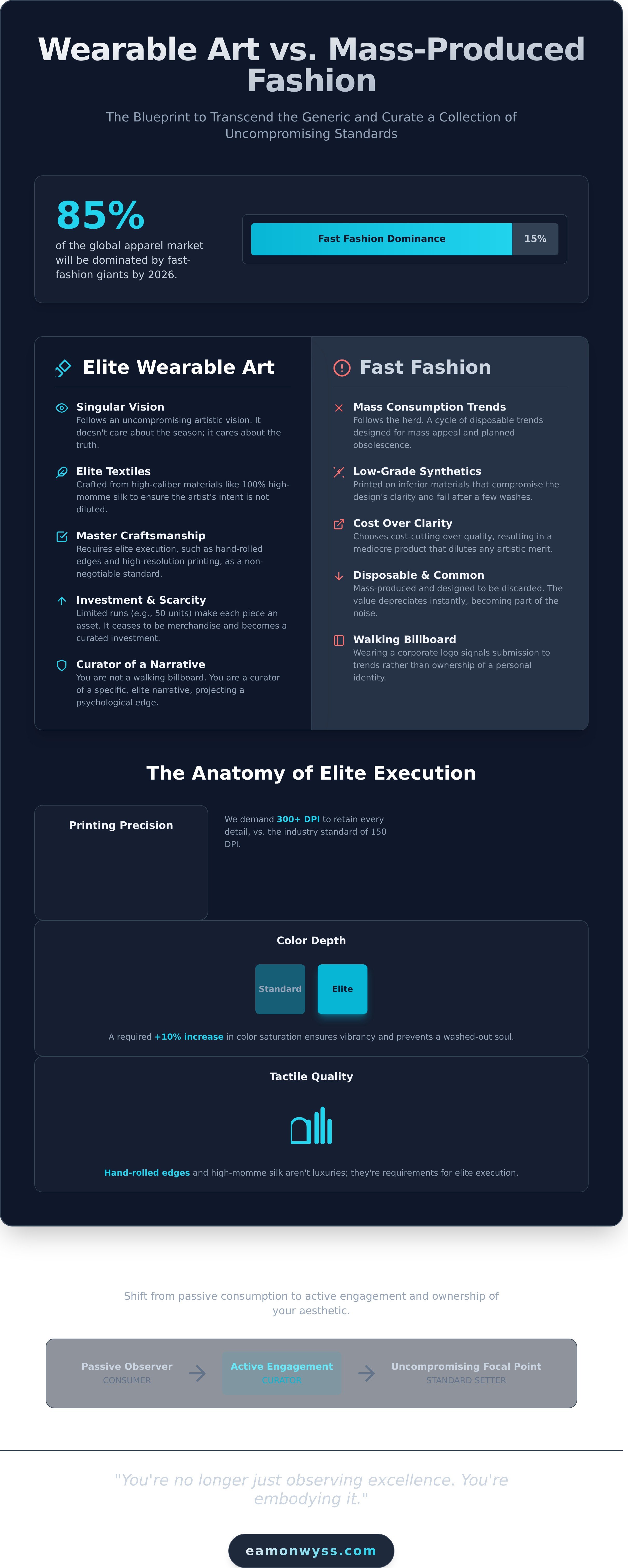
Wearable Art vs. Fast Fashion: Choosing Standards Over Trends
Fast fashion is a failure of discipline. It relies on the constant churn of 52 micro-seasons a year to keep you consuming low-tier goods that lose their shape after three washes. This is pure friction. Genuine wearable art stands in direct opposition to this cycle. It demands a higher standard of both the creator and the wearer. Mass-produced prints are merely echoes of echoes. They lack the soul of the original work and the precision of high-end manufacturing. When you choose mediocrity, you're voting for a disposable culture that devalues craftsmanship.
The environmental cost of "trendy" is staggering. Global textile waste has reached 92 million tons per year. Most of this comes from synthetic garments designed to be replaced within months. Success shouldn't be measured by how many items you own, but by the longevity of your assets. Art should outlast the season. It should outlast the decade. If a piece isn't built to endure, it's not an investment; it's a liability. High-achievers don't buy liabilities. They acquire pieces that retain their aesthetic and functional power over time.
Is it worth the investment? This is the wrong question. The real question is what it costs you to project an image of average standards. When you wear something unique, you eliminate the noise. You communicate authority without saying a word. You're not just buying a scarf. You're securing a strategic advantage in how you're perceived by peers and competitors alike.
The Economics of Art Scarcity
Value is tied to volume. Open-run merchandise is for the masses who seek comfort in the common. Limited editions are for the elite who understand that scarcity drives long-term worth. When a run is restricted to 50 or 100 pieces, it becomes a legacy asset. These items don't just sit in a wardrobe; they hold their place in a curated collection. The resale potential for limited edition wearable art pieces remains high because the supply is fixed while the artist's reputation grows. Ground your collection in a professional pedigree. You can learn more about the discipline behind these works on the About the Artist page. This isn't just fashion; it's a transfer of excellence from the studio to your person.
Material Integrity and Performance
Synthetics are a compromise you can't afford. Polyester and nylon blends fail the wearer in every critical metric. They trap heat, irritate the skin, and possess a dull, plastic sheen that screams "average." We operate on a "Standards over Feelings" basis. Your equipment must reflect your internal drive for perfection. Investing in wearable art made from 100% mulberry silk is a functional choice. Silk is one of the strongest natural fibers, with a tensile strength that rivals steel on a diameter-for-diameter basis. It regulates temperature and drapes with a precision that synthetic fibers can't replicate. Elite performers choose materials that perform under pressure. They don't tolerate friction in their gear, their business, or their lives. Choose the edge. Choose the standard.
How to Curate and Style Wearable Art for Maximum Impact
Styling is a discipline. It's the art of elimination. Most people fail because they attempt to compete with their own wardrobe. They add layers of noise that dilute their message. When you wear a high-level silk piece, you aren't just getting dressed; you're deploying a strategic asset. The artwork must remain the undisputed focal point. This requires a ruthless commitment to minimalism in every other element of your attire. You're looking for a 90/10 ratio. Ninety percent of your outfit should be a silent, high-quality foundation. The remaining ten percent is the wearable art that commands the room. This isn't about vanity. It's about visual hierarchy and the psychological edge it provides in high-stakes environments.
In 2024, executive presence is defined by clarity. A survey of 500 top-tier recruiters indicated that visual consistency is a primary marker of leadership potential. Chaos in dress suggests chaos in thought. By using a single, complex silk piece against a backdrop of neutral tones, you signal a capacity for focus. You're showing the world you can manage complexity without becoming overwhelmed by it. This is how you navigate a Q3 board meeting or a global summit. You use the silk as a tool to anchor the gaze of your peers. It's a calculated move. It eliminates the friction of a cluttered appearance and replaces it with the authority of a curated aesthetic.
The Focal Point Strategy
Pairing abstract aerial prints with neutral tones is a matter of mathematical balance. Use charcoal, navy, or stark white to create a void that the artwork fills. Do not allow patterns to clash. If your scarf features the intricate textures of a salt lake, your suit must be flawless and unpatterned. The mobile focal point acts as a high-velocity tool for strategic personal branding, ensuring your presence is anchored by a singular, uncompromising statement of intent.
Mastering the Silk Scarf
Move beyond the neck. A 90cm x 90cm silk square is a versatile instrument. Drape it over a shoulder and secure it with a structured belt to transform a standard blazer into a bespoke silhouette. This transition from day to evening is where you find your edge. A 14mm momme weight silk twill retains its structural integrity through a 14-hour day of high-performance demands. Learn How to style a silk scarf to maximize the utility of your investment.
Practicality is the bedrock of elite styling. To showcase large-scale silk artworks, you must understand the geometry of the fold. Every fold hides or reveals a specific topographical detail. In a 2023 study on cognitive perception, researchers found that humans make a status assessment in approximately 33 milliseconds. Your choice of wearable art is the catalyst for that assessment. If the silk is bunched or hidden, the impact is lost. You must allow the fabric to breathe. Lay it flat across the lapel or let it hang in a long, vertical line to elongate the frame. This creates a sense of height and dominance. It's a physical manifestation of your standards.
The versatility of luxury accessories lies in their ability to adapt without losing their soul. You don't need a different wardrobe for every event. You need a higher standard for the pieces you choose to include. A single, high-impact silk artwork can carry you through a decade of high-stakes social interactions if you treat it with the respect it deserves. Stop settling for basic motivation. Start operating at a level where your presence is an undeniable force. Use your style to eliminate the noise and focus on the result. It's time to secure your edge.
This principle of strategic curation extends beyond accessories. For high-stakes events where a specific designer dress is required, services like Style Me Up offer access to an elite collection, providing a tactical advantage without the need for permanent ownership.
The Salt Lakes in Silk: Eamon Wyss and the Edge of Wearable Art
Eamon Wyss doesn't create mere accessories. He manufactures wearable art for those who demand more than a luxury label. The Australian salt lakes are brutal, desolate, and perfect. They represent a raw discipline that most people never see from the ground. Wyss uses drone photography to capture these perspectives from altitudes often exceeding 120 meters. This isn't about capturing a scenic view. It's about translating the sharp edge of the earth into a medium that moves with the body. Each piece is a calculated strike against the mundane. It's a refusal to accept the standard definitions of fashion.
The transition from a raw digital file to a silk masterpiece requires an uncompromising eye. The colors are not enhanced to please the masses; they are preserved to reflect the truth of the landscape. This process eliminates the friction between the natural world and the urban environment. When you wear these pieces, you carry the weight of the Australian interior. You wear the heat, the salt, and the silence. It's a statement of ownership. You own the narrative. You own the aesthetic. You become a walking gallery of the most remote corners of the continent.
The Melbourne-based studio operates with a level of precision usually reserved for high-stakes consulting or elite athletic training. Every design is vetted for its impact and clarity. There is no room for error. If the texture of the lake bed doesn't translate perfectly to the silk, the design is scrapped. This commitment to the vision ensures that the final product is not just a garment but a legacy. It's a tool for self-expression that demands attention without saying a word. You're either on the edge or you're in the way.
From the Mallee to Melbourne
The geographic inspiration starts in the Mallee region, an area covering approximately 104,000 square kilometers of semi-arid landscape. It's a territory defined by survival and stark beauty. Eamon Wyss brings these textures back to his Melbourne-based studio to ensure every production stage meets his elite criteria. By choosing the Dreamscapes collection, you support local Australian artistry that competes on a global stage. The land's innate storytelling is preserved through high-resolution printing that captures every grain of salt and every ripple of sand. There is no dilution of the vision. The result is a product that speaks with authority.
Investing in the Eamon Wyss Vision
Acquiring a piece from the Abstractions collection is a strategic move. It's an investment in quality that transcends seasonal trends. Every silk fiber is selected for its durability and sheen, ensuring the 100% mulberry silk maintains its integrity over years of use. The Melbourne studio maintains a strict limit on production runs to ensure exclusivity for its collectors. You won't find these designs in a bargain bin or a mass-market retail chain. They are reserved for the few who understand that standards are more important than feelings. Every hand-rolled edge is a testament to the discipline required to reach the top. Don't settle for the middle ground. Explore the Salt Lakes in Silk Collection and join the elite group of individuals who wear their art with purpose.
Claim Your Territory on the Edge
Mediocrity is a choice you can no longer afford. By 2026, your visual presence must function as a mobile gallery that communicates power without saying a word. This transition requires a shift from disposable trends to the elite standard of wearable art. You've seen how the anatomy of a masterpiece relies on the 100 percent premium silk and hand-rolled edges that define the Eamon Wyss aesthetic. These aren't just accessories; they're strategic assets for those who operate at peak performance.
The market is flooded with noise, but exclusivity remains the ultimate currency. With limited edition runs validated by exhibitions at the Mildura Arts Centre and the Brunswick Street Gallery, these pieces ensure you remain rare. You don't settle for "good enough" in your business or your training. Don't settle for it in your expression. It's time to eliminate the friction between your internal drive and your external image. Own the standard. Secure the edge.
Secure your piece of the Salt Lakes in Silk collection.
The next level of performance—from your visual presence to your signature scent—is waiting for you to take it. To understand how to curate the latter, read more.
Frequently Asked Questions
What exactly defines a piece of clothing as wearable art?
Wearable art is a functional garment created as a unique, non-industrial piece of fine art. It eliminates the friction between utility and aesthetics. Each piece represents a 100% original vision, often signed or numbered by the creator. You aren't buying a trend; you’re acquiring a legacy. It demands a higher standard of appreciation than disposable fast fashion.
Is wearable art intended for daily use or special occasions?
Wearable art is designed for any moment where you demand your presence be felt. Don't wait for a specific date to wear excellence. Whether it's a high-stakes board meeting or a gallery opening, these pieces serve as your visual edge. High-achievers don't compartmentalize their standards. They bring their best to every environment, 365 days a year.
How do I care for high-end silk wearable art without damaging it?
Maintain your silk by dry cleaning only or hand washing in water under 30 degrees Celsius. Use a pH-neutral detergent to preserve the 12-momme or higher density fibers. Never wring the fabric. Lay it flat on a white towel to dry. This level of discipline ensures your investment remains elite for decades. Neglect is the enemy of quality.
Why is wearable art significantly more expensive than standard fashion?
You pay for the 400 hours of artistic labor and the uncompromising quality of 100% Mulberry silk. Standard fashion relies on 10,000-unit production runs to cut costs. Wearable art often limits production to fewer than 50 pieces globally. This scarcity creates value. You’re funding a vision, not a corporate marketing budget. Excellence has a price, and mediocrity is expensive in the long run.
Can men wear wearable art, or is it primarily for women?
Men wear these pieces to signal status and creative intelligence. A silk scarf adds a layer of strategic sophistication to a tailored blazer or a minimalist overcoat. In elite circles, 40% of luxury silk acquisitions are now made by men seeking a distinct edge. It’s about power and precision. Gender is irrelevant when the standard is excellence.
How do I know if a piece of wearable art is a good investment?
Assess the artist’s track record and the specific edition number of the piece. Authentic wearable art often sees a 12% price appreciation over 5 years if the artist is established. Look for hand-rolled edges and high-definition print clarity. If the work is limited to 100 units or fewer, the rarity protects your capital. Do your due diligence before you commit.
What is the difference between an artist-label scarf and a designer brand scarf?
Artist-labels prioritize the integrity of the work while designer brands prioritize the logo. An artist-label scarf is a canvas, often featuring 20 or more unique colors in a single composition. Designer brands often use 3-color templates for mass efficiency. Choosing the artist means choosing the raw, unfiltered expression of a creator over a corporate assembly line. Quality over volume.
Where can I see Eamon Wyss's wearable art in person?
View Eamon Wyss’s latest collection at his private studio in Zurich or via the 2024 digital archive. The current series is limited to 25 signed pieces per design. You can schedule a private consultation to experience the texture and weight in person. Don't settle for digital previews when the physical reality carries the true weight of the work. Precision requires proximity.
Leave a comment