

The Giclee Print Standard: An Uncompromising Guide to Fine Art Reproduction

Most art collections are dying. If your prints were produced on standard high-street hardware, they are likely losing 14% of their chromatic depth every 6 years. You are trading your capital for a fading ghost. A true giclee print is not a luxury; it is a standard of archival discipline. You deserve the edge that comes with museum-grade precision. Mediocrity in your environment breeds mediocrity in your mindset. Stop settling for disposable décor.
You understand that value is built on uncompromising standards. You want your collection to reflect the same level of performance you demand in your business. This guide eliminates the friction of technical jargon. I will give you the exact framework to ensure your collection meets the 100 year archival benchmark. We are diving into the physics of pigment-based ink, the structural integrity of 315gsm cotton rag, and the binary choice between canvas and paper. It is time to treat your acquisitions as investment-grade assets.
Key Takeaways
- Identify the exact technical markers that separate a true giclee print from a standard digital reproduction.
- Stop treating the surface as an afterthought and learn to select the precise substrate that gives your work a physical edge.
- Master the science of pigment-based ink systems to ensure your collection captures nature’s most elusive nuances with absolute precision.
- Permanence is a standard, not a suggestion. Discover how to use the Blue Wool Scale to protect your investment from the friction of time.
- Cut through the noise of mediocre printing and adopt the elite archival standards required for high-stakes fine art.
The Giclee Print Standard: More Than Just Digital Ink
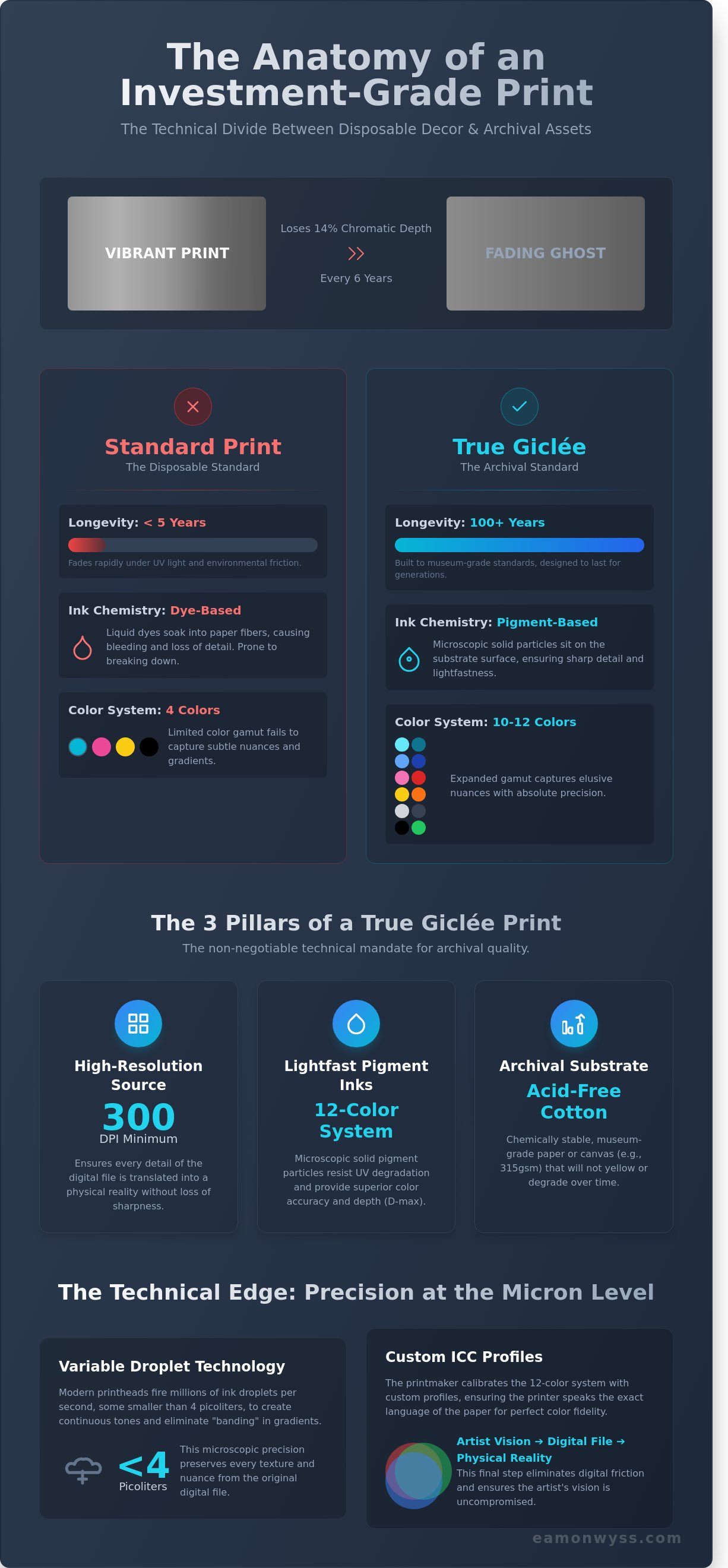
A giclee print isn't a marketing buzzword. It's a technical mandate. Most low-end retailers use the term to dress up cheap ink on thin paper. That's a deception. Real quality requires three non-negotiable pillars: a high-resolution digital source of at least 300 DPI; lightfast pigment-based inks; and acid-free archival substrate. Anything less is just a disposable poster. True giclee production demands precision, pigment, and permanence. It’s the difference between a fleeting image and an enduring asset.
The term stems from the French word "gicleur," meaning nozzle or jet. It describes the process of spraying millions of microscopic droplets of ink onto a surface. You can find a deeper dive into the technical history and What is a Giclée Print? through archival records. For the elite collector, this isn't about the name; it's about the chemistry. I apply these exact standards to every piece in my new prints collection to ensure the work survives the test of time.
The Origins of the Elite Print
In 1991, Jack Duganne transformed industrial technology into an artistic medium. He used the Iris 3047 printer, originally designed for high-end prepress proofing, to create the first fine-art inkjet prints. This shift moved the industry away from dye-based "posters" that faded within years. It introduced pigment-based "investments" designed to last centuries. The Iris printer set the initial benchmark, proving that digital reproduction could match, or even exceed, traditional lithography in depth and detail.
Giclee vs. Standard Inkjet: Identifying the Edge
The edge lies in the ink and the delivery. Consumer-grade printers use dyes that break down under UV light in less than 60 months. Museum-grade pigments are suspended particles that resist fading for over 100 years. Elite giclee setups utilize high nozzle density to eliminate "banding" in complex abstract gradients. This ensures smooth transitions that the human eye cannot distinguish from a continuous tone. A giclee print is the uncompromising intersection of ultra-high-resolution digital data and the physical chemistry of archival pigments bonded to museum-grade substrates. There is no room for friction in this process. Only the result matters.
The Technical Edge: Pigments, Precision, and Nozzles
Quality isn't an accident. It's an engineering feat. A true giclee print relies on a fundamental shift in chemistry. Most consumer printers use dye-based inks. These are liquid. They soak into the paper fibers and bleed. They fade under the sun. Pigment-based inks are different. They consist of microscopic solid particles. These particles sit on the surface of the substrate. They don't move. They don't surrender to UV light. This is where longevity begins. Precision is the only standard that matters.
Pigment Chemistry and Colour Permanence
Pigments provide the edge in archival stability. While dyes break down within years, pigment particles are built to last over a century. They offer superior resistance to environmental friction. This chemistry is vital for achieving high D-max levels. In abstract aerial photography, deep, rich blacks are non-negotiable. Without high density, the image loses its soul. To meet the industry standards for giclee, the ink must be lightfast. This isn't about looking good today. It's about looking identical in 2124. Standards over feelings, every time.
Precision at the Micron Level
Standard printing uses four colors. Elite giclee systems use 10 to 12. This expanded gamut captures the subtle shifts in a desert sunset or the cold blue of a salt lake. It's about eliminating digital friction. Modern printheads utilize variable droplet technology. They fire millions of droplets per second, some smaller than 4 picoliters. This allows for a 300 DPI resolution that feels organic, not mechanical. Every texture is preserved. Every nuance is respected. Mediocrity is the enemy of the printmaker.
The printmaker acts as the final gatekeeper. They translate a digital file into a physical reality through custom ICC profiles. These profiles ensure the printer speaks the exact language of the paper. Without this calibration, the artist's vision is compromised. It takes a disciplined eye to manage these 12-color systems effectively. If you want to see how these technical standards manifest in high-stakes art, explore the latest new prints in the collection. Every giclee print must survive this rigorous process before it earns its place on a wall.
Substrate Selection: Choosing Your Surface for Maximum Impact
The substrate is the arena where your vision lives or dies. It's not a background. It's the physical manifestation of your standard. If the ink is the soul of the work, the material is its skin. Elite standards demand synergy between both components. Choosing a surface requires a level of intentionality that most people ignore. They settle for "good enough." You don't. Every decision reflects your standard. Choosing a substrate isn't a secondary task; it's the foundation of the entire giclee print.
Avoid Optical Brightening Agents (OBAs) at all costs. These are chemical shortcuts used to manufacture a false sense of brilliance. They're a lie. Within 12 to 15 years, these chemicals degrade. The paper yellows. The value of the work collapses. True archival quality relies on natural whiteness. Elite collectors demand OBA-free media because it preserves the integrity of the work for 75 years or more. This is about legacy, not a quick fix.
Fine Art Paper: The Collector’s Traditional Choice
Standards define the outcome. For an elite giclee print, 300gsm is the non-negotiable floor. Anything less feels like a flyer, not a masterpiece. 100% cotton rag provides a tactile gravity that wood-pulp alternatives can't replicate. The matte finish is a tactical choice. It kills glare. It forces the viewer to engage with the art, not the reflection of their environment. This surface is the perfect partner for the complex textures in the Abstractions Collection. Precision is the only currency that matters here.
Premium Canvas: Transforming Photography into Painting
Canvas is a structural power move. It transforms a digital file into a physical presence. Archival-grade poly-cotton blends provide the specific tension needed for large-format displays. They don't sag under their own weight. They resist cracking at the corners. In abstract aerial photography, the weave of the canvas creates a subtle, rhythmic texture. It adds a third dimension to the composition. For spaces that require a bold, frameless statement, the Limited Edition Canvas Prints deliver the necessary impact. This is where scale meets an uncompromising refusal to blend in.
Archival Integrity: Protecting Your Investment for Generations
Most art dies a slow, invisible death. It happens in the margins. It happens because of low standards. A standard giclee print isn't just a reproduction; it's a technical fortress designed to withstand the erosion of time. This begins with the Blue Wool Scale. This 1 to 8 metric measures lightfastness. While cheap dye-based prints fail at a level 2 or 3, professional pigment inks reach level 6 or higher. This is the edge you demand. It ensures the colors you see today remain vibrant decades from now.
Paper quality is the next battlefield. Standard wood-pulp papers contain lignin. This organic compound creates acidity that turns paper yellow and brittle within 15 years. Elite archival standards require 100% cotton rag or alpha-cellulose bases. These are pH-neutral and acid-free. They don't decay. They don't surrender to the atmosphere. To maintain this state, you must control the environment. Aim for a steady 21 degrees Celsius and 50% relative humidity. Fluctuations create friction. Friction leads to degradation.
- Blue Wool Scale: Ensures pigment stability against UV radiation.
- Acid-Free Substrates: Prevents chemical yellowing and structural failure.
- Protective Barriers: Advanced varnishes shield canvas prints from moisture and oxidation.
The 100-Year Standard
In the world of museum-grade display, archival means a lifespan exceeding a century. Traditional silver halide photographs often begin to shift and fade after 40 years. They lack the molecular stability of modern pigment-based processes. A high-end giclee print bridges the gap between digital precision and historical permanence. It's built to outlast the owner. Archival integrity is a matter of choice, not luck.
Handling and Storage Protocols
Apply a "Standards over Feelings" approach to your collection. Your skin carries oils and salts that are corrosive to fine art surfaces. Never touch the print area with bare hands. Use white cotton gloves or handle only by the edges. Framing isn't just about aesthetics; it's a security measure. Use UV-protective glass that filters 99% of harmful rays to lock in the original vision. You can learn more about the artist’s commitment to these elite standards in the About the Artist section.
Own a piece of work that's built to endure. View the latest archival releases.
The Eamon Wyss Vision: Giclee as the Ultimate Medium
Abstract salt lake photography is a study of the ephemeral. It’s about the 1% of detail that separates a snapshot from a masterpiece. A high-standard giclee print isn't a luxury; it's a baseline requirement for this level of work. The salt lakes of Australia offer textures that vanish with the tide and wind. To capture that "Edge," you need the depth and tonal range only archival pigment-based inks can provide. Anything less is a compromise.
Scarcity creates value. Limited editions create a psychological anchor for the serious collector. They represent a finite moment in time captured with uncompromising clarity. When you own a piece from a run of 10 or 25, you own a physical artifact. It carries the weight of the land, translated through high-tension precision and elite production standards. It’s art that demands respect in a room.
From Drone to Substrate: A Seamless Process
The raw data from the drone must remain uncompromised. We use a 12-color pigment system to ensure every tonal shift in the salt crust is visible. In the Melbourne studio, the proofing process is brutal. We discard anything that shows even a hint of friction or inaccuracy. Every giclee print uses museum-grade, 310gsm cotton rag. This ensures your investment resists degradation for over 100 years. Perfection is the only acceptable output.
Building Your Collection
Art is an asset. Starting an investment-grade collection requires a focus on quality and origin. These works are 100% Australian-made, produced locally to maintain absolute control over the output. You aren't just buying a picture. You're acquiring the result of disciplined execution and a refusal to settle for the average. Stop settling for mass-produced mediocrity. Explore the limited edition collections and raise your standards.
Demand the Elite Standard
Mediocrity is the default. Excellence is a deliberate choice. A professional giclee print isn't just a digital copy; it's a technical feat of endurance. We use museum-grade archival pigments that guarantee 100+ year lightfastness. This ensures your investment resists the friction of time. It's about legacy, not just decoration. Every piece is independently produced in Melbourne by artist Eamon Wyss. You aren't buying from a faceless factory. You're securing work that meets a relentless internal benchmark of precision and power.
Each acquisition includes a limited edition certificate of authenticity. It's the ultimate proof of the standard you've set for your environment. If you're tired of mass-produced noise, it's time to shift your perspective. Choose the edge. Choose the uncompromising quality of a creator who values results over convenience. You've earned the right to own work that reflects your own discipline. Step up to the next level of fine art reproduction today.
Invest in an Uncompromising Standard. Shop the Collection
The standard is yours to claim.
Frequently Asked Questions
Is a giclee print better than a regular print?
A giclee print is objectively superior to a standard print because it utilizes a 12-color pigment-based ink system rather than a basic 4-color dye process. This technical edge results in a color gamut that is 40% wider than traditional digital prints. Standard prints fail the test of time. Giclee demands a higher standard. You choose the elite option or you settle for mediocrity.
How long do giclee prints last before fading?
You can expect a giclee print to remain color-fast for 100 to 200 years under museum-grade lighting conditions. Data from Wilhelm Imaging Research confirms that archival pigment inks on acid-free paper resist fading 50 times longer than standard retail prints. This is about legacy. It’s about building a collection that outlasts its creator. Don't compromise on durability.
Can you tell the difference between a giclee and an original painting?
Most viewers cannot distinguish a high-end reproduction from an original at a distance of 3 feet. The 300 DPI resolution captures every brushstroke and subtle tonal shift with 99% accuracy. However, a print lacks the 3D physical impasto of oil paint. It’s a precision reproduction. It offers the aesthetic of the original without the $50,000 price tag.
What is the best way to clean a giclee canvas print?
Use a dry, soft-bristle goat hair brush or a clean microfiber cloth to remove dust from the surface. Never use liquids or chemical cleaners, as they will dissolve the water-soluble pigment inks instantly. Maintenance is a discipline. Treat the work with the respect it deserves. A 30-second dusting every 6 months preserves the integrity of the ink layer.
Do giclee prints increase in value over time?
Limited edition giclee prints often appreciate by 15% to 25% once the initial run sells out. Value is driven by scarcity and the artist’s market demand, with specialist sellers like Galerie Prints curating collectable photographic and cinema memorabilia. An open edition print is a decor choice; a signed and numbered edition is a strategic asset. Track the secondary market on platforms like Sotheby’s to see the performance of elite reproductions.
Is giclee printing the same as digital printing?
Giclee is a specialized form of digital printing that requires a minimum resolution of 1440 DPI and archival materials. While all giclees are digital, 90% of digital prints fail to meet the giclee standard. It’s the difference between a mass-market sedan and a precision-tuned racing engine. One is built for volume; the other is built for performance.
Why are giclee prints more expensive than standard photo prints?
The cost reflects the elite materials used, including pigment inks that cost $150 per liter and 100% cotton rag paper. Standard photo prints use cheap wood-pulp paper and dye-based inks that degrade within 10 years. You’re paying for 200 years of archival stability. Quality isn't expensive; it's an investment in a higher standard of visual clarity.
What paper is best for giclee printing abstract art?
Choose a 310 gsm Hahnemühle German Etching paper to give your abstract art the necessary depth and tactile edge. This heavyweight, mold-made paper provides a distinct texture that mimics traditional watercolor sheets. It handles high ink loads without warping. For abstract works, the paper’s 100% alpha-cellulose composition ensures the colors pop with uncompromising intensity.
Leave a comment