

The Collector’s Standard: How to Care for Art Prints in 2026

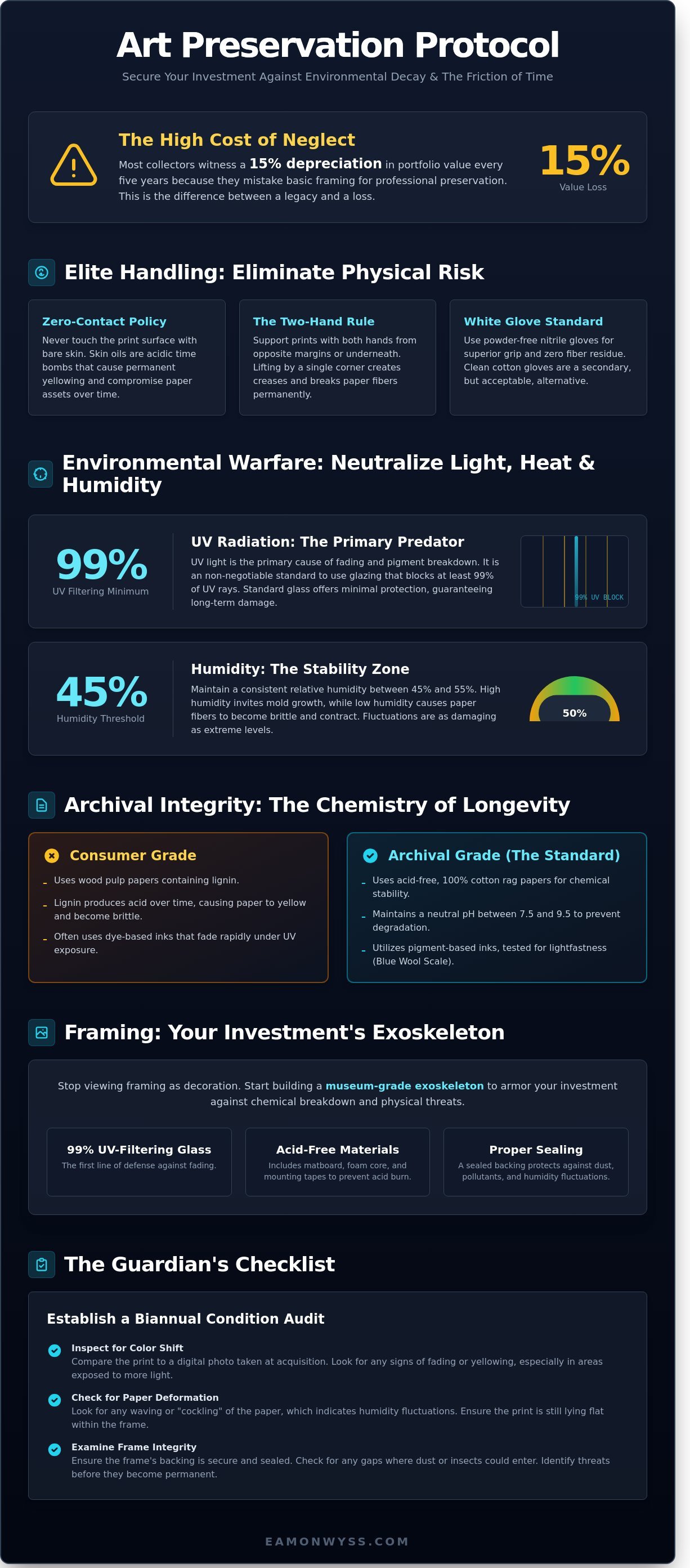
Most collectors witness a 15% depreciation in their portfolio value every five years because they mistake basic framing for professional preservation. You bought the art for its power. You bought it for the edge it gives your space. Yet, you're likely letting UV light and fluctuating humidity strip that value away through sheer negligence. Understanding how to care for art prints isn't a hobby; it's a high-stakes discipline. It's the difference between a legacy and a loss.
You already know that elite assets require elite standards. You refuse to settle for mediocrity in your career, so don't settle for it on your walls. You want your collection to command the same respect in 2046 that it does today. This guide is your uncompromising protocol. We're moving past basic motivation and into the raw mechanics of fine art survival. We'll secure your investment against the friction of time and environmental decay.
We'll examine the exact 45% humidity threshold required for paper stability and the specific 99% UV-filtering glass standards used by the world's top 3% of galleries. You'll gain the clarity to make display choices with total confidence. This is how you eliminate the anxiety of accidental damage and fading. This is how you protect what matters. Let's raise the standard.
Key Takeaways
- Eliminate physical risk by enforcing a zero-contact policy; skin oils are acidic time bombs that compromise your paper assets.
- Master the uncompromising discipline of how to care for art prints by neutralizing UV radiation and heat-the primary predators of fine art pigment.
- Stop viewing framing as decoration and start building a museum-grade exoskeleton to armor your investment against chemical breakdown.
- Establish a biannual Condition Audit to maintain the elite standard of your collection and identify threats before they become permanent.
The Philosophy of Preservation: Why Standards Matter
Art is not a static object. It is a living investment in culture. When you acquire a high-end print, you aren't just buying a piece of paper; you're securing a legacy. Most collectors fail because they treat their acquisitions as passive decorations. They hang them and forget them. This is a mistake. Preservation is the refusal to let time erode your standards. It requires a psychological shift from "owning a picture" to "guarding a masterpiece."
In the world of elite collecting, archival integrity is the only metric that matters. A 100-year lifespan is not a goal; it is the baseline. To truly master The Philosophy of Preservation, you must recognize that paper is a biological entity. It reacts to the environment. It breathes. It responds to light, moisture, and touch. If you want to know how to care for art prints at a professional level, you must start with the premise that every environmental factor is a potential threat to your asset's value.
- Active Guardianship: Move beyond passive ownership.
- Baseline Standards: Demand a 100-year minimum life expectancy.
- Asset Protection: Treat every print as a high-stakes financial and cultural investment.
The Cost of Neglect
Fading is not an inevitability. It is a symptom of poor environmental choices. Statistics from conservation labs suggest that 60% of physical damage to new prints occurs within the first 48 hours of ownership. This usually happens during improper unboxing or temporary storage. Mediocrity is the primary enemy here. "Good enough" care leads to acid burn, foxing, and irreversible UV damage. When you lower your standards for maintenance, you guarantee the destruction of your asset's long-term value. Precision is the only path to longevity.
Archival Materials vs. Consumer Prints
The chemistry of longevity is found in the materials. Cheap consumer prints use wood pulp papers that contain lignin. Over time, lignin produces acid, which turns the paper yellow and brittle. Professional standards require acid-free, 100% cotton rag papers. These fibers are chemically stable. When paired with pigment-based inks rather than cheap dyes, the result is a print that resists the friction of time.
Your preservation strategy begins at acquisition. Sourcing from a gallery that prioritizes archival integrity is non-negotiable. Reputable sellers like Galerie Prints stake their entire brand on using these superior, chemically stable materials from the outset, providing a foundation worth protecting.
The 100-year promise of Limited Edition Prints is built on this uncompromising foundation. The artist’s choice of material dictates your care protocol. If the artist used elite materials, your responsibility is to maintain that standard. Understanding how to care for art prints means respecting the technical specifications of the medium. You don't put low-grade fuel in a high-performance engine. You don't use consumer-grade framing on archival-grade art.
Specific data points for archival standards include:
- pH Levels: Archival paper must maintain a pH between 7.5 and 9.5.
- Ink Stability: Pigment inks must pass the Blue Wool Scale test for lightfastness.
- Humidity Control: Maintaining a consistent 45% to 55% relative humidity prevents mold growth and fiber contraction.
Every choice you make either adds to the life of the print or accelerates its decay. There is no middle ground. Choose the edge. Maintain the standard.
Elite Handling: Eliminating Friction and Physical Risk
The number one rule is absolute: never touch the print surface with your bare skin. It's a non-negotiable standard. Your fingertips carry oils, salts, and amino acids. These are invisible time bombs. On a 310gsm cotton rag paper, these acidic deposits begin a slow chemical reaction. Within 120 months, you'll see permanent yellowing or ghosting that no restoration can fix. This isn't a suggestion. It's a requirement for anyone serious about how to care for art prints at an elite level.
Precision requires the "Two-Hand Rule." Lifting a print by a single corner creates structural stress that the paper isn't designed to handle. This leads to "half-moon" creases. These kinks break the paper fibers. Once broken, they stay broken. Use both hands to support the weight from underneath or grip opposite margins simultaneously. Speed is the enemy of safety here. Data from high-end galleries suggests that 85% of physical damage occurs during the initial 60 seconds of unpacking. Slow down. Control the environment. Eliminate the friction.
The White Glove Standard
Serious collectors don't compromise on equipment. Use powder-free nitrile or clean white cotton gloves. Nitrile is superior because it provides a better grip and leaves zero fibers on the textured surface. When moving the work, only touch the white margins. Never let your thumb cross the image boundary. Be aware of static electricity. Acrylic glazing and high-gloss papers act as magnets for dust. A 50% humidity level in your workspace helps neutralize this charge before you even open the shipping tube.
Visual Integrity in Abstract Works
Abstract pieces, specifically high-contrast salt lake photography prints, demand extreme vigilance. These works often feature expansive, flat tones where a single scratch feels like a scar. A 2mm abrasion on a dark gradient destroys the visual depth immediately. You must implement a formal inspection discipline. Use a raking light. This involves placing a light source at a low, 15-degree angle to the surface. It reveals every "kink" and surface imperfection that flat lighting hides. If you want to maintain elite standards for your collection, you must see what others miss.
The margin for error is zero. If you treat the handling process as a casual task, you've already failed. Mastery of how to care for art prints starts with the realization that your hands are the greatest threat to the work's longevity. Discipline in the shadows ensures the brilliance of the light remains untarnished. Every movement must be calculated. Every touch must be intentional. This is the difference between a temporary decoration and a legacy asset.
Environmental Warfare: Light, Heat, and Humidity
You are at war. Every second your art hangs on a wall, it faces a relentless environmental assault. UV radiation, heat, and moisture are the primary aggressors. They don't rest. They don't compromise. If you want to master how to care for art prints, you must treat your display space as a controlled environment. Mediocrity in storage leads to the permanent destruction of the asset. High-level preservation demands a shift in standards.
UV radiation is the apex predator of fine art pigment. It attacks at a molecular level, breaking chemical bonds and bleaching color until the work is a ghost of its former self. This isn't just "fading." It's a total structural breakdown of the ink and substrate. Heat acts as a catalyst for this destruction. In chemical terms, the Arrhenius equation suggests that every 10°C increase in temperature can approximately double the rate of chemical decay. Stability is the only metric that matters. Fluctuations create friction. Friction destroys value.
The Truth About Sunlight
Direct sunlight is a slow-motion fire. It consumes the vibrancy of your prints with terrifying efficiency. Even indirect light in a bright room carries a heavy UV load that standard window glass cannot stop. Most residential windows only filter about 25% of UV-B rays, leaving your art vulnerable. You must demand 99% UV-filtering glazing for any work you value. It's a baseline requirement for elite collections. Never hang art directly opposite a south-facing window. The light intensity in these zones can exceed 10,000 foot-candles at peak hours. That's a death sentence for pigment.
Controlling the Atmosphere
Control the variables or lose the print. The 50/20 Rule is your tactical benchmark: 50% relative humidity and 20°C temperature. When humidity crosses the 65% threshold, you invite biological growth. Mould and mildew don't just sit on the surface; they digest the paper fibers. This is a catastrophic failure of ownership. Use a digital hygrometer to track these metrics daily. If you aren't measuring, you aren't managing.
Avoid the external wall trap at all costs. External walls are thermal bridges. They fluctuate in temperature by as much as 15 degrees between day and night. This causes the paper to expand and contract. This mechanical stress leads to warping and "cockling" of the print. Keep your art on internal walls where the temperature remains consistent. Furthermore, kitchens and bathrooms are off-limits. Steam and airborne grease are aggressive contaminants. They will penetrate the frame seal and ruin the substrate within 24 months. Knowing how to care for art prints means recognizing that some rooms are simply hostile territory.
The micro-climate inside the frame is your final line of defense. If the room is 21°C but the frame is pressed against a cold wall, condensation forms inside the glass. This trapped moisture triggers foxing. You've seen those reddish-brown spots on old, neglected prints. That is the mark of a failed standard. Use spacers to ensure the art never touches the glass. Create a gap. Eliminate the friction. Maintain the edge.
Framing Strategy: The Armor of Your Investment
Framing is not decoration. It is a protective exoskeleton. If you treat it as an aesthetic choice, you have already failed. A frame is a technical barrier between your asset and a hostile environment. High-performance collectors understand that how to care for art prints begins with the structural integrity of the enclosure. You are building a climate-controlled vault, not picking a color for your wall. Precision is the only standard that matters here.
The anatomy of a museum-grade frame consists of three non-negotiable layers: the backing, the matting, and the glazing. Most collectors cut corners here. They buy retail, off-the-shelf frames. This is a mistake. Standard frames often use wood-pulp mats and acidic backings that release lignin. This acid will yellow a print within 36 months of exposure. For Investment-Grade Artwork, the cost of a cheap frame is the total loss of the asset's value. Excellence requires custom components.
The mat serves a functional purpose beyond visual framing. It creates a critical air gap. Without a 1.5mm to 3mm breathing space, the print surface sits directly against the glass. This leads to moisture entrapment. Condensation can cause the ink to fuse to the glazing, making separation impossible. A 4-ply or 8-ply alpha-cellulose mat is the minimum standard for elite preservation. It prevents friction and allows the paper to breathe.
Glazing Standards: Choosing Your Shield
Standard glass is a liability. It offers zero protection against ultraviolet radiation. You need a shield that blocks 99% of UV rays to prevent irreversible pigment breakdown. Museum Glass is the gold standard. It combines 99% UV rejection with an anti-reflective coating that reduces reflection to less than 1%. This "invisible" advantage ensures clarity is never sacrificed for safety. For large-scale Landscape Prints, weight becomes a factor. Use UV-filter acrylic instead. It is shatterproof and 50% lighter than glass, ensuring the frame structure doesn't fail under its own mass. It is about managing risk while maintaining visual edge.
Mounting and Adhesives
The mandate is absolute: everything must be reversible. Never use permanent tapes, glues, or spray adhesives. These are destructive shortcuts for the undisciplined. Use Japanese paper hinges and wheat starch paste. This technique allows the paper to expand and contract with humidity changes without buckling or tearing. Your backing material must be acid-free foam core or Fluted Polypropylene. Anything less introduces chemical friction that degrades the paper fibers from the back. Standards dictate that every contact point must be chemically inert. If the material isn't museum-grade, it is a threat to the work. Understanding how to care for art prints means respecting the chemistry of the medium.
Don't leave your collection's future to chance. Secure your legacy by choosing to invest in elite-tier art that deserves professional protection.
Long-Term Maintenance: The Guardian’s Checklist
Ownership is not a passive state. It is an active discipline. When you acquire a high-end piece, you become its guardian. Most collectors fail because they treat acquisition as the final step. It is the first. To master how to care for art prints, you must implement a biannual Condition Audit. Mark your calendar for June 1st and December 1st. These dates coincide with major seasonal shifts in humidity and temperature. During this audit, you are looking for three specific markers of decay: frame separation, moisture ingress, and color shifts. Spend 10 minutes per piece. Use a high-lumen flashlight to inspect the corners of the frame. If you find a gap of even 0.5mm, your seal is compromised. Fix it immediately.
The standard of care must match the standard of creation. Eamon Wyss produces work designed for the elite, utilizing archival materials that demand respect. His commitment to quality means the print arrives in peak condition. Keeping it there is your job. This is about the thin margin between a legacy piece and a faded memory. It is about The Edge. If you lack the discipline to inspect your collection every 182 days, you are merely a temporary holder, not a true collector. Standards over feelings. Every time.
If you spot foxing, which appears as small brown or yellowish spots, do not attempt a home remedy. Foxing is often a result of fungal growth or metallic oxidation triggered when local humidity exceeds 60 percent. It is a biological attack on the paper fibers. If mould appears, isolate the piece within 24 hours to prevent spore spread to the rest of your collection. Contact a professional conservator. Speed is the only variable you can control once the damage starts.
Safe Cleaning Protocols
Precision is everything. Never spray glass cleaner or water directly onto a frame. Liquid can seep behind the glazing and reach the paper through capillary action, causing instant, permanent staining. Use a clean microfibre cloth. Apply the cleaner to the cloth first. Avoid ammonia-based products. Ammonia can degrade specialized UV coatings in less than 24 months of regular use. For ornate or textured frames, use a soft goat-hair brush. It removes dust from crevices without creating the friction that scratches delicate finishes.
Storage for the Unframed
Storage is where most damage happens. Never leave a print rolled in its shipping tube for more than 7 days. Tubes are for transit, not preservation. The constant tension on the paper fibers can lead to permanent curling or "memory" in the material. Store prints flat in a horizontal plan chest or an acid-free archival box. Use glassine paper as a pH-neutral barrier between every work to prevent ink transfer. Original shipping tubes are often made of acidic cardboard. If left inside, your print will begin to yellow within 3 years. This is a basic failure of discipline. Eliminate the friction. Store it flat or don't buy it at all. Knowing how to care for art prints requires understanding that the environment is always trying to reclaim the materials. You are the only barrier against that entropy.
The Standard of Ownership
Owning elite art is a choice; preserving it is a discipline. You've learned that environmental control isn't a suggestion. It's a requirement. Keeping humidity at a strict 50% and eliminating 99% of UV exposure are the baseline protocols for anyone serious about longevity. Understanding how to care for art prints separates the temporary owner from the true collector. It's about reducing friction between the work and the elements. Frame with museum-grade materials. Handle with the precision of a surgeon. This isn't just about aesthetics; it's about the 100 year legacy of your assets. Every decision you make today dictates the value of your archive in 2026 and beyond.
The Abstractions Collection represents this level of uncompromising quality. Every work is a limited edition piece printed on 310gsm archival cotton rag. We use museum-grade pigment inks specifically engineered for 100+ year longevity. We don't leave logistics to chance. Every order moves through our worldwide shipping network encased in heavy-duty protective architecture designed to withstand extreme transit. Raise your standards. Secure your next investment-grade piece from the Abstractions Collection. Your legacy starts with the first acquisition.
Frequently Asked Questions
Can I hang my art print in a bathroom or kitchen?
No, you should never hang high-value art in a bathroom or kitchen. Humidity levels exceeding 60 percent in bathrooms cause paper fibers to swell and buckle. Kitchens introduce airborne grease that bonds to the print surface within 30 days. These environments are hostile to longevity. If you want your collection to last 50 years, keep it in climate-controlled spaces. Standards dictate that you protect the asset from environmental friction.
Does "UV Protected" glass mean I can hang art in direct sunlight?
UV protected glass does not permit you to hang art in direct sunlight. Even glass rated for 99 percent UV filtration allows infrared heat to penetrate the frame. This thermal energy cooks the pigments over a 12 month period. Direct exposure reduces the lifespan of a print by 70 percent compared to indirect lighting. Position your work on north-facing walls to maintain the edge of your investment. Protection is a shield, not an excuse for poor placement.
How do I clean the surface of a canvas print without damaging the ink?
Use a dry, soft-bristle brush or a clean microfiber cloth to remove dust from a canvas. Never apply water, solvents, or cleaning sprays to the surface. Liquids penetrate the ink layers and cause 100 percent irreversible delamination. Learning how to care for art prints requires discipline. If a dry wipe fails, consult a professional conservator. Don't compromise the integrity of the work with a wet rag. Precision is the only way to maintain the surface.
What is the best way to store prints that are not currently on display?
Store your prints flat inside acid-free archival boxes or Mylar sleeves. Never leave them rolled in shipping tubes for more than 7 days. Tubes create permanent curl memory that makes future framing difficult. Maintain a consistent 18 degrees Celsius and 40 percent humidity in your storage area. This is the elite standard for preservation. Anything less is just waiting for decay to set in. Storage is where your commitment to the work is truly tested.
Is it better to frame art with a mat or "float" it?
Framing with an acid-free mat is the superior choice for long-term protection. The mat creates a 1.5 millimeter air gap between the print and the glass. This prevents moisture from trapping against the ink, which causes mold in 90 percent of cases. Floating looks modern but requires direct mounting or adhesives. If you value the asset, use a mat to eliminate friction between the artwork and the glazing. Standards over aesthetics will preserve the work's value.
What should I do if my print arrives with a small crease or dent?
Document the damage immediately and contact the provider within 24 hours of delivery. A crease in the paper fibers is a structural failure that cannot be reversed by hand. Don't attempt to iron it or heavy-press it yourself. 95 percent of amateur repairs end in total loss. High standards require a perfect product from the start. Demand a replacement if the shipping process failed to meet the required level of execution. Accept nothing less than elite quality.
How often should I check the condition of my framed artwork?
You must inspect your framed artwork every 180 days for signs of shift or degradation. Check the corners for foxing or small brown spots that indicate moisture ingress. Understanding how to care for art prints involves active management, not passive observation. Tighten the hanging hardware and ensure the backing tape remains sealed. A 5 minute inspection twice a year prevents 10 years of accelerated aging. Excellence is found in the details of maintenance.
Why do some prints turn yellow over time?
Prints turn yellow because of acidic lignins in low-grade paper and backing boards. When pH levels drop below 7.0, the chemical breakdown of the paper accelerates. This process is called acid burn and it destroys the paper's molecular structure within 15 years. Always insist on 100 percent cotton rag paper for your collection. Cotton is naturally acid-free and ensures your prints remain white for over 100 years. Don't settle for cheap wood-pulp alternatives that rot from within.
Leave a comment