

Salt Lake Aerial Photography: Stripping Away the Noise to Reveal the Land's Truth

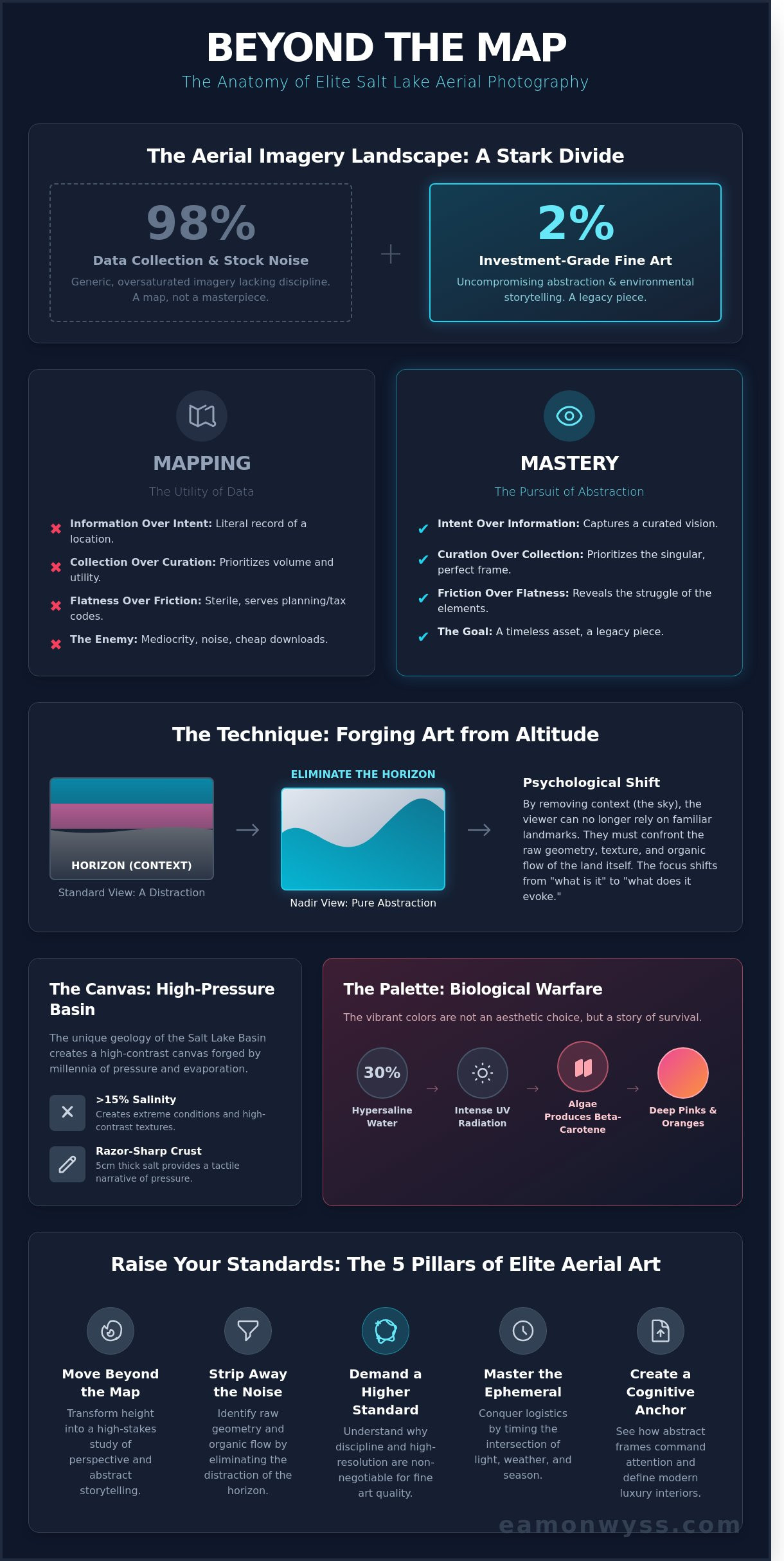
Most of what you see is noise. It's a map, not a masterpiece. Since the consumer drone market exploded in 2018, 98% of the imagery you encounter is nothing more than data collection disguised as art. You're likely exhausted by the flood of generic, oversaturated stock photos that lack any real depth or discipline. You want the truth. Salt Lake aerial photography is a high-stakes pursuit that demands more than a high-resolution sensor; it requires an uncompromising eye for abstraction and environmental storytelling. Mediocrity is the primary enemy here. When you stop looking for a view and start looking for a standard, the land reveals its secrets.
This is where we strip away the friction of traditional mapping. You'll learn how to evaluate the standards of elite aerial art and understand why specific compositions hold their value as investment-grade pieces. We're moving beyond the surface to find the edge where the land finally speaks. It's time to demand a higher level of clarity from the art you collect. This is about the thin margin between a hobbyist's snapshot and a legacy piece.
Key Takeaways
- Move beyond the map. Learn how to transform height into a high-stakes study of perspective and abstract storytelling.
- Strip away the noise. Identify the raw geometry and organic flow of nature by eliminating the distraction of the horizon.
- Raise your standards. Discover why high-resolution sensors and uncompromising discipline are non-negotiable for fine art quality.
- Conquer the outback. Master the logistics of salt lake aerial photography by timing the ephemeral intersection of light, weather, and season.
- Create a cognitive anchor. See how abstract aerial frames command attention and define the standards of modern luxury interiors.
The Perspective of the Elite: Defining Salt Lake Aerial Photography
Height is a cheap commodity. Perspective is rare. Most people confuse the two. They believe that putting a camera 120 meters above the ground constitutes art. It doesn't. True salt lake aerial photography is a study in the elimination of the unnecessary. It's a deliberate choice to move beyond the map and enter the realm of abstract storytelling. This is where the literal representation of a shoreline dies and the soul of the land begins. You aren't looking at water and salt; you're looking at the raw friction of existence.
The elite understand that salt lakes provide the ultimate canvas for high-stakes composition. There's no room for error. Minimalist environments demand uncompromising standards. If the frame is off by a single degree, the tension evaporates. We call this "The Edge." It's the thin margin where a photograph ceases to be a digital file and becomes a timeless asset. In 2024, the market is flooded with noise. To find the truth, you must strip everything else away. You must demand more from the frame than just a birds-eye view.
Mapping vs. Mastery: Why GIS is Not Art
Utility is the enemy of the extraordinary. Salt Lake County GIS imagery serves a purpose: it tracks 1,700 square miles of data for tax codes and urban planning. It's sterile. It's dead. An artist doesn't capture data; they capture intent. Stock sites and cheap digital downloads fail because they lack a point of view. They provide a literal record of a location without the emotional weight of a curated vision. Mastery requires you to reject the utilitarian and embrace the abstract. You'll find more truth in a single fine art abstraction than in a thousand satellite pings.
- Intent over Information: Data tells you where the lake ends. Mastery tells you why it matters.
- Curation over Collection: Stock sites prioritize volume. The elite prioritize the singular, perfect frame.
- Friction over Flatness: Art captures the struggle between minerals and moisture.
The Allure of the Salt Lake Basin
The Salt Lake Basin is a high-pressure environment. Salinity levels often exceed 15 percent, creating a unique geological friction that produces high-contrast textures. These mineral deposits dictate a palette that no human could invent. The white crusts and deep teals aren't just colors; they're the result of thousands of years of evaporation and pressure. These lakes act as mirrors. They reflect the sky, but more importantly, they reflect the internal state of the observer. When you look at these compositions, you're forced to confront the clarity you've been avoiding. It's a mirror of your own standards. It's a reminder that beauty exists at the limits of what's survivable.
The Anatomy of Abstraction: How Salt Lakes Become Art
Altitude is the ultimate filter. At 500 feet, the horizon remains a distraction. At 2,000 feet, it disappears entirely. You're left with the raw data of the earth. Salt lake aerial photography isn't about capturing a scenic view. It's about stripping away the noise of human scale to reveal a brutal, mathematical precision. When you remove the sky, you remove the context. This forces a psychological shift. The viewer can no longer rely on familiar landmarks. They must confront the geometry of the land itself.
Nature doesn't do "random." From the air, the organic flow of brine channels reveals a complex system of efficiency. These patterns represent the path of least resistance, carved over thousands of years. The texture of a dried salt crust, often 5 centimeters thick and razor-sharp, provides a tactile narrative of evaporation and pressure. It's visceral. It's uncompromising. This perspective demands focus. It mirrors the mental state required for high-level performance: cutting through friction to see the underlying structure of a challenge.
Colour Theory in Hypersaline Environments
The palette of a salt lake isn't an accident of aesthetics. It's a result of biological warfare. In water with 30 percent salinity, only the elite survive. Dunaliella salina algae thrives here, producing beta-carotene to protect itself from intense UV radiation. This creates the deep pinks and oranges that define the landscape. When light hits 99 percent pure salt crystals, the refraction creates an uncompromising glow that a standard camera sensor struggles to hold.
Clarity is the standard. We don't use filters to manufacture drama. The goal is to maintain colour integrity from the moment the shutter fires to the final production of a limited edition canvas print. This requires a technical discipline that refuses to settle for "close enough." The result is a visual that feels both alien and deeply grounded in reality.
The Narrative of the Land
Every line in the salt is a record of a high-stakes environmental battle. A flood in 2011 leaves a specific silt deposit. A drought in 2019 creates a crystalline ridge. These aren't just shapes; they're geological scars. The role of the artist is to act as a translator, turning deep-time processes into a modern visual language that resonates with those who value precision.
The land doesn't care about your feelings. It operates on standards of physics and chemistry. By capturing these ancient processes, we provide a window into a world where only the essential remains. You can explore the stories within our Abstractions collection to see how this translates into art. For those seeking a higher standard of visual impact, understanding the Eamon Wyss philosophy is the first step toward true clarity.
Beyond the Stock Photo: Fine Art Standards in Aerial Capture
Hobbyists chase views. Elite artists chase truth. Effective salt lake aerial photography requires more than a flight controller and a dream; it demands a 100-megapixel sensor capable of resolving the crystalline micro-structures of a drying basin. You don't get a second chance when the sun hits the salt at a 45-degree angle. The glare is blinding. Managing 14.7 stops of dynamic range isn't a suggestion, it's the barrier to entry. If your highlights are blown, your work is garbage. Standards dictate the output. Every frame must be a calculated execution of geometry and light, not a "lucky shot" born of spray-and-pray tactics. This is the edge where technical mastery meets creative vision.
The Scarcity of the Moment
Salt lakes are ephemeral. They exist in a state of constant flux. A rain event in the Mallee might create a specific mineral pattern that lasts only 48 hours before the wind or heat destroys it. You have a 15-minute window before the shadows lose their depth. Being an elite photographer means respecting the land's silence. It means operating with an ethics-first mindset, ensuring the drone is a ghost in the air, not a nuisance to the ecosystem. You are there to witness, not to disrupt. You can read more about the uncompromising standards of fine art drone photography to understand the discipline required at this level.
Post-Processing as Refinement, Not Fabrication
Digital fiction is for amateurs. In the world of high-stakes salt lake aerial photography, post-processing is a tool for extraction, not invention. The goal is to reveal the inherent truth that the raw file hides. This involves a meticulous workflow where every pixel is scrutinized for clarity and color accuracy. When preparing a file for fine art paper prints, the margin for error is zero. We use heavy 300 GSM cotton rag papers because they hold the ink with a depth that digital screens cannot replicate. The print is the ultimate expression of discipline. It's the physical proof that you held the line when the environment tried to break your gear. It's the final stand against mediocrity.
Mastering the Ephemeral: The Logistics of Salt Lake Photography
Success in the outback isn't about luck. It's about the brutal management of friction. Salt lake aerial photography demands a level of discipline that breaks most hobbyists. You don't just show up. You calculate. You wait. You execute. The sun angle must hit a precise 12 degrees to reveal texture without washing out the highlights. If the wind exceeds 25 knots, the drone becomes a liability. Most photographers wait for the perfect day. The elite create the conditions for the perfect shot through relentless preparation and a refusal to compromise.
Reaching these remote basins in the Australian outback is a physical trial. It involves 10-hour drives through the Mallee where the temperature regularly hits 44 degrees Celsius. The salt is a corrosive enemy. It eats electronics. It jams rotors. It tests your standards. The ritual begins weeks before the shutter press. It involves satellite mapping, fuel calculations, and the mental fortitude to trek five kilometers into a dry lake bed carrying 15 kilograms of gear. There's no room for error when the nearest town is 200 kilometers away.
The Role of the Drone as a Brush
Technology has democratised the sky, but it hasn't democratised vision. High-spec hardware is just a baseline. Precision flight is the prerequisite for the abstract symmetry found in my work. Maintaining a perfectly vertical 90-degree pitch at 115 meters requires steady hands and a cold mind. The drone is a brush. It's a tool to strip away the horizon and find the truth in the ground. If you can't control the tool, you can't command the frame.
Conditions of the Salt
The landscape changes in hours, not days. A shallow flood creates a mirror that reflects nothing but the void. A dry bed offers a cracked, visceral texture that speaks of ancient heat. In the Mallee, unpredictability is the only constant. During my 2023 expeditions, I saw lakes transform from bone-dry white to vibrant pink in a single afternoon. You can see these shifts in the Mildura Arts Centre collection, where regional insights meet uncompromising art. Standards dictate that you stay until the light dies. Feelings dictate that you go home. Follow the standards.
Stop settling for the view from the ground. Elevate your perspective and own the elite vision of the Australian outback. Secure your piece of the land's truth today.
Living with Abstraction: Integrating Aerial Art into Your Space
Your environment reflects your standards. It's the physical manifestation of your internal clarity. In a world saturated with visual noise, salt lake aerial photography acts as a cognitive anchor. It demands focus. It strips away the unnecessary until only the truth remains. This isn't just art; it's a tool for mental calibration. When you place an abstract aerial work in a room, you're setting a frequency of precision and depth.
The versatility of salt lake art lies in its raw, uncompromising geometry. In a minimalist setting, it provides the essential friction needed to prevent sterility. In industrial lofts, the organic salt patterns contrast with cold steel and concrete. In luxury interiors, it serves as a sophisticated statement of elite taste. The choice between canvas and paper is a decision of intent. Canvas offers a visceral, tactile presence that feels like an extension of the land itself. Paper, specifically 310gsm museum-grade cotton rag, provides a level of detail and color depth that serves the image's absolute truth. It's the difference between feeling the landscape and analyzing its soul.
Investing in limited edition aerial artwork is a move toward scarcity. In an age of mass production, owning a piece that captures a fleeting geological moment is a strategic acquisition. Scarcity creates value; clarity creates power. You aren't just buying a print. You're securing a piece of the edge.
Scaling for Impact
Salt lake aerials are not meant to be small. They demand scale. To appreciate the intricate crystalline structures and the subtle transitions of mineral deposits, the work must dominate the field of vision. A large-format print, often exceeding 1.5 meters in width, allows the viewer to lose themselves in the abstraction. Anything less is a compromise. Choosing the right size is a matter of standards; if the art doesn't challenge the space, it doesn't belong there.
The Transference of Art to Apparel
The vision doesn't stop at the wall. It moves with you. When the aerial landscape becomes wearable art, it transforms into a statement of identity. The Salt Lakes in Silk collection takes the uncompromising patterns of the earth and applies them to 100% silk. This is tactile luxury. The natural sheen of the silk enhances the salt lake patterns, creating a fluid representation of a static landscape. It's a fusion of rugged geological truth and refined elegance. You carry the edge with you.
Claim Your Absolute Perspective
The landscape doesn't compromise. Neither should your environment. Salt lakes represent a brutal reduction of the earth to its most essential, high-performance elements. This isn't passive observation. It's an elite standard of salt lake aerial photography that cuts through the noise of generic stock imagery. By integrating these abstractions into your space, you're not just hanging art. You're establishing a benchmark of clarity and discipline. Every piece in this collection has met the rigorous standards of the Brunswick Street Gallery in 2024. These are limited edition prints. Each one arrives with a signed certificate of authenticity to verify its status as a high-end asset. We provide worldwide shipping on all art goods to ensure your standards are met, regardless of your coordinate on the map. Stop settling for the mediocre. Choose the edge.
Secure your piece of the landscape in the Abstractions Collection
The truth is waiting for those who have the vision to see it. Step up.
Frequently Asked Questions
What is the best time of day for salt lake aerial photography?
High sun between 11:00 AM and 1:00 PM is the standard for salt lake aerial photography. You need the light to penetrate the shallow brine to reveal the crystalline structures below. Golden hour creates too much glare on the salt crust. Midday light eliminates shadows and maximizes the raw, saturated pinks. It's about precision. You want the land's truth, not a sunset distraction. This window provides the highest clarity for the camera sensor.
How do salt lakes get their vibrant pink and red colours?
The vibrant hues come from Dunaliella salina algae and salt-loving bacteria like Halobacteria. These organisms produce carotenoids to survive extreme salinity. When salt levels exceed 20 percent, the water transforms into a deep crimson or neon pink. It's a biological survival mechanism. You're looking at a battle for life in a high-pressure environment. The result is a visual masterpiece of chemical endurance that demands your attention.
Is drone photography legal at all salt lakes in Australia?
Drone legality depends on CASA regulations and specific land ownership. You can't fly in 28 national parks in South Australia without a commercial permit. Heavy fines of up to $1,100 apply for unauthorized commercial flights. Check the OpenSky app before you launch. Standards matter. Ignorance of the law is friction you don't need. Respect the airspace or stay on the ground. Professionalism requires knowing the rules before you break the seal.
What is the difference between a satellite image and an aerial photograph?
Resolution is the primary differentiator. Satellite images often provide 30 centimeters per pixel, while professional salt lake aerial photography captured from a low-altitude aircraft offers 2 centimeters per pixel. You get texture and depth that a satellite cannot reach. Aerial shots capture the nuance of the crust and the movement of the water. It's the difference between a grainy surveillance feed and an intimate, high-stakes portrait of the earth's surface.
Why is abstract aerial photography considered fine art?
Abstract aerials are fine art because they remove the horizon and force a confrontation with pure form. By stripping away the context of the sky, the viewer must engage with the texture and color on a visceral level. This is about the edge of perception. It challenges the standard way of seeing. It isn't a map; it's a psychological mirror reflecting the land's rawest state. Fine art requires this level of uncompromising vision.
How should I display a large salt lake aerial print for maximum impact?
Go large or don't bother. A 1.5 meter wide print creates an immersive environment that demands attention. Use metallic paper or acrylic face-mounting to enhance the depth of the salt crystals. Position the center of the piece exactly 145 centimeters from the floor. This is the gallery standard for eye-level engagement. Command the room. Your space should reflect the same high standards and lack of friction found in the artwork itself.
Do salt lake aerial prints hold their value over time?
Limited edition prints from recognized artists have seen secondary market growth of 5 to 12 percent annually. Value is driven by scarcity and the artist's reputation. When a 1-of-10 print sells out, the price floor rises. Don't buy mass-produced decor. Invest in archival-grade pieces that use Pigment-on-Rag technology. These prints last over 100 years. They are assets, not just decorations. Quality is a choice that pays dividends.
What are the challenges of photographing salt lakes from above?
The environment is your primary enemy. Salt lakes are often located in 40-degree heat with corrosive dust that destroys sensors. You have 15 minutes of perfect light before the wind creates ripples that ruin the reflection. Pilots must maintain an exact altitude of 1,000 feet to avoid distortion. Success requires elite preparation and zero excuses. If you aren't ready for the friction, the land will win every time. Clarity is earned.
Leave a comment