

Pink Salt Lakes Australia: The Uncompromising Guide to Nature’s Abstract Masterpieces

Most travelers settle for filtered snapshots of mediocrity while missing the raw, visceral reality of the landscape. You've likely sifted through generic fluff only to find that capturing the true essence of pink salt lakes australia requires more than a smartphone and a flight. It's frustrating to chase a vibrant hue only to arrive at a dull, grey basin because your timing was off by 72 hours. Nature doesn't wait for the unprepared. Standards matter.
You demand a higher standard of clarity. This guide provides the elite data required to master the 14-day window of hyper-salinity where Dunaliella salina transforms the water into an abstract masterpiece. I'll cut through the noise to deliver the exact environmental variables and the strategic edge needed to witness these ephemeral landscapes before they vanish. We'll analyze five uncompromising locations from South Australia to the West and connect you with investment-grade art that preserves these high-stakes moments forever. Precision is the only currency here.
Key Takeaways
- Understand the biological grit behind the beauty: why extreme environmental stress forces algae to produce its signature pink hue.
- Identify elite geographic coordinates for pink salt lakes australia, moving beyond common paths to find the most elusive landscapes.
- Master the aerial perspective to capture true abstraction; the ground view is a compromise that hides the scale of nature’s masterpiece.
- Execute with precision by ignoring the "Golden Hour" and leveraging high-noon sun for maximum color intensity.
- Elevate your environment by transitioning from a fleeting digital moment to the uncompromising standard of a limited edition legacy.
The Science of Pink: Why Australia’s Salt Lakes Defy Nature
Nature is indifferent to your aesthetic preferences. The vibrant hue found across pink salt lakes australia is not a design choice; it is the visual evidence of biological warfare. These environments represent the edge of habitability. Survival here requires an uncompromising adaptation to extreme salinity and UV radiation. When you look at these waters, you are witnessing a high-stakes response to environmental friction. This is biology operating at its absolute limit.
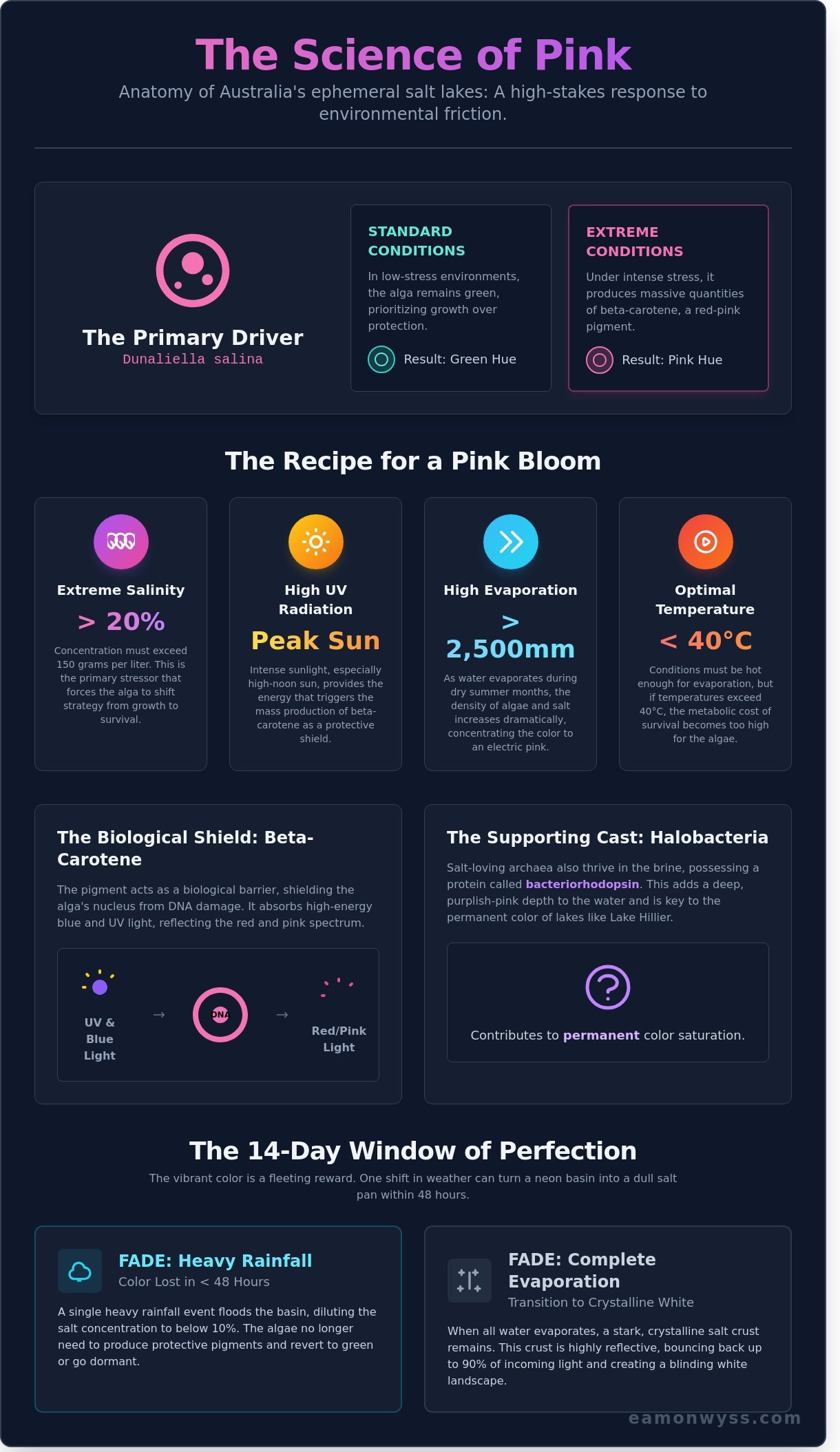
The primary driver is a single-celled green alga called Dunaliella salina. In standard conditions, it remains green. When salinity levels exceed 20 percent and light intensity peaks, the organism shifts its strategy. It produces massive quantities of beta-carotene to shield its nucleus from DNA damage. This pigment acts as a biological barrier. It absorbs high-energy blue and ultraviolet light, reflecting only the red and pink spectrum. It is a protective shield, not a decoration.
This process requires a precise chemical threshold. If the salt concentration drops below 150 grams per liter, the alga loses its edge. The color fades. If the temperature exceeds 40 degrees Celsius, the metabolic cost of survival becomes too high. The result is a landscape that demands perfection from every variable. One shift in weather patterns can turn a neon basin into a dull grey salt pan in 48 hours.
The Biological Mechanism of Carotenoids
The Australian sun is a relentless force. To survive, Dunaliella salina must prioritize protection over growth. Carotenoids serve as the ultimate sunscreen. They prevent the formation of reactive oxygen species that would otherwise destroy the cell's internal machinery. This is not the only player in the ecosystem. Halobacteria, or salt-loving archaea, thrive within the salt crusts. These organisms possess a protein called bacteriorhodopsin. It captures light energy to fuel their metabolism, adding a deep purplish-pink depth to the water. The famous Lake Hillier maintains its permanent color because these microorganisms remain trapped in a closed, high-salinity loop. Pink is the signal of an elite survivor refusing to yield to the outback heat.
This principle of a protective barrier against harsh elements is mirrored in high-performance marine technology. For vessels operating in similarly demanding saline environments, a non-toxic marine hull coating provides an engineered shield, ensuring durability and peak performance without harming the ecosystem.
This resilience is the standard for elite natural wellness. It’s why Australian brands at the top of their game, like Ripple & Wave, build their products around these principles of uncompromising adaptation.
Water Levels and Color Intensity
Color intensity is a function of evaporation. During the summer months, evaporation rates in Western Australia can exceed 2,500 millimeters per year. This concentrates the brine. As the water volume decreases, the density of Dunaliella salina and Halobacteria increases. This creates the "bloom" effect. The pink becomes electric. It is a visual representation of maximum concentration. Conversely, a single heavy rainfall event can destroy the visual impact instantly. Flooding dilutes the salt concentration to below 10 percent. The algae no longer need to produce protective pigments. They revert to green or go dormant. Predicting a peak bloom requires monitoring the intersection of three specific data points: evaporation rates, cumulative solar radiation, and current brine density. There is no room for error. You either meet the standard for the bloom, or you fade into the background.
The transition from a bubblegum pink to a stark, crystalline white occurs when the water evaporates entirely. The remaining salt crust reflects 90 percent of incoming light. This cycle is ephemeral. It demands your attention because it is temporary. In these pink salt lakes australia, the color is a fleeting reward for surviving a brutal environment. It is the result of organisms operating at the peak of their capacity under the most hostile conditions on the planet.
The Geographic Edge: Mapping Australia's Premier Pink Lakes
Geography is a baseline. Performance is a choice. When hunting for pink salt lakes australia, your location matters less than your timing. You don't just show up and expect a result. You monitor the salinity. You track the rainfall. You demand the right conditions. Australia’s terrain is brutal and unforgiving. It rewards the prepared and punishes the casual tourist. This isn't about a scenic drive; it's about identifying the specific coordinates where biology and chemistry collide to create something elite.
Hutt Lagoon and Lake Hillier (WA)
Western Australia sets the standard for scale. Hutt Lagoon spans 14 square kilometers. It isn't just a lake; it's a high-output factory for Beta-carotene. The pink here is aggressive. It’s industrial. If you want the edge, you fly over it. Seeing the grid-like ponds from 1,500 feet reveals the strategic precision of the landscape.
Lake Hillier on Middle Island is different. It offers no compromise. While other lakes fade, Hillier stays pink 365 days a year. It’s 600 meters of permanent pigment surrounded by a rim of white salt and dark green eucalyptus. Accessing this site requires a 120-minute flight from Esperance or a high-speed boat charter. The cost is high. The logistical friction is real. That is exactly why it remains a benchmark for the committed.
South Australia’s Pink Bucket List
- Lake MacDonnell: Located on the Eyre Peninsula. The Point Sinclair Road cuts through the water, creating a "watermelon" contrast. High salinity on one side, blue ocean on the other. It’s a visual representation of two worlds colliding.
- Lake Bumbunga: Efficiency matters. Located 130 kilometers from Adelaide, Bumbunga is the most accessible high-performance site. It changes from bubblegum pink to white to blue depending on the season’s standards.
- Kati Thanda-Lake Eyre: The ultimate high-stakes event. At 15 meters below sea level, it only fills fully a few times per century. The last major flood was in 2019. When the water hits the salt crust, the transformation is violent and brief. You don't wait for inspiration here; you wait for the data.
The Victorian Salt Lakes
The Mallee region demands a different level of focus. This isn't about the vastness of the desert; it's about the intricacy of the salt pans. Near Mildura and inside Murray-Sunset National Park, the textures are tactile and raw. Understanding Victoria's pink lakes requires an appreciation for the ephemeral. These sites are a masterclass in abstract geometry.
The salt crusts here create patterns that look like fractured glass or topographic maps of another planet. Capturing the uncompromising aesthetic of South Western Victoria requires you to look past the color and see the structure. It’s about the friction between the drying mud and the crystallizing salt. This is where the landscape stops being a background and starts being a challenge.
Success in these environments is never guaranteed. It's earned through observation and a refusal to accept mediocre light. If you want to witness the pink salt lakes australia at their peak, you must operate with the same discipline as the environment itself. Develop your eye for the uncompromising beauty of the edge and stop settling for the standard view.
The Aerial Perspective: Why the Ground View is Never Enough
Standing on the shore is a compromise. You see a flat horizon and stained mud. It's a low-resolution experience that masks the true scale of the landscape. To witness the reality of pink salt lakes australia, you must ascend. Height provides the Edge. At 100 meters, the chaotic reality of the shoreline vanishes, replaced by a sophisticated tapestry of mineral deposits and brine. The lake stops being a body of water. It becomes a canvas.
The ground view is a lie because it's limited by human biology. Aerial perspective eliminates the friction of the horizon. When you remove the sky, you're forced to confront pure form and color. This isn't about taking a picture of a lake; it's about capturing the soul of the terrain. From above, the scale shifts. What looked like a puddle on the ground reveals itself as a 500-meter fracture of crystalline salt. This perspective demands a higher standard of observation. It's the difference between looking at the world and actually seeing it.
Finding Abstraction in the Salt
Abstraction isn't an accident. It's a deliberate pursuit of the land's hidden narrative. Eamon Wyss looks for storytelling in the scars left by thousands of years of evaporation. These aren't just patterns; they're the biological and chemical history of the continent written in pink and white. You must identify the "paint-like" veins where the brine is densest. A standard landscape photo is a postcard. An abstract aerial print is a piece of fine art. One documents a location; the other captures a vibration. The goal is to isolate the texture until the viewer forgets they're looking at pink salt lakes australia and starts seeing a masterpiece of natural design.
The Technical Standards of Drone Art
Mediocrity is the default state of most drone users. They settle for snapshots. Elite aerial photography requires uncompromising discipline and a refusal to coddle the equipment. Out in the Australian outback, the environment is your primary adversary. You're operating in 45-degree Celsius heat with 20-knot winds that threaten your stability. Your gear must be professional-grade, or it will fail when the light is perfect. Consider these requirements for high-stakes capture:
- Light Management: You have a 15-minute window during the golden hour. Any later and the harsh sun washes out the delicate pink hues.
- Compositional Rigor: Move past the basic rule of thirds. Seek pure abstract symmetry or lead the eye through mineral "veins" that act as natural focal points.
- Zero Friction: Use ND filters to control the glare off the salt crust. Without them, your textures become a blown-out mess of white noise.
- Battery Intelligence: Heat drains power 30% faster. If you aren't managing your cycles, you'll lose the shot while the drone is in the air.
Standards over feelings. The desert doesn't care about your creative vision. It only responds to your preparation. Every flight is a high-stakes session where the margin for error is zero. You don't hope for a good shot; you engineer it through technical mastery and a refusal to accept the easy view. This is how you move from being a hobbyist to becoming a creator of elite visual assets.
Capturing the Ephemeral: The Art of Timing and Standards
The "Golden Hour" is a trap for the ill-informed. Most photographers cling to the soft light of sunset because it's forgiving. It's safe. For pink salt lakes australia, soft light is a tactical failure. You need the overhead sun. Between 11:00 and 14:00, the vertical light hits the brine with maximum intensity. It penetrates the shallow water and reflects off the white salt floor, saturating the beta-carotene produced by the Dunaliella salina algae. This is the edge. It's uncomfortable. It's blinding. It's the only way to capture the uncompromising neon hue that defines these landscapes.
Seasonal discipline is your primary filter. Summer heat isn't an obstacle; it's the catalyst. High evaporation rates increase salinity levels to over 35 percent. This is when the pink is most visceral. You're trading physical comfort for elite results. The ephemeral nature of these lakes means your shot is a one-time event. Wind, water levels, and light change by the minute. If you miss the window, it's gone. There's a heavy emotional weight to that reality. It demands a shift in standards. You don't leave when you're tired. You leave when the work is done. The physical toll is the price of entry. Standing in 42-degree heat for six hours is what separates the creators from the tourists.
The Best Time to Visit Pink Lakes
February is the elite choice for performance. By late summer, evaporation has peaked. The water is shallow. The salt is thick. If you arrive in June, you'll find a grey, flooded basin. Precision matters. Check the Bureau of Meteorology for recent rainfall. A single 12mm event can dilute the salinity and kill the color for three weeks. Use Sentinel-2 satellite data to verify the current hue before you commit to a 600-kilometer drive. Data eliminates the friction of uncertainty. It ensures your effort is directed toward a guaranteed outcome.
The Philosophy of the Shot
Waiting for the "Edge" requires a specific brand of patience. You're waiting for the wind to hit zero. When the surface tension holds, the pink salt lakes australia become a perfect mirror. This reflection creates a visceral reality that 99 percent of photos miss. Most images capture a color; they don't capture the depth. You need the salt-crust patterns to be sharp. This requires total stillness. It's taxing. Your feelings about the flies or the heat are irrelevant to the quality of the image. The lake doesn't care about your comfort. It only responds to your presence at the right moment.
- February: The elite window for peak color density.
- High Noon: The specific time for maximum UV penetration.
- 0km/h Wind: The requirement for a perfect mirror reflection.
- 35% Salinity: The chemical threshold for intense pigmentation.
Capturing these landscapes isn't about luck. It's about an uncompromising adherence to timing and environmental data. You're looking for the thin margin where biology and geology align. Most people settle for "good enough" and leave when the sun gets too hot. They miss the peak. They settle for mediocrity because the alternative is difficult. If you want the shot that no one else has, you have to be willing to do what no one else will. This is the reality of high-performance photography in the Australian outback.
From Landscape to Legacy: Bringing the Salt Lake into Your Space
A photograph captures a fleeting moment; a Limited Edition Print establishes a permanent standard of living. Your environment is the silent architect of your performance. Mediocrity thrives in cluttered, uninspired spaces. Excellence demands a focal point that reflects an uncompromising vision. When you bring an aerial perspective of the pink salt lakes australia into your office or home, you aren't just hanging art. You're installing a reminder of scale, clarity, and the value of a high-altitude view. This is about more than aesthetics. It's about the psychological edge that comes from surrounding yourself with elite representations of the natural world.
High achievers don't tolerate friction in their workflows or their surroundings. Abstract aerial art provides a necessary mental reset. It strips away the noise of the literal world and leaves only the raw, essential patterns of the earth. Investing in these landscapes is a strategic move. Scarcity is the ultimate currency in art. By securing a piece from a limited run, often restricted to just 10 or 25 prints, you're acquiring a diminishing asset. The landscape changes every season; these prints preserve a version of the outback that may never look the same again. It's a legacy of the land, captured from 400ft and delivered with surgical precision.
Curating Your Collection
Choosing your medium is a tactical decision. It isn't about what looks "nice." It's about the room's mission. Canvas offers a rugged, tactile presence that commands attention in high-traffic areas. Fine art paper provides the surgical sharpness and depth required for spaces dedicated to deep focus and strategy. The Mildura Arts Centre collection serves as a benchmark for this level of storytelling. These works resonate with high-performers because they mirror the complexity of high-stakes decision-making. There's no room for ambiguity in these frames. Every salt crust and mineral vein is a result of extreme environmental pressure, reflecting the discipline required to reach the top of any field.
Wearable Art: The Silk Scarf Revolution
The transition from a 400ft aerial view to Salt Lakes in Silk represents a move toward functional excellence. We've taken the visual intensity of the pink salt lakes australia and translated it onto 100% premium silk. This isn't a mere accessory; it's a tactile revolution. We use 12 momme silk to ensure the fabric carries the weight and durability expected of a luxury piece. The vibrant, mineral-rich hues are reproduced with 98% color accuracy, ensuring the visual impact of the outback remains intact.
- Tactile Intensity: Experience the friction between raw outback grit and refined silk luxury.
- Elite Standards: Each scarf is a wearable version of a high-altitude mission, designed for those who reject the ordinary.
- Versatile Styling: Drape a piece of the Australian landscape over a tailored blazer to signal a connection to the land and a commitment to high-level aesthetics.
Style is a choice. Carrying a piece of the Australian landscape requires a rejection of fast fashion. It's an investment in quality that mirrors your professional standards. When you wear these colors, you carry the story of the outback's resilience. You aren't just following a trend; you're setting a new benchmark for what wearable art can be. Don't settle for mass-produced items that offer no connection to the source. Demand the edge that only raw, unfiltered nature can provide.
Command the Absolute Horizon
The raw chemistry of pink salt lakes australia demands more than a casual glance. It requires a total shift in perspective. You've learned that 100% of ground-level views fail to translate the complexity of these salt crusts. Only an aerial view, captured at a 90-degree vertical angle, reveals the uncompromising geometry of the land. This isn't about luck. It's about the 1% of timing where salinity and light converge to create a masterpiece. Mediocrity is easy. Capturing the elite edge is work.
My Abstractions Collection, recently featured in the Mildura Arts Centre, brings this discipline to your walls. These are limited edition, museum-grade captures printed on 100% archival materials. We provide worldwide shipping to ensure global collectors can secure these rare views. Stop looking at the noise. Start focusing on the clarity of a high-performance landscape. Your space reflects your standards. Make them elite.
Explore the Uncompromising Beauty of the Abstractions Collection
The edge is waiting for you.
Frequently Asked Questions
When is the best time of year to see pink salt lakes in Australia?
Visit between October and January for peak saturation. High evaporation rates during these 4 months increase salinity. This creates the optimal chemical environment for the pink hue. Don't waste your time in mid-winter. Rain dilutes the salt and kills the visual impact. You want the edge of summer when temperatures hit 30 degrees. Precision matters when chasing these pink salt lakes australia offers. Timing is the difference between an elite view and a dull one.
Why are some pink lakes in Australia turning white or green?
Salinity levels dictate the color. When rainfall exceeds 50mm in a single month, the salt concentration drops below 20 percent. The Dunaliella salina algae stops producing beta-carotene. It turns green. If the lake dries out completely, you're left with a white salt crust. It's binary. The environment either meets the standard for pink or it doesn't. Biology doesn't care about your travel schedule. It only responds to the data of the water.
Can you swim in the pink salt lakes?
You can swim, but it's often a poor decision. Salinity levels often hit 300 grams per liter, which is 10 times saltier than the ocean. It's abrasive. Sharp salt crystals at the bottom will cut your feet. Most lakes, like Hutt Lagoon, are less than 1 meter deep. It's a shallow brine. Focus on the visual. Don't let a search for a photo op compromise your skin or the lake's ecosystem. Standards over feelings.
Which pink lake is closest to Melbourne?
Westgate Park is the closest, located just 5 kilometers from Melbourne's CBD. It turns pink during high-temperature periods when evaporation is peak. This usually happens in February. If you want a more rugged experience, drive 4 hours to Lake Tyrrell near Sea Lake. It covers 20,830 hectares of salt crust. Choose your level of commitment. The city lake is for convenience; the Mallee is for those seeking the edge of the map.
What causes the pink color in Australian salt lakes?
The color is a survival mechanism. Dunaliella salina algae produce beta-carotene to protect themselves from intense UV radiation. This combines with Halobacteria in the salt crust. These organisms thrive when salinity is high and light is intense. It's a masterclass in extreme adaptation. These pink salt lakes australia hosts are biological engines operating under extreme pressure. They don't just exist; they dominate their environment through chemical resilience. Success is written in their DNA.
Is it legal to fly a drone over Australia's pink lakes?
You can fly, but you must follow the standards. CASA regulations require you to stay below 120 meters and at least 30 meters away from people. Many lakes sit in National Parks, which require a $150 commercial permit in Western Australia. Don't be an amateur. Check the specific park's 2024 management plan before launching. Failure to comply results in heavy fines. Professionalism requires preparation and respect for the rules of the airspace.
How do I get to Lake Hillier in Western Australia?
Access to Lake Hillier is restricted to air or sea. The lake sits on Middle Island, 11 kilometers off the coast of Esperance. You cannot land on the island itself. Book a 1.5-hour scenic flight or a high-speed boat tour. It's an investment in a rare perspective. Most people settle for ground-level views at other sites. The elite choose the aerial view to see the 600-meter-long lake against the blue Southern Ocean.
What is the difference between Lake MacDonnell and Hutt Lagoon?
Geography and utility set them apart. Lake MacDonnell is in South Australia, famous for the "Watermelon Avenue" road that splits the lake. Hutt Lagoon is in Western Australia and spans 14 kilometers. BASF uses Hutt Lagoon to harvest 20 percent of the world's natural beta-carotene. One is a visual icon for photographers; the other is a high-performance industrial asset. Choose your destination based on the specific result you want to achieve.
Leave a comment