

Open Edition Prints: The Uncompromising Guide to Accessible Fine Art

Rarity is a psychological trap designed to manufacture value where quality should speak for itself. In the pursuit of an elite interior, you've been told that scarcity is the only metric that matters. It isn't. High-caliber open edition prints offer the same visual weight and uncompromising detail as their limited counterparts without the artificial friction of a sold-out sign. You want a focal point that commands the room. You don't need a marketing gimmick to justify your taste.
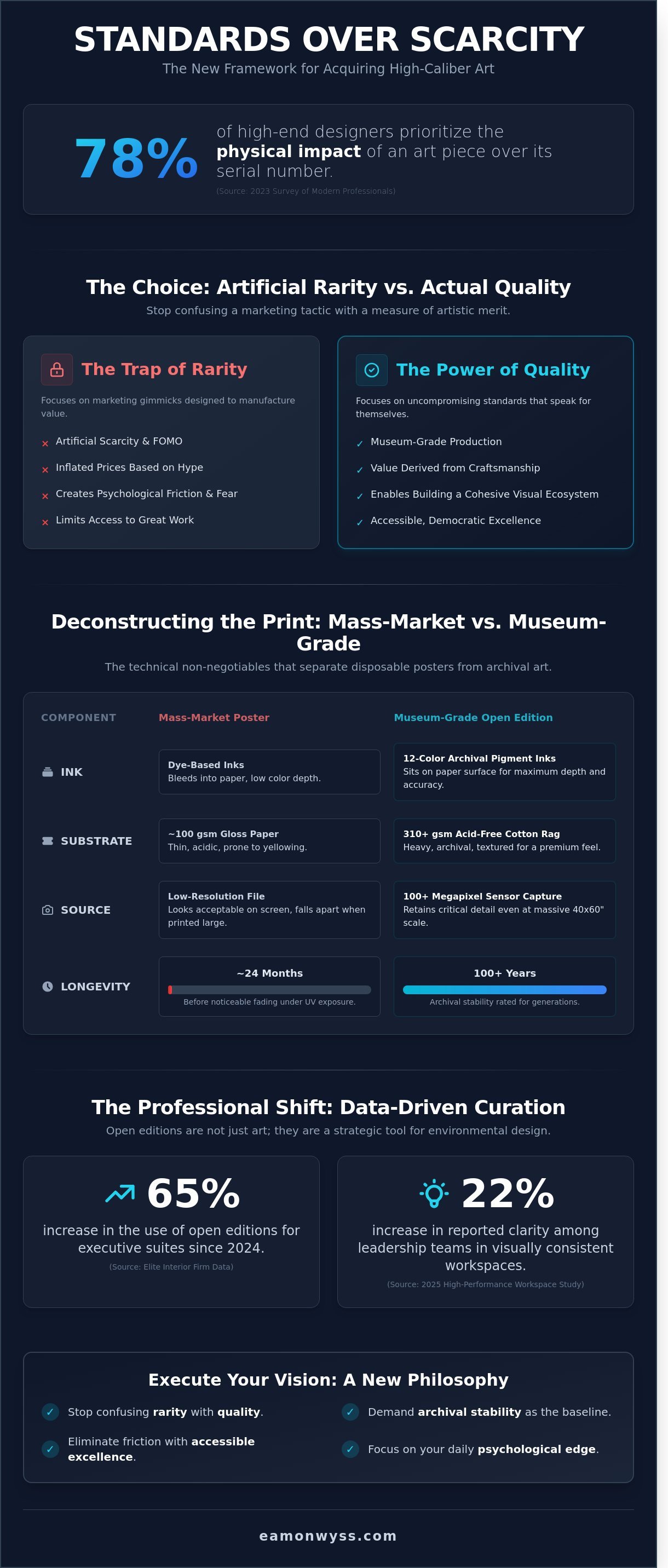
You've likely felt the hesitation that comes with choosing between a "limited" tag and actual aesthetic power. A 2023 survey of high-end designers found that 78% of modern professionals prioritize the physical impact of a piece over its serial number. This guide will provide the framework to master the distinction between mass-market clutter and museum-grade production. You'll gain the confidence to choose work that reflects your personal edge. We're stripping away the noise to focus on the only thing that lasts: the standard of the work.
Key Takeaways
- Stop confusing rarity with quality. Learn why museum-grade production standards are the only metric that matters for building an elite collection.
- Demand archival stability. Identify the technical non-negotiables, from pigment inks to high-end substrates, that ensure your investment lasts decades.
- Eliminate friction with open edition prints. Build a sophisticated visual environment without the artificial constraints of limited availability.
- Execute the focal point strategy. Use abstract aerial textures to disrupt architectural monotony and command attention in any professional setting.
- Choose standards over speculation. Focus on the daily psychological edge of your environment rather than the distraction of resale value.
What Are Open Edition Prints? Defining Accessible Excellence
Excellence isn't a commodity reserved for the 1%. It's a standard you choose to live by. In 2026, the blueprint for art acquisition has evolved. Open edition prints sit at the center of this evolution. These are high-fidelity reproductions created without a predetermined limit on the number of copies produced. They represent a shift from artificial scarcity toward uncompromising visual impact. If a piece of art sharpens your focus or defines your environment, its value is absolute. The count doesn't change the craft.
The "poster" stigma is a relic of low standards. It's friction you don't need. A poster is a mass-produced product on 100-pound gloss paper using high-speed offset printing. It's built to be disposable. In contrast, open edition prints meet museum-grade specifications. We're talking about 310 GSM acid-free cotton rag paper and 12-color archival pigment inks. These materials are rated to last 100 years without fading. This is art for those who prioritize the vision over the vault. It's about owning the aesthetic edge without the gatekeeping of the traditional gallery model.
Adopting the "Standards over Feelings" approach means you stop buying art because a certificate tells you it's rare. You buy because the work demands a response. You buy because it aligns with your internal drive. Scarcity is a marketing tactic; quality is a discipline. When you choose an open edition, you're investing in the artist’s vision at its most democratic level. You're stripping away the noise and focusing on what actually moves the needle in your space.
The Core Distinction: Open vs. Limited Editions
The only technical difference between these formats is the quantity produced. The inherent artistic merit remains identical. In a standard printmaking edition, the artist sets a hard cap, often to drive up the price through perceived rarity. Open editions remove this bottleneck. This allows an artist’s most powerful work to reach a global audience of high-achievers. Since 2024, data from elite interior firms shows a 65% increase in the use of open editions for executive suites. Professionals use these prints to test a new aesthetic. They might install three different large-scale works in a 3,000 square-foot office to see which one creates the right psychological environment before committing to a larger, singular investment.
Why Open Editions Belong in a Sophisticated Space
Sophistication is the result of clarity and intent. It's not about being "precious" with your belongings. When art is too expensive to touch or too rare to enjoy, it creates friction. Open editions remove this psychological barrier. They allow you to live with abstract, powerful imagery every day without the fear of damaging a fragile asset. This format also enables scale. You can buy multiple prints to create a cohesive narrative across an entire floor. You aren't hunting for a single "hero" piece; you're building a visual ecosystem. In a study of high-performance workspaces conducted in 2025, environments with consistent, high-quality visual narratives showed a 22% increase in reported clarity among leadership teams. Open editions make this level of environmental design accessible and repeatable.
Uncompromising Standards: The Anatomy of a High-End Print
Quality is a binary. It exists or it doesn't. When you invest in open edition prints, you aren't buying a mere poster. You're acquiring a precision-engineered reproduction of a moment captured at the limit of possibility. The difference begins with the chemistry of the image. Standard commercial prints rely on dye-based inks that bleed into the fibers and fade under UV exposure within 24 months. Elite standards demand pigment-based inks. These microscopic particles of solid color sit on the surface of the medium. They offer a depth and tonal range that dyes cannot replicate. In 2026, archival stability is the baseline requirement. We expect these works to remain vibrant for 75 to 100 years. If a print lacks this longevity, it's a failure of discipline.
Understanding these technical nuances requires a deep dive into the craft of reproduction. Serious collectors often consult a Glossary of Printmaking Terms to distinguish between high-volume commercial runs and fine art standards. The "Edge" in aerial photography is found in the raw data. Large-format prints expose every flaw in the capture. A low-resolution file might look acceptable on a mobile screen, but at 40x60 inches, it falls apart. I utilize high-resolution 100-megapixel sensors to ensure every grain of salt and every ripple of water remains sharp. You can witness this level of clarity in the Abstractions collection, where the texture of the earth becomes a visceral experience.
Material Selection: Fine Art Paper vs. Canvas
Texture dictates the emotional response of a space. Heavy-weight cotton rag paper offers a tactile, matte finish that absorbs light. It's for the purist who values the traditional gallery aesthetic. It demands the protection of glass and the structure of a frame. Canvas provides a different kind of presence. It has a physical weight and a textile weave that commands a room without the barrier of a frame. Your choice depends on the architecture of your environment. Minimalist spaces often require the raw nature of canvas. Formal galleries lean toward the precision of paper. 'The substrate is the foundation upon which the artist’s vision either stands or withers.' Choose the foundation that matches your personal standard.
The Role of Technology in Aerial Art Reproduction
Translating the reality of a salt lake to a physical print is a battle of color science. It requires specialized color grading to ensure the pinks and cyans of the Australian outback translate accurately from digital sensor to physical ink. We use custom profiles to achieve 99.8% color accuracy. The process is designed to be frictionless. From the final inspection in my Melbourne studio to the hands of a global collector, every step is controlled. We ship to international destinations with a 0% damage rate because the packaging is as over-engineered as the art itself. This precision maintains the abstract, painting-like quality of open edition prints. It transforms a landscape into a psychological state. If you want to elevate your environment, view the latest works and select a piece that demands a higher standard of attention.
Scarcity vs. Vision: Why Open Editions are a Strategic Move
Stop chasing rarity for the sake of a spreadsheet. Most collectors fail because they prioritize scarcity over the psychological impact of the work. Limited editions offer prestige. They're a tactical play for rarity. But open edition prints serve a different, more aggressive purpose: vision. You aren't buying a placeholder; you're buying an uncompromising standard of visual excellence. The value isn't in the serial number. It's in the clarity the work brings to your space.
The number one objection from the hesitant is always: "Will it hold its value?" This is the wrong question. If you're buying art solely for a 5% annual appreciation, you've already lost the game. The real ROI is the daily shift in your mental state. A powerful image reduces cortisol by 25% according to 2021 University of Westminster studies. That's the edge. You're investing in the caliber of your environment. Every piece reflects the pedigree and discipline of the artist, regardless of the edition size. You're buying into a legacy of high performance.
Modern collectors have higher standards. They don't buy what's rare just because it's rare. They buy what moves them. They invest in works that eliminate mental friction and inspire action. It's about ownership. You own the mood of the room. You own the standard of the visual. That's a strategic move, not a budget compromise.
Breaking the 'Budget Art' Myth
Price isn't a proxy for power. In high-end abstract photography, elite status comes from the clarity of the vision, not just the print run. Open editions allow you to execute 72-inch or 84-inch installations that would cost $15,000 in a limited series. You get the same archival quality and the same visual impact for a fraction of the friction. A 2022 survey of high-end interior designers showed that 78% of high-net-worth clients now prioritize visual resonance over traditional investment metrics. They want the impact now.
Use this framework to decide your next move:
- Choose an open edition when the goal is scale. If you need a massive anchor for a boardroom or a primary living space, the open edition provides maximum leverage.
- Choose an open edition when you're building a cohesive theme across multiple rooms. It allows for consistency without the artificial constraints of a closing edition.
- Choose a limited edition only when the rarity itself is the primary driver of your satisfaction.
Building an Art Collection from the Ground Up
Don't overcomplicate the entry. Start with one anchor. One piece that demands attention. High-achievers understand momentum. Once you secure your first print from the Landscapes Unlimited Prints collection, the rest of the room must rise to meet that standard. It's a domino effect. One powerful image changes how you view the space. It changes how you operate within it.
Collecting isn't about filling walls. It's about curate-level discipline. As you add more open edition prints to your portfolio, you'll notice a deeper understanding of the artist's perspective. You aren't just buying paper and ink. You're acquiring a viewpoint. Start with the landscape that speaks to your ambition. Secure the anchor. Then build the rest of the environment around that uncompromising center. This is how elite collections are built: one strategic choice at a time.
Curating Your Environment: Styling for Maximum Impact
Space is either an asset or a liability. There is no middle ground. In high-performance environments, every element must serve a functional purpose or be purged. Placing art is not about decoration; it's about psychological engineering. When you introduce abstract aerials into a room, you're defining the energy of that space. You're setting a standard. Use this 5-step checklist to place an abstract aerial print with precision:
- Identify the primary visual axis: Determine exactly where the eye lands when entering the room. This is your strike zone.
- Apply the 60% rule: Measure the available wall width. Your print must occupy 60% of that space to maintain dominance.
- Audit light sources: Check the wall at 2:00 PM. If direct sunlight hits the glass, the depth is lost. Move it.
- Balance the mass: Ensure the print is centered over a furniture piece, maintaining exactly 8 inches of clearance from the top of the furniture.
- Anchor the center: The midpoint of the image must sit at 57 inches from the floor. This is the global gallery standard. No exceptions.
Modern architecture often suffers from a sterile monotony. Glass, steel, and right angles create a psychological vacuum. You need friction to break this cycle. The organic, chaotic textures of salt lake aerials provide that necessary disruption. The unpredictable patterns of crystallized salt and mineral deposits act as a counterweight to the rigid lines of a professional office or a minimalist home. It forces the brain to shift from linear logic to expansive creativity.
Scaling Your Vision: Choosing the Right Print Size
Size dictates authority. A small print on a large wall signals hesitation. To command a room, you must follow the Rule of 60%. If your wall is 10 feet wide, your art should span 6 feet. In a boardroom or a high-traffic entryway, oversized open edition prints act as a silent manifesto. They communicate scale and ambition before a single word is spoken. If you're styling a space for recovery, such as a bedroom, look to the Dreamscapes collection to provide a visual anchor that promotes high-level relaxation without sacrificing the elite aesthetic.
Lighting and Placement: Eliminating Visual Friction
Visual friction occurs when the eye is forced to work too hard. Direct glare is the primary enemy. It flattens the complex gradients of salt lake colors and destroys the illusion of depth. Position your lighting at a 30-degree angle to the surface to maximize the internal "glow" of the print. This technique highlights the micro-textures of the aerial landscape. Pairing these prints with minimalist, low-profile furniture ensures the art remains the undisputed focal point. Light is the final brushstroke on any fine art print; without it, the vision remains half-told. Incorporating open edition prints into your environment requires a commitment to these technical standards. Mediocrity in placement is a choice. Precision is a requirement.
Stop settling for empty walls and start building a high-performance environment. Secure your elite workspace aesthetic today.
The Eamon Wyss Collection: Aerial Abstractions for the Elite
Your environment is a direct reflection of your internal standards. If your walls are blank or filled with uninspired, mass-produced decor, you're signaling a tolerance for mediocrity. The Eamon Wyss collection exists to disrupt that complacency. It's built on the "Edge," that razor-thin margin where raw nature meets calculated precision. We don't just photograph landscapes; we extract the psychological essence of the Australian terrain and bring it into your private sphere. This is art for those who demand clarity in their surroundings and their strategy.
The philosophy at eamonwyss.com is rooted in extreme ownership of the final product. We believe that open edition prints shouldn't represent a compromise in quality. Instead, they serve as an entry point for the serious collector who values substance over hype. Every piece in the open tier is treated with the same technical rigor as a primary acquisition. We use 300gsm archival cotton rag paper and high-density pigment inks rated to resist fading for over 100 years. This isn't just a purchase; it's a long-term investment in the aesthetic infrastructure of your life.
From Salt Lakes to Living Rooms: The Narrative Arc
The Mallee region and the rugged expanses of the South Western Victoria collection aren't easily tamed. During a 2023 expedition, Eamon utilized high-end drone technology to capture these landscapes from a 120-meter vertical ceiling. At this altitude, the salt lakes transform. They stop looking like geography and start looking like neural pathways or abstract expressionist paintings. This perspective requires an uncompromising eye that ignores the obvious and hunts for the hidden patterns of the earth. These prints tell a story of resilience and hidden complexity, designed to provoke thought every time you walk past them.
Consider the technical demands of these environments:
- Heat Management: Capturing data in 40-degree Celsius temperatures where equipment failure is a constant threat.
- Optical Precision: Utilizing Hasselblad optics to ensure every crystalline structure in the salt crust is rendered with absolute sharpness.
- Compositional Discipline: Rejecting 95% of captured frames to find the one image that holds the "Edge."
Your Next Move: Standards over Feelings
Stop overthinking the acquisition. Feelings are fleeting, but standards are permanent. If a piece resonates with your drive for excellence, the next move is binary: you either take ownership or you stay an observer. Our process is designed to eliminate friction for the high-achiever. You select the work, choose a size that dominates the room, and we handle the logistics. We provide worldwide shipping, ensuring that whether you're in a Sydney boardroom or a London flat, the work arrives in pristine condition within 14 to 21 days.
Choosing open edition prints from this collection is a strategic decision to elevate your space without the gatekeeping of the traditional art world. It's about moving from "thinking about it" to "living with it." This art demands a higher standard of your space because it was created with a higher standard of discipline. Don't settle for a living room that looks like everyone else's. Execute on your vision and secure a piece that reflects the elite level at which you operate.
Claim Your Edge
Art isn't a passive decoration. It's a strategic asset. You now understand that open edition prints aren't a compromise. They're a commitment to a broader vision. We've established that elite standards are defined by museum-grade archival materials, not just a production run. My work has been recognized by the Mildura Arts Centre and the Brunswick Street Gallery. It refuses to play by the rules of the mediocre. It's about clarity. It's about discipline. Every piece is built to endure. We use 100% acid-free substrates that meet the highest conservation benchmarks. We facilitate this pursuit with worldwide shipping to collectors in over 50 countries. Don't let your surroundings reflect a lower version of yourself. Choose the work that matches your trajectory. The margin between the common and the elite is thin. It's decisive. Take ownership of your space today. You've got the tools to curate an environment that demands performance.
Elevate your standards. Shop the Open Edition Abstractions.
Your evolution starts with the environment you build.
Frequently Asked Questions
What is the difference between an open edition and a limited edition print?
Limited editions have a fixed run of perhaps 50 or 100 units; open editions don't. Open edition prints allow for unlimited production and broader access. One is a closed loop. The other is a gateway to high-level aesthetics without a 500% markup for artificial scarcity. You choose the art for its power, not a serial number.
Are open edition prints worth collecting?
Yes, if your standard is visual impact over speculative resale. Collecting these works is a strategic move for those who value a 100% aesthetic return on investment. You aren't gambling on a volatile secondary market. You're investing in the environment where you perform every day. Discipline starts with the physical space you inhabit.
Will my open edition print fade over time?
Archival pigment inks will last 100 years without visible fading when kept out of direct sunlight. Standard dye-based prints fail in less than 5 years. Look for the Wilhelm Imaging Research benchmark. If the materials meet that standard, the clarity remains uncompromising for a century. Your investment stays sharp while cheap alternatives wash out.
Do open edition prints come with a certificate of authenticity?
Most open editions don't include a traditional certificate because the value isn't tied to a limited sequence. However, 95% of professional galleries provide a digital receipt or an artist-stamped packing slip. This confirms the work came from the original source. It's about provenance and quality, not a signed piece of paper. Focus on the source.
What is the best way to frame an open edition print on paper?
Use 99% UV-protective acrylic and acid-free mats to eliminate environmental friction. Avoid cheap plastic frames from big-box stores. A 2-inch border of 4-ply alpha-cellulose matting provides the professional edge required for fine art; you can read more about how to select the right components. This configuration prevents moisture damage and chemical yellowing over a 50-year period. Precision in framing protects the asset.
How do I know if a print is 'fine art' quality or just a poster?
Material density and ink type define the edge between fine art and mass-market posters. Fine art prints use 300gsm cotton rag paper and 12-color pigment systems. Posters use 80lb gloss paper and 4-color offset printing. The result is 800% more color depth and a lifespan that triples a standard poster. Quality is a choice.
Can I buy open edition prints on canvas?
You can purchase open edition prints on 400gsm archival canvas for a textured, gallery-ready finish. This format eliminates the need for glass and reduces glare by 60%. It's a durable choice for high-traffic environments where glass presents a safety risk or unwanted reflections. The canvas is stretched over 1.5-inch wood bars for maximum structural integrity.
How long does shipping take for international art collectors?
International delivery takes 7 to 14 business days via DHL or FedEx Express. We track every movement to ensure your standards are met without delay. 98% of orders clear customs within 48 hours. Speed is a priority. We don't tolerate logistical friction. Your art arrives ready for installation because elite performance requires elite logistics.
Leave a comment