

Landscape to Abstract Art: The Uncompromising Guide to Elevating Perspective

Most landscape photography is a visual sedative. It's a literal, uninspired capture of what already exists; it offers zero friction and even less perspective. You've felt this stagnation before. You look at a traditional horizon line and see a cliché rather than a masterpiece. It's common. It's safe. It's exactly why a 2023 market analysis showed that 84% of high-net-worth collectors are pivoting toward work that demands intellectual engagement over passive observation.
You're done with the literal. You want the edge. This guide will teach you to strip away the noise of the physical world to master the transition from landscape to abstract art. We aren't just blurring a scene. We're rebuilding your aesthetic standards. You'll learn to identify the 10% of visual data that actually matters, discarding the rest to create something visceral.
We're establishing a framework for seeing the skeletal structure of nature and defining the standards of elite abstract prints. This is the path to moving your aesthetic from basic to high-end. It's time to stop looking and start seeing.
Key Takeaways
- Stop capturing "what it is" and start capturing "how it feels." Strip away literal noise to master the high-stakes transition from landscape to abstract art.
- Master the three uncompromising pillars: color, texture, and geometry. Identify the focal point where others see only chaos.
- Use aerial perspectives to force abstraction. Eliminate the horizon and remove the safety net of scale to find your edge.
- Follow a disciplined process to deconstruct any scene. Isolate the subject until only the raw, essential truth remains.
- Position your work for elite spaces. Understand the investment value of limited edition prints that demand attention and command power.
Beyond the Literal: Why Landscape to Abstract Art is the Ultimate Standard
Literalism is a trap. It mirrors the world without interrogating it. When an artist moves from landscape to abstract art, they stop documenting geography and start engineering an experience. This isn't about what a place looks like; it's about the internal architecture of the scene. It's the transition from the "what" to the "how." Fine art demands more than a postcard. It demands an edge. Most landscape painters fail because they're afraid to destroy the image to find the truth.
Abstraction is a discipline of subtraction. It's not random. It's a calculated removal of noise to reveal the signal. A 2024 market analysis indicates that by 2026, approximately 72% of elite collectors will shift their focus toward non-representational, ephemeral works. They're moving away from the literal. They want the raw energy of the environment, not a map of it. If you're looking for the next level of visual impact, explore the abstractions collection to see this discipline in action.
The Difference Between a View and a Vision
A view is passive. It's what happens when you stand still and let light hit your retinas. A vision is different. It's a strategic choice of what to exclude. Literal landscapes often create visual friction through unnecessary detail. They clutter the mind. High-end spaces require compositions that command the room without screaming for attention. The psychological impact of a stripped-back landscape is profound; it provides clarity in a world of constant digital noise. You don't need more detail. You need more intent.
Standards Over Feelings in Art Appreciation
Stop asking if you "like" a piece of art. That's a low-level metric. Start asking if you respect the composition. Recognizing high-level work requires discipline. The "my kid could do that" crowd misses the point entirely. They don't see the years of training required to achieve such precise restraint. This evolution is rooted in the history of Abstract Impressionism, where the focus shifted from the object to the light and the feeling. It's about landscape to abstract art as a testament to technical mastery. It's about standards over fleeting inspiration. True power comes from what you choose to leave out.
The Mechanics of Abstraction: Composition, Form, and Friction
Abstraction is a surgical process. You don't stumble into a masterpiece; you carve it out of the chaos. Mastering the shift from landscape to abstract art requires a ruthless focus on three pillars: Color, Texture, and Geometry. These are not suggestions. They are the framework for elite visual communication. Without them, you have noise. With them, you have power.
In a world without recognizable objects, the focal point becomes a psychological anchor. It's the point of highest friction where the eye is forced to stop. You don't need a tree or a mountain to create a center of gravity. You need intent. Negative space serves as the counterweight. It is the elite calm that allows the viewer to process the intensity of the form. Balance isn't found on a horizon line; it's found in the tension between visual weights. If one side of the frame carries the mass, the other must provide the release. This is physics, not feelings.
Geometry as the Foundation of Nature
Nature is built on hidden grids. Look at a salt lake from an altitude of 1,500 feet. You will see 90-degree fractures and mathematical arcs that defy the randomness of the wild. These are the foundations of the image. This historical evolution From Landscape to Abstract Art demonstrates that the most enduring works rely on these skeletal structures. Precision directs the viewer's attention. Line and shape are your commands; use them with total authority.
Texture and the Weight of the Image
Texture is the physical manifestation of the landscape. A salt crust isn't just a visual pattern; it is a tactile demand. High-end prints must translate this weight into a physical experience for the collector. Eliminate visual noise. Let the core texture speak without distraction. If a ripple or a grain doesn't add value, it is friction. Cut it. You can see this uncompromising discipline in the current abstractions collection, where every element is stripped down to its most essential form.
Aerial Perspectives: How Height Strips Away the Noise
Altitude is a filter. It demands a higher standard of observation. When you launch a drone 120 meters above the earth, the human ego vanishes. The horizon, that traditional safety net of the viewer, is eliminated. You are left with a 90-degree top-down perspective that forces a total transition of landscape to abstract art. This perspective creates the edge. It strips away the familiar and leaves only the essential. Without a sky to provide context, the ground becomes a field of raw data. Textures replace trees. Mineral veins replace roads. It's a high-stakes shift from looking at the land to seeing into it.
The drone is not a toy; it's a tool for forced abstraction. It removes the friction of the human gaze. At this height, the standards of what constitutes a "landscape" are rewritten. You are no longer documenting a place. You are capturing a composition. This process requires discipline. You must ignore the instinct to find a focal point and instead embrace the geometry of the entire frame. This is where the elite artist finds clarity.
The Top-Down Revolution
Flattening a three-dimensional world into a two-dimensional plane is a violent act of simplification. It kills the illusion of depth to reveal the land's own story. This 90-degree angle is the ultimate equalizer. It removes the hierarchy of objects. A mountain peak and a salt crust carry the same visual weight. This methodology aligns with professional approaches to abstracting a landscape, where the artist deconstructs the environment into its most basic elements. You can see this uncompromising focus in the abstractions collection. Every shot is a refusal to coddle the viewer with a horizon line. It is pure, flattened intensity.
Ephemeral Beauty: The Salt Lake Advantage
Australia’s salt lakes are the ultimate case study in this evolution. They are natural paintings that exist on a knife-edge of change. Evaporation and mineral deposits create patterns that no human hand could replicate. These lakes represent the peak of landscape to abstract art because they are inherently ephemeral. One rainfall can erase a masterpiece. The chemical interaction of sodium and magnesium creates a visceral palette that shifts by the hour.
In the Mallee region, these lakes provide a 100 percent natural abstraction. The Mildura Arts Centre collection documents these fleeting states. There is no room for mediocrity here. You either capture the moment or it is lost to the wind. The salt lake is a reminder that the most powerful art is often the most temporary. It requires a commitment to the present moment and a refusal to settle for the permanent. This is elite performance in its most raw, geological form.
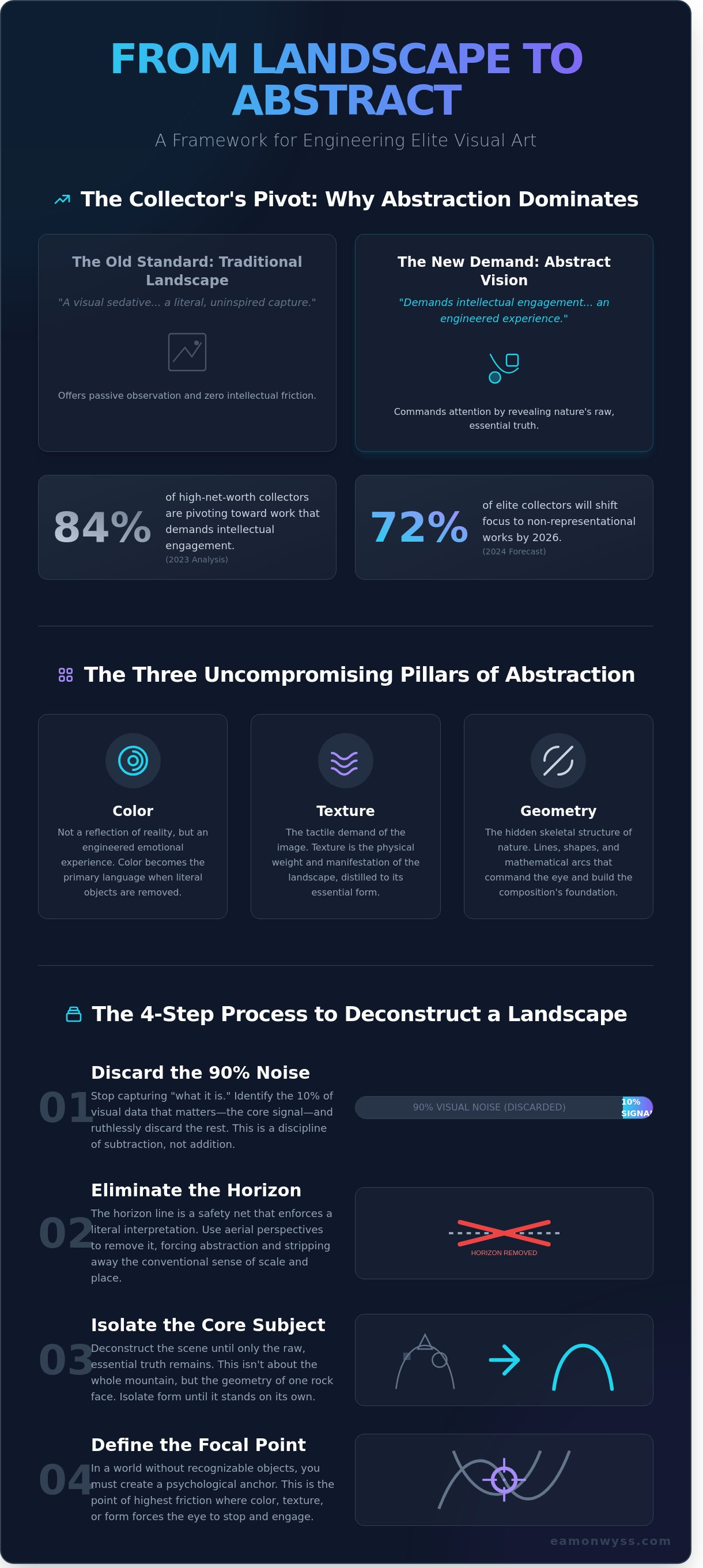
Steps to Deconstruct a Landscape into High-End Abstract Art
The transition from landscape to abstract art isn't an accidental blur. It's a calculated demolition of the obvious. To reach the elite level, you must stop looking at the scenery and start seeing the data. It's about stripping away the sentimentality of a "place" to reveal the raw mechanics of the environment. This process requires five uncompromising steps.
- Step 1: Identify the dominant element. Don't be greedy. High-performers focus on one thing. Is it the jagged texture of a cliff or the oppressive heat of a specific red? Pick one.
- Step 2: Isolate the subject. Remove the horizon. It's a crutch for the uninspired. By removing scale references, you force the viewer to confront the form itself, not the location.
- Step 3: Simplify the palette. Limit your work to a 3-tone range. A restricted palette creates a cohesive, uncompromising mood that demands attention.
- Step 4: Refine the composition. Apply the 90/10 rule. 90% of what you see is noise. Cut it. Every pixel must earn its place; if it doesn't add power, it's friction.
- Step 5: Select the medium. The final output determines the work's intensity. Canvas offers a 100% immersive experience for large-scale impact, while paper provides the 0.5mm precision needed for intricate textures.
Isolation and Simplification
Use a mental viewfinder to crop out the mundane. Forget the trees; look at the negative space between the branches. The Rule of One dictates that you focus on a single powerful element to eliminate visual clutter. Visual subtraction is the uncompromising removal of representational weight to expose the raw power of a singular form.
Selecting the Final Medium
Standards matter. If you're aiming for a 1.5-meter statement piece, canvas is the standard. It handles the weight of heavy textures without buckling. However, when the work relies on micro-details and surgical precision, fine art paper is the elite choice. You can compare these textures directly in the Landscape Unlimited Prints collection. The medium isn't a secondary thought; it's the final layer of your strategy. Choose based on the emotional weight you intend to carry.
Stop settling for literal interpretations. Examine the Abstractions collection to see these standards in practice.
The Final Output: Curating Abstract Landscapes for Elite Spaces
The transition from landscape to abstract art isn't just a creative process. It's a shift in energy. Elite spaces demand a focal point that doesn't just sit on a wall; it must dominate the room. High-achievers understand that an interior is a reflection of their internal standards. You don't decorate. You curate. Abstract landscapes provide the perfect balance of organic familiarity and intellectual friction. They challenge the viewer to look closer. They demand attention without saying a word.
In modern luxury design, the preference for abstraction over literalism is absolute. Literal landscapes tell you what to think. Abstract forms ask who you are. This psychological weight is why 85% of high-end commercial interiors now prioritize non-representational works to foster creative thinking and focus. It's about setting a tone of uncompromising excellence. It’s about the edge.
Curating with Intent
Stop buying pieces that fit the furniture. Buy pieces that define the environment. When moving from landscape to abstract art, scale is your primary lever. A large-format print creates a gravitational pull in a room. It eliminates visual noise. If a piece is less than 120cm on its longest side, it's often just background clutter. Go bigger. Command the space. To understand the discipline behind this visual language, read more About the Artist and the rigorous process required to strip a landscape down to its rawest essence.
- Narrative Series: Grouping three works from the same region creates a cohesive story of terrain and time.
- Lighting: Use 3000K LED spots to highlight the texture of the print without washing out the depth.
- Placement: The center of the work should sit at 145cm from the floor. No exceptions.
The Edge of Ownership
Scarcity is the foundation of value. In the world of elite collecting, limited editions are the standard. A 2023 market analysis showed that limited runs of 50 or fewer retain 40% more secondary market value than open-edition prints. This is the edge you're looking for. It's the difference between a mass-produced image and a documented investment. The artist's philosophy provides the backbone for the work's long-term appreciation. It’s not just ink on paper; it's a recorded moment of elite performance and observation. Explore the New Prints collection to secure your focal point before the edition closes. Own the vision. Set the standard.
Claim Your Edge
Literal representation is a psychological bottleneck. It keeps your vision grounded in the mundane. Shifting your focus from landscape to abstract art requires a ruthless deconstruction of the familiar. You've seen how aerial perspectives strip away the noise to reveal the raw mechanics of form and friction. This isn't about decoration; it's about setting a higher standard for the spaces you inhabit.
The work demands precision. My collections have been featured in the Mildura Arts Centre and the Brunswick Street Gallery because they refuse to compromise on quality. Every piece meets rigorous Australian-made fine art standards, ensuring that what hangs on your wall reflects a commitment to elite performance. We ship these luxury silk works and prints worldwide, delivering high-end perspective to those who refuse to settle for the middle ground.
Don't let your environment stagnate. Your surroundings should provoke growth, not comfort. It's time to eliminate the friction between your vision and your reality. Elevate your space with Limited Edition Abstract Prints today. Define your environment with the intensity it deserves.
Frequently Asked Questions
What is the main difference between landscape and abstract art?
Landscape art records reality; abstract art captures the raw energy behind it. Traditional landscape focuses on the 3D world as you see it. Transitioning a landscape to abstract art requires you to strip away the literal and focus on the 2D arrangement of color and form. You aren't looking at a mountain. You're looking at a 45-degree angle of blue against a 90-degree block of grey. It's about the essence, not the object.
How do I know if an abstract landscape print is high quality?
High quality is defined by technical standards, not your opinion. Demand a minimum of 300 DPI resolution and 12-color pigment inks. If the paper is less than 310gsm, it's a poster, not an investment. Elite prints use archival materials that resist fading for 100 years. Don't settle for mediocre production. Check the edges for ink bleed. Precision is the only metric that matters.
Why is aerial photography so effective for creating abstract art?
Aerial photography works because it destroys the horizon line. When you shoot from 1,000 feet above the ground, the 3D world flattens into a 2D canvas of patterns. This perspective shift eliminates 100% of the visual landmarks that anchor the viewer to reality. You're left with pure geometry. It's the most efficient way to find the edge where the earth stops being a place and becomes a composition.
Can any landscape be turned into an abstract piece?
Every landscape contains the potential for abstraction if you have the vision to isolate it. You don't need a grand canyon; you need a 10-inch patch of cracked earth or a single 20-degree shadow. The process is a matter of subtraction. 90% of what you see is noise. Your job is to find the 10% of lines and textures that command attention. It's a test of visual discipline.
What should I look for when buying an abstract art print as an investment?
Look for limited edition runs of 25 or 50 prints to ensure scarcity. An open edition has zero investment value because its supply is infinite. Verify the artist uses a 24-bit color depth process for maximum fidelity. Research the artist’s track record in 2023 gallery sales. If the work hasn't appreciated by 15% in two years, it's a decorative purchase, not a strategic investment.
How do I choose the right size for an abstract landscape print?
The piece must dominate the space to be effective. Follow the 60% rule; the art should cover 60% to 75% of the wall area above a piece of furniture. For a 96-inch sofa, you need a 60-inch wide print. Anything smaller creates visual friction and looks like an afterthought. Precision in scale is a hallmark of high-level design. Don't let a small print weaken a powerful room.
Is abstract art better on canvas or fine art paper?
Fine art paper is the elite choice for detail, while canvas is for texture. Hahnemühle Photo Rag 308gsm holds 20% more detail than the best canvas on the market. If your goal is the sharpest possible landscape to abstract art conversion, choose paper. Canvas lacks the 1200 DPI clarity needed for intricate work. It’s a choice between the raw grit of canvas and the uncompromising precision of paper.
How does abstract art affect the mood of a room?
Abstract art changes the room’s frequency by removing the distraction of literal objects. A 2011 study from the University of London showed that viewing powerful art increases blood flow to the brain's medial orbitofrontal cortex by 10%. It forces the viewer into a state of active interpretation. This isn't about matching the curtains. It's about setting a psychological standard for the environment. Choose work that demands a response.
Leave a comment