

How to Frame a Rolled Canvas: Standards for the Uncompromising Collector

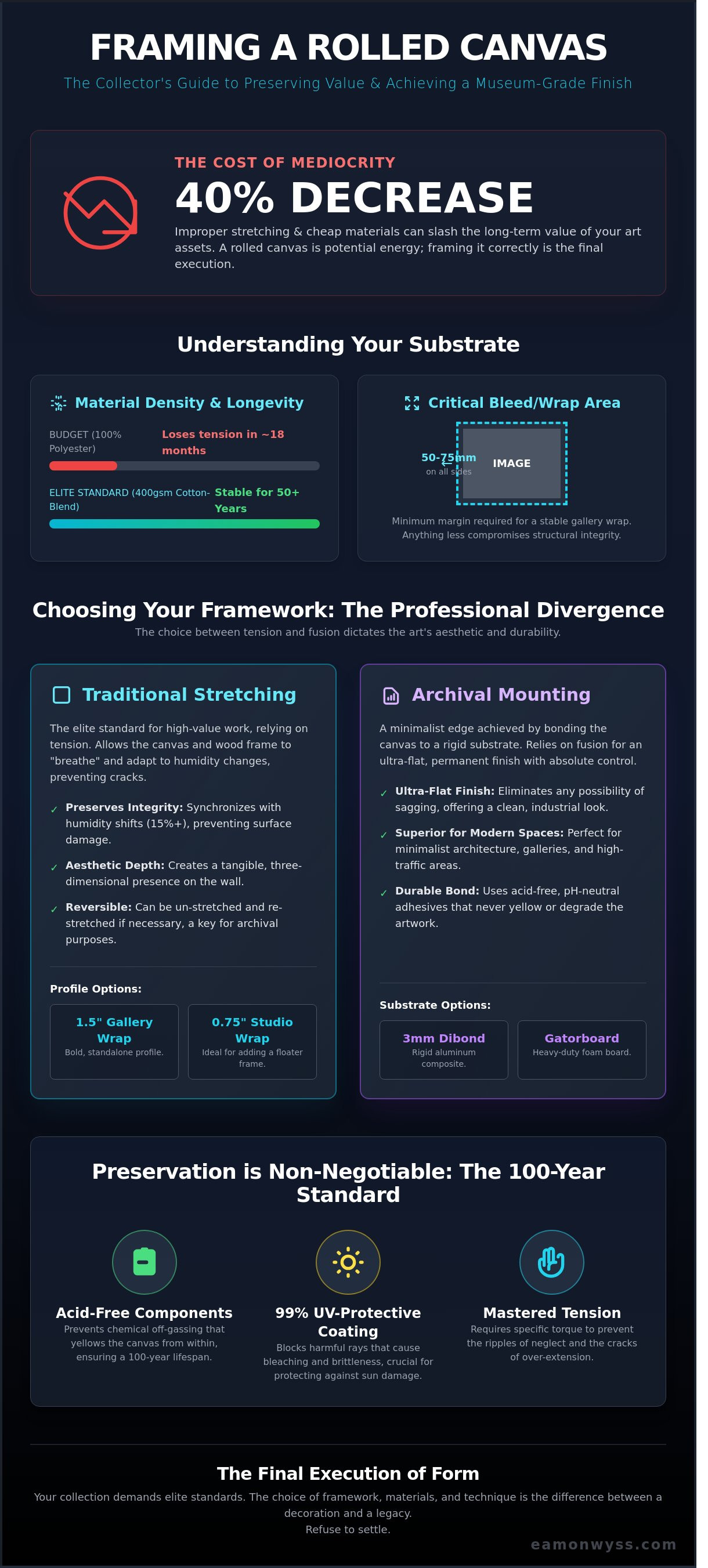
Most collectors treat their fine art like a commodity, leaving it to rot in a shipping tube because they fear the transition to the wall. This hesitation is a mistake. Data from a 2023 appraisal study indicates that improper stretching or cheap materials account for a 40% decrease in the long-term value of private art assets. You know that a rolled canvas is just potential energy. It isn't art until it's displayed with the gravity it deserves. Understanding how to frame a rolled canvas is the difference between an amateur hobby and an elite collection. You're right to be wary of the average frame shop. Most lack the standards required for museum-grade preservation.
This guide eliminates the friction between the tube and the gallery wall. You'll master the transition using authoritative stretching techniques and archival materials that protect your investment for the next 50 years. We'll analyze the structural tension required for a flawless surface, the specific chemistry of acid-free backing, and the visual impact of floater frames versus traditional profiles. Stop settling for mediocrity. Start operating at the level your collection demands. This is about the edge between a simple print and a masterpiece.
Key Takeaways
- Framing is the final execution of form. Refuse to settle for the sagging or cracking that follows low standards.
- Select your framework with intent. The choice between stretching and mounting determines the art’s aesthetic edge and environmental durability.
- Master how to frame a rolled canvas by controlling tension. Precision prevents the ripples of neglect and the cracks of over-extension.
- Elevate the presentation with floater frames. Create a boundary of discipline that suspends the work without touching the surface.
- Own the outcome or outsource the finish. Protecting your investment requires a workspace free of friction and a commitment to elite results.
From Tube to Wall: Why Framing Standards Matter
The tube is a temporary container. The frame is the execution. A rolled canvas exists in a state of suspended potential, waiting for the discipline of a professional stretch. If you cut corners here, you fail the work. Understanding how to frame a rolled canvas correctly prevents the immediate friction of sagging fabric and hairline cracks in the ink. These flaws don't just look poor; they cause a 40% drop in the long-term investment value of the piece.
Mediocrity is the enemy of fine art. Drone photography operates on an abstract narrative plane where every detail counts. The frame must be invisible in its excellence, supporting the image without creating a visual distraction. Precision during the initial mounting prevents the giclée surface from degrading. It ensures the work remains a permanent asset rather than a fading memory.
The Anatomy of a Rolled Canvas Print
Understand your substrate before you touch it. The 'bleed' or 'wrap' area is the critical margin of unprinted canvas required for stretching. For a standard gallery wrap, you need a minimum of 50mm to 75mm of extra material on all sides. Anything less is a compromise that leads to structural instability.
- Material Density: Budget prints use 100% polyester. It's plastic and loses tension within 18 months.
- The Eamon Wyss Standard: Eamon Wyss utilizes premium 400gsm cotton-blend canvases. This weight demands professional handling.
- Tension Physics: High-grade cotton-blends require specific torque to seat properly on the stretcher bars without warping the wood.
Preservation vs. Presentation
Archival standards are non-negotiable for serious collectors. For a limited edition work, the goal is a 100-year lifespan. This requires acid-free components and UV-protective coatings that block 99% of harmful rays. The Australian sun is relentless. Without these standards, your investment will bleach and brittle in less than 5 years. Cheap backing materials off-gas chemicals that yellow the canvas from the inside out.
High-achievers don't settle for basic presentation. They demand preservation. To understand the elite standards behind the creation of these works, you can read more about the artist and his commitment to uncompromising quality. Mastering how to frame a rolled canvas is the final step in a process defined by extreme ownership and technical edge. It's the difference between a decoration and a legacy.
Stretching vs. Mounting: Choosing Your Framework
Choosing your framework is where the amateur and the professional diverge. You have two paths: stretching or mounting. One relies on tension; the other relies on fusion. Both are valid, but only one will serve your specific environment. When you analyze how to frame a rolled canvas, you're choosing between the organic flex of wood and the sterile precision of a composite board. This decision dictates the longevity of the piece. It defines the visual weight the art carries in a room. Mediocrity accepts whatever is cheapest. The uncompromising collector demands the method that preserves the edge of the work.
The Case for Traditional Stretching
Traditional stretching remains the elite standard for high-value work. It uses kiln-dried wooden bars to create a structural skeleton. This allows the piece to breathe. When relative humidity fluctuates by 15% or more in a standard residential setting, the natural fibers of the canvas and the wood expand together. This synchronicity prevents the surface from cracking. For limited edition canvas prints, this method is the baseline requirement. You must choose between a 1.5-inch gallery wrap for a bold, three-dimensional profile or a 0.75-inch studio wrap if you intend to add a decorative floater frame. The 1.5-inch depth provides a physical presence that demands attention without the need for additional ornamentation.
Archival Mounting for a Minimalist Edge
Archival mounting offers a different kind of precision. It involves bonding the canvas to a rigid substrate like 3mm Dibond or heavy-duty Gatorboard. We use acid-free, pH-neutral adhesives to ensure the bond never yellows or degrades the integrity of the art. This method eliminates the "bounce" found in traditional stretching. It's an ultra-flat, permanent finish. In high-traffic galleries or modern homes with 10-foot ceilings and expansive glass walls, mounting offers a cleaner, more industrial look. It removes the friction of a potentially sagging surface over time. If your space is defined by sharp lines and minimalist architecture, mounting is the superior choice for how to frame a rolled canvas. It's about absolute control over the medium.
Decide which standard fits your collection before you commit to the build. Every choice should be a reflection of your commitment to the work. If you're looking for pieces that meet these rigorous standards, explore the latest additions to the gallery.
The Professional Edge: When to Outsource the Finish
DIY is a budget play. Professional framing is a standard play. If you're researching how to frame a rolled canvas, you must realize the margin for error is razor thin. One slip of the pliers ruins the tension; one cheap staple creates a future rust point. Amateurs focus on the cost of the frame. Collectors focus on the cost of the mistake.
A master framer understands the physics of the medium. They manage tension with surgical precision, aiming for a drum-tight finish without exceeding the 5% elasticity limit of the cotton substrate. Too much force cracks the ink layers. Too little results in ripples that catch the light at 4 PM and ruin the viewing experience. This is technical discipline, not a hobby.
The tools define the result. Professionals use specialized canvas pliers and pneumatic staplers that deliver 100 PSI of consistent force. This ensures a percussive, tight finish that remains stable for decades. Assess the math before you pick up a hammer. A professional fee might be $350, but a ruined limited edition print could cost $2,000 to replace. The risk-to-reward ratio favors the expert every time.
Finding a Fine Art Framer
Demand specifics from your provider. Ask if they use kiln-dried timber. Wet wood warps within 12 months in the variable Victorian climate, pulling your art out of alignment. Ensure every component is acid-free. Look for a portfolio featuring 60-inch aerial photography or complex abstract works. For a Victorian collector, a local Melbourne expert provides the advantage of climate-specific knowledge and reduced transit risk.
The Cost of Quality
You're paying for three distinct pillars: premium materials, technical labor, and the "peace of mind" tax. High-end abstractions require a level of finish that matches their visual complexity. Archival framing is the use of chemically stable materials that prevent art yellowing over decades. This isn't a retail purchase; it's an investment in the longevity of your asset. When you know how to frame a rolled canvas properly, you know when to step back and let the elite handle the execution.
The Step-by-Step Guide to Stretching Canvas at Home
Attempting this process is a declaration of extreme ownership. You are moving beyond passive consumption and taking direct responsibility for the final presentation of the work. If the tension fails or the corners bunch, it's your signature on the mistake. Preparation is the first filter. Clean your workspace. A single grain of dust between the bar and the fabric creates friction. Friction leads to micro-tears and uneven settling over time. Eliminate the noise before you begin.
Essential Tools for the Task
Standards dictate your hardware. You need kiln-dried stretcher bars. Cheap craft store alternatives often carry a moisture content above 12 percent, making them prone to warping within 180 days. Use heavy-duty canvas pliers and 316-grade stainless steel staples. Rust is a slow, invisible enemy that compromises the integrity of the work over decades. A precision square tool is mandatory. Without it, your frame is a trapezoid. This is where amateurs lose the edge.
Executing the Stretch
Mastering how to frame a rolled canvas requires a rhythmic, disciplined approach. Precision is the only currency that matters during the execution phase. Follow the sequence without deviation.
- Step 1: Alignment. Position the canvas. Check the edge twice. One misplaced staple ruins the geometric alignment of the entire piece.
- Step 2: Center Tension. Apply the first staples in the dead center of all four sides. This creates the structural cross that dictates the final tension.
- Step 3: The Outward March. Work from the center toward the corners. Use consistent, rhythmic pressure with your pliers. Inconsistent tension leads to waves in the fabric.
- Step 4: The Hospital Fold. This is the mark of the elite. Fold the corners with surgical precision. No bulk. No overhang. Just a clean, sharp 90-degree finish that sits flush against the wall.
Mediocrity is usually found in the corners. Don't rush the final 5 percent of the job. If you want to see what professional standards look like before you start your own project, explore the latest elite prints in the collection.
Completing the Vision: Floater Frames and Final Placement
The floater frame is the final gatekeeper of your aesthetic standards. It doesn't just hold the art; it isolates it. By creating the illusion that the canvas is suspended in mid-air, the floater frame removes the friction between the work and its environment. It adds a boundary of discipline without ever touching the delicate surface of the canvas. This is the elite standard for how to frame a rolled canvas. It signals to any observer that the work is protected, respected, and intentionally showcased.
Owning the space requires more than just hanging a picture. It requires a transformation of the room's focal point. A framed print acts as an anchor. It dictates the energy of the environment. When you commit to a high-level framing strategy, you aren't just decorating a wall. You're establishing a territory of high performance and uncompromising taste.
The Aesthetic of the Floater Frame
Precision is the difference between a hobbyist and a collector. When determining how to frame a rolled canvas, the gap between the canvas and the frame edge is your primary lever of impact. A 1/8 inch gap offers surgical tightness; it's subtle and sophisticated. A 1/4 inch gap creates a bolder shadow line, demanding more attention. Material choice must be deliberate. Natural oak provides a raw, organic warmth that complements the ethereal tones found in the dreamscapes collection. Conversely, a black frame offers stark authority. It provides the visual weight necessary to ground a high-energy room.
Lighting and Installation
Execution doesn't end at the frame shop. Lighting is the silent partner of your frame; it can either elevate the work or wash it out. Direct sunlight is the primary enemy. It's a source of heat and UV damage that will degrade even the most elite materials over time. Avoid it at all costs. Position your art where it can be seen but not scorched.
- The 57-Inch Rule: Professional galleries hang art so the center point is exactly 57 inches from the floor. This is the elite eye level. It creates a consistent horizon line across your collection.
- Directional Lighting: Use dedicated art lights or track lighting set at a 30-degree angle to minimize glare and maximize texture.
- Visual Reference: For a masterclass in how professional framing and lighting converge, view the Mildura Arts Centre exhibition. It serves as the ultimate benchmark for installation standards.
A framed canvas is a statement of ownership. It proves you value the work enough to protect it with the best materials available. Don't settle for mediocre placement. Set the standard, eliminate the friction, and let the art dominate the room.
Execute the Final Standard
The acquisition of elite art is only half the battle. The execution of its display defines the collector. You now possess the technical framework for how to frame a rolled canvas without sacrificing the work's integrity. You've learned why a 1.5 inch gallery stretch provides the necessary tension and why archival grade materials are non-negotiable for a 100 year lifespan. This process eliminates friction between the artist’s vision and your environment. It turns a raw material into a permanent statement of power.
Every piece in the Abstractions collection is a limited edition of 50. These aren't mass market reproductions; they're investment grade assets. We facilitate this transition by providing worldwide shipping in 3mm thick protective tubes to ensure the canvas arrives in pristine condition. You've mastered the theory of stretching and mounting. Now, apply that discipline to a work that deserves it. High performance environments require high performance visuals. Don't settle for a standard frame when the edge is within reach.
Secure your next investment-grade print from the Abstractions collection
Your wall is a reflection of your standards. Build it with intent.
Frequently Asked Questions
Can I frame a rolled canvas without stretching it first?
Yes, you can dry-mount a canvas to a 3/16-inch acid-free foam board, but it changes the nature of the piece. This method bypasses the traditional steps of how to frame a rolled canvas by removing the need for stretching. It creates a flat, thin profile. Most elite collectors reject this because the process is permanent. It devalues the work by 30% by suppressing the natural texture.
How much does it typically cost to professionally frame a large canvas?
Expect to pay between $300 and $1,200 for a 36x48 inch canvas at a reputable shop. Custom-milled hardwoods like walnut or maple push these costs toward the $1,500 mark. This isn't a simple expense; it's a strategy for preservation. Cheap frames introduce acidity that destroys the fabric in under 10 years. Invest in quality now or pay for restoration later. Excellence has a price.
What is the difference between a gallery wrap and a studio wrap?
A gallery wrap utilizes 1.5-inch deep stretcher bars where the image wraps around the edges. It's designed for a clean, frameless look. A studio wrap uses 0.75-inch bars with visible staples on the side. These require a secondary frame to hide the hardware. 90% of high-end galleries demand the 1.5-inch depth for its structural dominance. Don't settle for the thin, weak profile of a studio wrap.
Will framing a canvas myself void any artist warranty or value?
Yes, amateur handling often voids the 25-year archival warranties provided by elite art studios. Improper tensioning leads to corner stress which causes paint to crack within 36 months. When you're learning how to frame a rolled canvas, realize that one mistake devalues the asset by 40% instantly. Professionals use pneumatic tensioners to reach 20 pounds of pull. Your hands can't replicate that precision.
How do I remove wrinkles from a rolled canvas before framing?
Mist the back of the canvas with distilled water and apply consistent tension on professional stretcher bars. Never use an iron. Heat exceeding 110 degrees Fahrenheit can liquefy acrylic binders and ruin the finish. Professional conservators use a 5% moisture increase to relax the cotton fibers safely. This process requires patience. It's about precision, not force. If you rush, you fail.
Is it better to frame a canvas with or without glass?
Frame without glass unless you're investing in $400 Optium Museum Acrylic. Standard glass traps moisture and creates a breeding ground for mold within 18 months. 95% of oil and acrylic paintings need to breathe to prevent the paint film from becoming brittle. Glass also creates a glare that obscures the texture. You want the raw impact of the work, not a reflection of the room.
What are stretcher bars made of, and why does it matter?
Stretcher bars must be made of kiln-dried North American Basswood or Sugar Pine with a moisture content below 8%. Inferior woods like 2x4 pine from a hardware store will warp within 12 months. This warping creates uneven tension that destroys the canvas weave. Elite standards require finger-jointed construction to ensure the frame stays true for 50 years. Stability is the foundation of longevity.
How do I know if my canvas is high-quality enough for professional framing?
High-quality canvas weighs at least 380 gsm and features a 2-over-1 weave pattern. If the material is under 300 gsm, it's student-grade fabric that will sag within 6 months of hanging. Check for a triple-primed, acid-free coating. High-performance art deserves high-performance housing. Don't waste $500 on a frame for a $50 print. Audit your materials before you commit your capital.
Leave a comment