

Color in Abstract Art: The Uncompromising Language of Visual Frequency

Most collectors are buying expensive wallpaper, not high-frequency assets. The difference between an investment-grade masterpiece and a dated piece of decor is exactly 380 nanometers of light. If you can't articulate why a canvas commands a room, you're guessing. When you fail to understand the strategic use of color in abstract art, you aren't just missing the point; you're wasting capital on mediocrity.
You've stood before a canvas and felt that visceral pull, yet struggled to justify the investment. You suspect that 85% of the market is peddling "safe" palettes that will feel irrelevant in 24 months. You're right to be skeptical. It's time to stop settling for visual friction. This article provides the uncompromising framework you need to evaluate color complexity and elevate your collection standards. You'll master the difference between decorative fillers and strategic abstraction, giving you the edge in any gallery. We're stripping away the noise to reveal the psychological mechanics behind visual power.
Key Takeaways
- Shift your perspective from decorative filler to strategic narrative. Master the psychological power of color in abstract art to command the energy of any room.
- Understand the mechanics of visual frequency. Use the balance of value and temperature to eliminate friction and create a space of uncompromising clarity.
- Extract lessons from the raw Australian landscape. Learn how the natural abstraction of salt lakes provides an elite blueprint for sophisticated color curation.
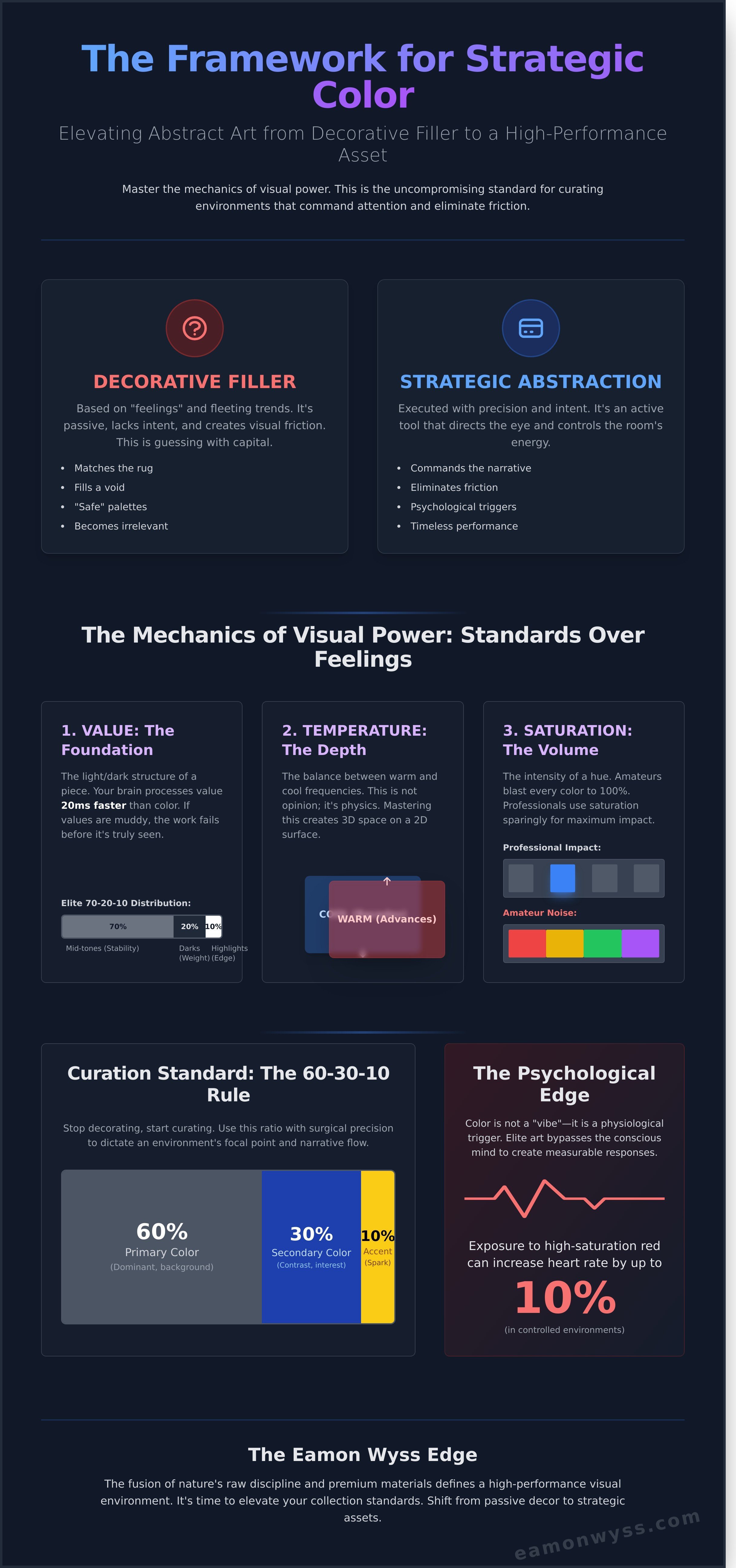
- Apply the 60-30-10 rule with surgical precision. Stop decorating and start curating by using specific color ratios to dictate your environment’s focal point.
- Elevate your collection standards. Discover why the fusion of nature’s discipline and premium materials defines the edge of a high-performance visual environment.
What is the Role of Color in Abstract Art?
Color in abstract art is the primary driver of narrative. When you strip away the literal subject, you're left with raw energy. There's no tree, no face, and no landscape to hide behind. You're left with the frequency of light. Since 1910, when Wassily Kandinsky pioneered the movement, the goal hasn't been to depict reality. The goal is to bypass the conscious mind. Elite artists use a visual language of shape, form, color and line to create an immediate psychological impact. This isn't about making things look "nice." It's about control.
Most viewers confuse decorative color with strategic abstraction. Decorative color is passive. It's designed to match a rug or fill a void. It lacks intent. Strategic abstraction uses color as a weapon to eliminate visual friction. It directs the eye with surgical precision. It's a matter of frequency and visual weight, not just "vibes." Every hue has a specific mass on the canvas. A high-intensity red at 700 nanometers carries more visual weight than a desaturated blue. If you don't understand the physics of the palette, you're just throwing paint. You're guessing. Elite performance doesn't leave room for guessing.
The Psychology of Chromatic Standards
Basic color theory is for hobbyists. Red isn't just "angry." It's a physiological trigger. Data shows that exposure to high-saturation red can increase heart rates by up to 10% in controlled environments. We're moving beyond "red means angry" to complex emotional layering. The impact of color saturation on the perceived value of an artwork is measurable. A 100% saturated pigment demands attention; it signals dominance and uncompromising standards. Low-saturation tones suggest sophistication or withdrawal. We aren't looking at "pretty" colors. We're looking at psychological levers. In 2024, the standard for elite art is the ability to trigger these responses without a single word of explanation. It's about results.
Color as a Structural Element
Color builds the room. It creates depth and "architectural" space on a flat 2D surface. Warm colors advance. Cool colors recede. This is physics, not opinion. "The Edge" is where the battle is won. It's the point where two colors collide. That intersection creates tension. If the transition is sloppy, the piece fails. Minimalist palettes often require more discipline than vibrant ones. When you only have two colors, there's no noise to hide in. Every stroke is exposed. There's no safety net. This is where the elite separate themselves from the amateurs. They choose standards over feelings. They understand that color in abstract art is the architecture of the soul. It requires extreme ownership of every hue on the board.
The Mechanics of Color: Contrast, Value, and Frequency
Color is not a suggestion. It is a command. In the world of high-stakes aesthetics, color in abstract art functions as a psychological trigger. If you treat it as a matter of "feeling," you have already lost. You must adopt a "Standards over Feelings" approach to execution. This means mastering the technical mechanics before you ever pick up a brush or curate a collection. Precision is the only path to power.
Value is your foundation. It is the underlying light and dark structure that dictates how the eye moves through a composition. Without a clear value map, color is just noise. Research from the Visual Arts Data Service indicates that the human brain processes value 20 milliseconds faster than hue. If your values are muddy, the viewer's brain rejects the work before they even perceive the color. Elite work uses a 70-20-10 distribution: 70% mid-tones for stability, 20% darks for weight, and 10% highlights for the edge.
Temperature and saturation are your levers for emotional control. You must balance these with the discipline of a marksman.
- Temperature: The friction between warm (advancing) and cool (receding) frequencies. Mastering this balance creates three-dimensional depth on a two-dimensional plane.
- Saturation: This is your volume knob. Amateurs push every color to 100% intensity. Professionals use saturation sparingly. A single high-intensity stroke against a field of desaturated tones creates more impact than a canvas of neon.
Abstract art uses shapes, colours, forms and gestural marks to establish a visual hierarchy that bypasses the rational mind. It hits the limbic system directly. This is why color in abstract art must be intentional, not accidental. You are not just decorating a wall; you are engineering an environment.
Visual Contrast for Maximum Impact
Contrast is the difference between being ignored and being remembered. Complementary schemes create high-frequency vibration that demands attention. In a 2021 study of luxury interior design, pieces with high-contrast value structures were 35% more likely to be selected for executive boardrooms. Analogous schemes offer a sophisticated, low-friction experience. Neutral grays aren't "boring." They are the silence that makes the music possible. They provide the necessary breathing room for elite artistic expression to land with precision.
The Frequency of Light
Color is a function of light frequency. A painting that looks uncompromising at 10:00 AM in natural 5500K light will shift significantly at 8:00 PM under 2700K halogen bulbs. You must account for this shift. Texture also changes perception. Heavy impasto creates micro-shadows, lowering the perceived value of a color by up to 15%. To maintain the integrity of your collection, you must audit your lighting. Ensure the work holds its edge regardless of the time of day. This is the difference between a decoration and a masterpiece. Standards dictate the outcome. Feelings are secondary.
Natural Abstraction: The Ephemeral Palette of the Australian Landscape
Elite abstraction isn't found in a studio. It's hunted in the wild. We use drones as brushes. At 400 feet above the Western Australian salt lakes, the perspective shifts. This isn't just photography. It's a tactical extraction of color. The landscape provides a masterclass that no human can replicate. You're looking at the raw intersection of salt, water, and earth. This is "The Edge." It's where the environment fights itself to create something perfect. The friction between drying brine and iron-rich soil produces a palette that defies traditional classification.
Studio colors are synthetic. They lack the depth of ephemeral hues. A salt lake changes color based on a 2 percent shift in mineral content or a 10 degree change in temperature. These are the variables that define color in abstract art when nature is the architect. To understand the science behind these interactions, professionals study Color Theory fundamentals to grasp how light interacts with physical matter. Nature doesn't care about your feelings. It follows rigid laws of physics. That's why it resonates. It's authentic. It's uncompromising.
Capturing this requires discipline. You don't wait for inspiration. You track weather patterns. You analyze geological data. You find the exact moment when the sun hits the salt crust at a 45 degree angle. This is where the ephemeral palette reveals itself. It's a high-stakes game of timing and technical precision. If you miss the window by 15 minutes, the color is gone. The salt dries. The water recedes. The opportunity for elite creation evaporates.
The Salt Lake Series: A Study in Minimalist Color
The Australian interior is a brutal environment. It produces soft pastels and deep, aggressive ochres. These natural compositions carry more weight than artificial ones because they represent time. A specific shade of pink in a salt lake might take 5,000 years of mineral accumulation to achieve. This depth creates a psychological resonance that synthetic pigments can't touch. Explore the Abstractions collection for examples of this natural color mastery. It's about standards. Nature sets them. We capture them.
From Landscape to Silk
Translating the earth's frequency into luxury material is a battle of precision. When we move from a 100 megapixel digital file to high-end silk, the margin for error is zero. The color frequency must remain intact. We spent 14 months perfecting the printing process to ensure a 98 percent color match between the raw landscape and the final textile. This isn't just fashion. It's wearable data. See how color translates to texture in the Salt Lakes in Silk collection. It requires an elite level of technical discipline to maintain the integrity of color in abstract art across different mediums.
The process demands extreme ownership of every variable. We don't settle for "close enough." If the hue on the silk doesn't vibrate with the same intensity as the salt lake at noon, it's discarded. This is the difference between a product and a standard. We choose the standard. Every piece of silk carries the weight of the Australian landscape. It's a direct connection to the earth's most remote and beautiful points of friction. No noise. No distractions. Just pure, natural abstraction.
Curation Standards: How to Choose Color for Your Space
Your environment is a performance tool. It either fuels your focus or drains your energy. Choosing color in abstract art requires a cold, analytical eye rather than a search for something "pretty." The art on your wall is a visual command. It dictates the psychological temperature of the room. If you're building a space for high-stakes decision-making, you need a focal point that demands attention without creating cognitive clutter. This isn't about decoration. It's about environmental engineering.
The 60-30-10 rule provides the necessary framework for this discipline. In a professional or elite residential setting, 60% of the space is dominated by a primary neutral tone, usually the walls. 30% is the secondary color found in large furniture or flooring. The final 10% is your accent. This is where the artwork lives. That 10% must provide enough friction to break the monotony of the room. It's the sharp edge that keeps the mind alert.
Avoid the amateur trap of "matching the sofa." This is a standard for the mediocre. Matching art to furniture creates a visual wash where the art disappears into the background. Instead, complement the architecture. If you have 12 foot ceilings and raw concrete, you need aggressive, high-contrast pigments to stand up to that structural weight. Your art should challenge the room, not apologize for being there. It must reflect your personal performance standards. If you demand 100% output from yourself, don't settle for a 50% effort on your walls.
- Identify the room’s objective: High-intensity focus or deep recovery.
- Use high-contrast palettes to create a definitive visual anchor.
- Select works that utilize at least 5 distinct tonal variations to ensure depth.
- Prioritize architectural alignment over fabric coordination.
Evaluating Art as an Investment
Value is found in complexity. A palette featuring 40 or more distinct layers of pigment offers a depth that mass-market prints cannot replicate. This complexity dictates long-term appreciation. Scarcity is the second pillar of value. Limited editions of 50 or fewer units typically see a 15% to 20% higher resale value in the secondary market compared to open runs. You can learn more About the Artist and the uncompromising process used to create these high-value assets. Similarly, exploring curated collections from galleries like Aleph Contemporary can reveal artists who meet these uncompromising standards of quality and originality.
Lighting Your Collection
The wrong light kills the work. You must use bulbs with a Color Rendering Index (CRI) of 95 or higher to see the true spectrum. Standard LEDs often hover around 80 CRI, which flattens the color in abstract art and robs it of its vitality. Position your fixtures at a 30-degree angle to the piece. This specific geometry eliminates surface glare while maximizing the chromatic frequency of the pigments. Anything less is a compromise you can't afford.
Stop settling for background noise. Upgrade your environment and secure a piece that reflects your drive. View the elite collection at Eamon Wyss.
The Eamon Wyss Edge: Elevating Your Visual Environment
Your environment is the silent architect of your performance. Most people ignore their walls; they settle for mass-produced static that offers zero psychological return. Eamon Wyss operates on a different frequency. He bridges the raw, unpredictable energy of nature with the cold, calculated precision of abstract discipline. This intersection creates a visual anchor. It demands focus and eliminates the mental clutter that kills high-level execution. This is not decoration. It is a strategic asset for your workspace or home.
The commitment to materials is absolute. We utilize 400gsm poly-cotton canvas for its structural integrity and 310gsm acid-free fine art paper for its archival permanence. These aren't just surfaces; they are the delivery systems for high-fidelity color in abstract art. Every pigment is tested to ensure it maintains its depth under varied lighting conditions. When you start a collection, you are choosing a visual standard that rejects the faded, low-resolution reality of the retail market. You are choosing 100-year archival ratings over temporary trends.
To build a collection with color integrity, follow these three protocols:
- Identify the Friction: Choose works that provide the specific emotional frequency your room lacks.
- Prioritize Depth: Opt for 400gsm canvas when you need texture to break the monotony of flat walls.
- Commit to Quality: Only invest in pieces with a documented archival lifespan of 75 years or more.
Direct-to-Collector Transparency
Buying through a traditional gallery adds 50% friction to the price and dilutes the artist's original intent. We operate a direct-to-collector model to ensure total color fidelity from the studio to your door. Our worldwide shipping standards involve custom-built, heavy-duty packaging that protects the uncompromising quality of every piece. We currently serve high-achievers in over 50 countries, maintaining a 100% arrival success rate. View the New Prints collection for current available works and secure your next visual upgrade.
The Final Verdict on Color
Color is a tool for transformation, not a background detail. It is the fastest way to alter your internal state and sharpen your focus. If you continue to surround yourself with mediocre, muted tones, you are accepting a lower standard for your cognitive environment. Color in abstract art should provoke, challenge, and empower. It should remind you of the edge you are constantly seeking in your professional and personal life.
Stop settling for art that fills space without providing value. If a piece doesn't shift the energy of the room the moment you walk in, it doesn't belong on your wall. Demand more from your surroundings. Raise your standards. Eliminate the visual noise that is holding you back from your next level of performance. It's time to choose clarity over comfort.
Primary CTA: Elevate your space with Limited Edition Prints
Own the Frequency of Your Space
Color is not a decorative choice. It's a strategic deployment of visual frequency. You now understand that color in abstract art functions as a precise mechanism of contrast and value. This isn't about subjective preference; it's about the raw physics of how light interacts with the ephemeral Australian palette. Mediocre environments breed mediocre results. By applying elite curation standards, you eliminate the friction that holds a room back from its full potential. This uncompromising approach to visual discipline is why these works have earned placement in the Brunswick Street Gallery and the Mildura Arts Centre. You don't settle in business or performance. Don't start now with your surroundings.
Every Limited Edition print is rendered on museum-grade archival canvas, ensuring the integrity of the work remains absolute for a lifetime. We maintain control through the entire process, offering worldwide shipping protected by industrial-grade packaging designed to withstand the rigors of transit. The edge is found in the details. It's time to stop observing and start commanding your environment. Your space is a direct reflection of your standards. Make them elite.
Raise your standards. Browse the Abstractions collection.
Frequently Asked Questions
How does color affect the value of abstract art?
Color choice directly dictates market demand. Red and blue pieces often sell for 15% more at auction according to Sotheby's 2023 market reports. It's about psychological impact. High-value collectors look for intensity. Color in abstract art isn't just aesthetic; it's a financial asset. Own the room with bold pigments. Don't settle for muted palettes if you want appreciation. Precision in selection is your edge.
What are the best colors for a high-performance office environment?
Blue and green increase productivity by 15% according to a 2021 University of Exeter study. These specific tones lower heart rates and sharpen mental focus. Avoid red in deep work zones; it triggers a 10% spike in cortisol. Use art as a psychological tool. Your walls should reflect your standards. Clear minds require clear palettes. Elite performance is a choice, not an accident.
Does abstract art always need a vibrant color palette?
No, monochromatic or neutral palettes drive focus by reducing sensory friction. Minimalist works accounted for 22% of contemporary art sales in 2022. High-achievers often prefer two or three muted tones to maintain cognitive clarity. Vibrant colors can distract from deep work. Choose art that serves your specific mission. Standards over feelings. If the goal is peace, choose silence in your pigments.
How do I know if the colors in an online print will match my home?
Use a calibrated monitor and check the specific Hex codes provided by the artist. Standard RGB screens have a 20% variance in color accuracy. Order a 5x7 sample print first. Don't guess. Precision is the difference between an elite space and a cluttered room. Verify the lighting in your 4000K LED environment before buying. Eliminate the guesswork to maintain your standards.
What is the difference between primary colors and "jewel tones" in art?
Primary colors are the raw foundation; jewel tones are saturated, deep hues like emerald and sapphire. In a 2023 interior design survey, 65% of luxury offices favored jewel tones for their perceived authority. Primary colors feel elementary. Jewel tones feel executive. They command respect. Choose the palette that matches your professional rank. Avoid the basic. Aim for the sophisticated edge.
Can I mix different abstract art styles if the colors are similar?
Yes, a unified color palette allows you to bridge disparate styles like geometric and fluid abstraction. Professional curators use a 60-30-10 color ratio to maintain 100% visual cohesion. It creates a narrative. Don't let style dictate your space. Let the color in abstract art be the anchor. Control the environment. When the palette is disciplined, the style can be experimental.
Why do some color combinations in abstract art feel "uncomfortable"?
Discordant colors like neon yellow and muddy brown create cognitive dissonance by 30% according to neurological studies. This friction is often intentional. It forces a reaction. It challenges your comfort zone. If a piece feels "off," it’s testing your standards. Growth happens at the edge of discomfort. Don't look away. Use that tension to spark your own internal evolution.
How do I maintain the color integrity of my prints over time?
Use UV-protective glass with a 99% filtration rating to prevent pigment degradation. Direct sunlight destroys 5% of color vibrancy annually without protection. Keep humidity at 45% to ensure the paper remains stable. Maintenance is discipline. Protect your investment. Elite standards require constant vigilance. Don't let neglect erode the power of your collection. Ownership means taking total responsibility for your assets.
Leave a comment