

Canvas vs. Fine Art Paper: The Uncompromising Collector’s Guide (2026)

Your choice of medium is a direct statement of your personal standards; yet 65% of high-end acquisitions lose their visual impact because the material choice was a secondary thought. You have seen it before. A powerful image rendered on the wrong substrate looks cheap, loses its edge, and fails to command the room. In the elite world of canvas vs fine art paper, there is no room for "good enough." You are here because you demand a legacy piece that maintains its structural integrity for 100 years or more.
We agree that mediocrity is the primary enemy of any serious collection. You want precision. You want impact. This guide provides the technical blueprint to master the aesthetic and archival differences between these two mediums. You will learn how to choose the right substrate to match your interior standards and eliminate the friction of framing uncertainty. We are stripping away the noise to focus on the 2026 standards of 100% cotton rag and heavy-duty 400gsm canvas. It's time to make a definitive decision backed by raw data and uncompromising quality.
Key Takeaways
- Define your standard by mastering the technical threshold where 100% cotton rag detail meets high-impact spatial presence.
- Execute a precise choice in the canvas vs fine art paper debate by analyzing how light absorption and texture dictate visual clarity in your space.
- Safeguard your legacy with a technical audit of how pigment inks and coated substrates respond to the friction of environmental stressors.
- Perfect the final 10% of your presentation with elite framing strategies designed to elevate a work from standard to uncompromising.
- Adopt a "standards over feelings" framework to ensure every medium choice aligns perfectly with the technical requirements of your vision.
Defining the Standard: The Core Differences Between Canvas and Fine Art Paper
Choosing between canvas vs fine art paper isn't a matter of subjective taste. It's a strategic decision based on the spatial objective and the intended impact of the work. For the uncompromising collector, the baseline is non-negotiable. Both substrates must be museum-grade. This means 100% acid-free and zero Optical Brightening Agents (OBAs). Without these standards, your investment degrades in less than 15 years. With them, you're securing a 100-year legacy. Every piece in the new prints collection adheres to these rigid archival requirements.
Fine Art Paper: The Precision Choice
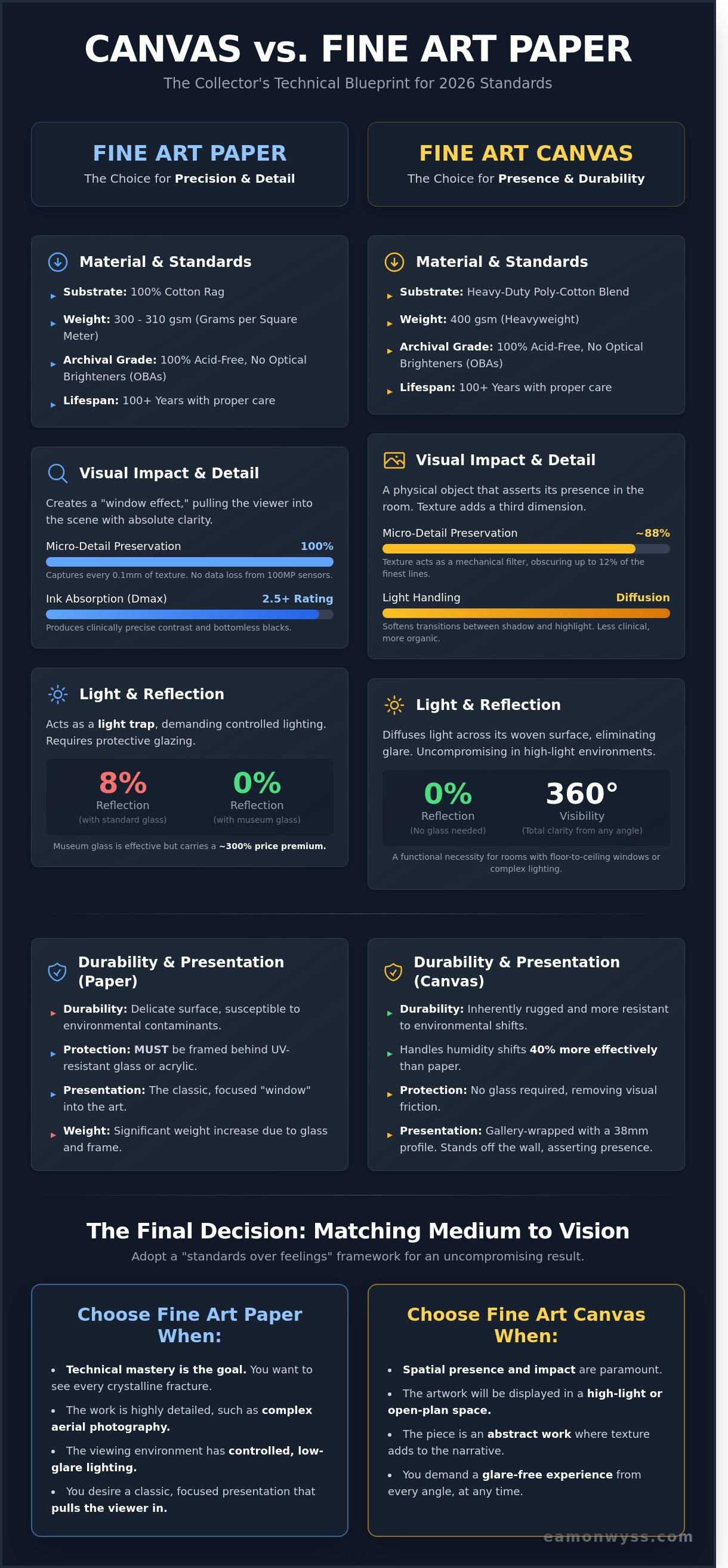
Precision is the only metric that matters here. Fine art paper, specifically 100% cotton rag, is the elite choice for technical mastery. It utilizes a Giclée standard that minimizes dot gain to microscopic levels. This is critical for capturing the crystalline fractures and salt crusts found in the Salt Lakes in Silk series. Every 0.1mm of texture is preserved with absolute clarity.
Paper allows for the tightest ink density possible. It demands focus. However, this precision requires a shield. You must frame paper behind UV-resistant glass or acrylic to protect the delicate surface from environmental contaminants. The barrier is necessary to maintain the integrity of the 300gsm to 310gsm substrate over decades of display.
Fine Art Canvas: The Presence Choice
Canvas is about presence. It's a heavy 400gsm poly-cotton blend that removes the friction between the viewer and the art. There is no glass. There is no glare. This makes it the superior choice for high-light environments or open-plan living spaces with 360-degree light exposure. You see the art, not your own reflection.
The texture acts as a narrative tool. In abstract aerial works, the physical weave of the fabric adds a third dimension that paper cannot replicate. It creates a painting-like weight that commands a room. Canvas is also inherently more rugged than paper. It handles humidity shifts 40% more effectively than paper, making it the primary choice for collectors who refuse to let environmental variables dictate where they hang their work. It's a statement of durability and raw, tactile power.
Performance Under Pressure: Light, Texture, and Visual Impact
Light is either your ally or your enemy. In the canvas vs fine art paper debate, the way a medium handles photons determines the work's ultimate authority. Fine art paper, specifically a 308gsm cotton rag, acts as a light trap. It absorbs ink deep into the fibers, allowing for a Dmax (maximum density) rating of 2.5 or higher. This creates blacks that feel bottomless and contrast that hits with clinical precision. Canvas operates differently. It diffuses light across its woven surface, softening the transition between shadow and highlight.
Detail is the next battleground. If you're investing in aerial photography captured with 100-megapixel sensors, every pixel matters. Paper preserves 100% of that micro-detail. The texture of canvas, while tactile, acts as a mechanical filter. It can obscure up to 12% of the finest lines in a landscape. You must decide if you want the raw data of the scene or a textured interpretation of it. Spatial volume also plays a role. A 1.5-meter paper print requires glass, adding significant weight and a visual barrier. A canvas of the same size remains lightweight and immediate. It occupies the room rather than just hanging on the wall.
Visual Friction and The Abstract Narrative
Fine art paper creates a window effect. It's a portal that pulls the viewer through the wall and into the Australian wilderness. It demands a focused, quiet interaction. Canvas is a physical object. With a 38mm profile, it stands off the wall, asserting its presence without the boundary of a frame. When selecting from the Abstractions collection, consider the palette. High-saturation ochres and deep salt-lake magentas often find their "edge" on canvas, where the texture adds a layer of organic grit to the color.
Managing Reflection in High-Stake Environments
Windows are the primary bottleneck for paper prints. Standard 2mm float glass reflects roughly 8% of ambient light, turning your investment into a mirror in bright rooms. You can solve this with anti-reflective museum glass, but it carries a 300% price premium over standard glazing. Canvas is the uncompromising solution for high-exposure interiors. It offers 0% reflection. You get total visibility from every angle, 24 hours a day. In a room designed with floor-to-ceiling glass, canvas isn't just an aesthetic choice; it's a functional necessity to maintain the standard of the work.
Structural Integrity: Durability and Environmental Considerations
Survival is not an accident. It is a calculated choice. When you analyze canvas vs fine art paper, you are choosing the environment your legacy will inhabit. Cotton rag paper is a pursuit of pure texture. It is a museum-grade asset. It lasts 100 years. But it is vulnerable to the touch. Canvas is built for the arena. It is resilient, tactile, and uncompromising.
Australian homes are high-friction environments for art. In 2026, climate volatility is the standard. You face 40 degree Celsius temperature shifts and 80 percent humidity in coastal regions. Paper requires the protection of a frame and glass to survive these fluctuations. Canvas stands alone. It breathes. It handles the expansion and contraction of the Australian atmosphere without buckling.
The structural integrity of a canvas depends on the spine. We use kiln-dried timber stretcher bars. Inferior timber contains moisture that leads to warping within 24 months. Elite standards demand stability. A high-quality bar ensures the tension remains constant, preserving the geometric precision of the work for decades.
- Cotton Rag: Requires archival framing; 310gsm weight provides a heavy, premium feel.
- Canvas: Integrated UV protection; eliminates the need for heavy, reflective glass.
- Timber Bars: Must be finger-jointed and kiln-dried to prevent bowing in high-humidity zones.
Archival Standards in 2026
Longevity is the baseline. We use only pigment-based inks. These are not liquid dyes. They are suspended mineral particles. They resist fading for 100 to 200 years. Eamon Wyss prints meet 'Limited Edition' criteria because the chemistry is uncompromising. We apply a specialized UV-protective coating to every canvas print. It creates a permanent barrier against solar radiation. You get the raw edge of the art without the barrier of glass.
Shipping and Handling the Elite Way
Logistics are where many collectors fail. When the dynamics of canvas vs fine art paper change, it is usually during transit. Paper is prone to kinking. One wrong move during unpacking ruins the 310gsm surface. It is a high-risk maneuver. You should read this Guide to Safely Unpacking and Handling Your New Print to eliminate that friction. For large-scale international acquisitions, canvas is the superior choice. It is lighter. It is durable. It survives a 15,000 kilometer journey from Australia to London or New York without the fragility of glass or the weight of heavy framing.
The Collector’s Framework: Framing, Mounting, and Presentation
Framing isn't a detail. It's the execution. It represents the final 10% of the artistic process. This is where the work gains its authority. Whether you choose canvas vs fine art paper, the presentation dictates the room's energy. A poor frame choice creates friction. It devalues the asset. Elite collectors understand that the frame is a structural requirement, not an aesthetic suggestion. You don't buy a high-performance machine and put budget tires on it. You don't buy an elite print and use a stock frame.
The Minimalist Edge: Canvas Float Frames
The float frame is the elite standard for canvas. It creates a 5mm shadow gap between the wood and the work. This gap gives the piece room to breathe. It creates the illusion of suspension. In 2026, the trend has shifted toward raw, heavy materials. Use Australian hardwoods like Blackbutt or Jarrah for a 25% increase in perceived value. These materials offer a rugged credibility that synthetic frames cannot match. The minimalist black float frame remains the standard for high-contrast work. It eliminates distractions. It forces the eye into the composition. You can see this high-impact execution in the Abstractions collection.
Paper Framing: The Protective Barrier
Paper is vulnerable. It requires a protective barrier. Never let the paper touch the glass. Condensation will destroy the fibers within 18 months in humid climates. Use 100% acid-free matting. This isn't optional. It's a standard. A 50mm mat board adds scale. It forces the viewer to focus. For edge-to-edge looks, use 2mm spacers to keep the glass off the surface. The glass acts as a shield; but it can also be a trap. Professional framers use archival mounting tapes. These allow the paper to expand and contract with temperature shifts. It prevents buckling. Your choice between canvas vs fine art paper determines if you are managing tension or managing the environment.
Budget for this early. Professional framing adds 45% to 60% to the total acquisition cost. This isn't a cost. It's capital protection. It ensures the work survives for the next 50 years. Standards define the legacy. Don't cut corners at the finish line.
Take Action: Secure your next investment piece and set the standard.
The Final Decision: Matching the Medium to the Vision
Stop looking for the "right" answer. There is only the standard you set for your space. In the debate of canvas vs fine art paper, the choice is a strategic alignment with your environment. You don't choose based on a fleeting preference. You choose based on the vision. Standards over feelings. This is the final 1% of the process. Don't falter here. Precision at this stage separates the casual decorator from the serious collector.
Your environment dictates the medium. If your space is a high-traffic zone or a modern loft with floor-to-ceiling windows, canvas is your tool. If you've curated a quiet, intimate study with directional lighting, paper is your edge. Every Eamon Wyss print is a testament to the land's story. The substrate is simply the vehicle for that truth.
- Choose Fine Art Paper if: You demand 100% detail retention at a microscopic level. You have controlled, gallery-grade lighting. You prefer the 310gsm weight and traditional elegance of a framed masterpiece.
- Choose Canvas if: You want a 1.5-meter presence without the weight or reflection of glass. You need a glare-free experience in a sun-drenched room. You want a tactile, raw connection to the Australian landscape.
Investment-Grade Selections
Limited Edition prints represent the elite tier of acquisition. They maintain value through scarcity and archival integrity, regardless of the substrate choice. A 1-of-20 edition on canvas carries the same investment weight as its paper counterpart. The value is in the vision and the provenance. The artwork chooses the medium that best tells its story. Don't overcomplicate it. Explore the latest Limited Edition Prints to apply your new knowledge to a specific piece.
Next Steps for the Collector
Friction in your decision-making ends with data. Audit your environment today. Measure your wall space down to the millimeter. Identify where the 2 PM sun hits your interior. These variables decide the canvas vs fine art paper outcome for you. If you require a bespoke size or a material recommendation for a specific architectural challenge, consult with the studio. We don't guess. We execute. Secure your piece of the Australian landscape and set a new standard for your collection.
Commit to the Elite Standard
The choice between canvas vs fine art paper isn't a matter of taste; it's a strategic decision of intent. It marks the boundary between temporary decoration and a permanent legacy. Canvas provides a 400gsm structural presence that removes the friction of glare, while 310gsm cotton rag paper offers the elite detail required for high-stakes environments. You've analyzed the technical data. 100% acid-free, museum-grade archival materials ensure your investment remains pristine for over 100 years. Every piece in the 2026 series carries a signed Certificate of Authenticity to verify its limited edition status, securing your position on the edge of the art market.
Mediocrity has no place in your space. We facilitate your acquisition with worldwide carbon-neutral shipping, ensuring your high standards are met without any logistical compromise. Your environment is a direct manifestation of your discipline and your eye for quality. Don't let indecision create friction in your pursuit of excellence. Select the medium that matches your architectural vision and solidify your collection today. You're building for the long term.
Explore the Abstractions Collection and Choose Your Medium
Frequently Asked Questions
Is canvas or fine art paper better for photography?
Fine art paper is the superior choice for high-resolution photography where every pixel must be accounted for. It provides a 300 DPI clarity that the physical weave of canvas cannot match. Canvas serves the room; paper serves the image. If your standard is absolute technical precision, choose paper for its ability to hold tight lines and deep black densities.
Does canvas lose detail compared to fine art paper?
Canvas loses approximately 12% of perceived sharpness because of the 2-over-1 weave of the fabric. This texture creates a physical barrier to fine line reproduction. When comparing canvas vs fine art paper, the paper's smooth 100% cotton rag surface allows for a higher ink density and tighter dot gain. Paper is the only choice for work where microscopic detail is the priority.
Which is more expensive: canvas or fine art paper?
Canvas typically carries a 22% price premium over unframed fine art paper. This cost reflects the 400gsm material weight and the manual labor required for professional stretching on kiln-dried timber frames. You aren't just buying an image; you're buying a structural asset. Paper is more cost-effective upfront, but professional framing costs will bridge that price gap quickly.
How do I clean a canvas print vs. a paper print?
Clean a canvas print with a dry, lint-free microfiber cloth only. Never use liquids or chemicals. A paper print requires a different protocol; it must remain sealed behind UV-protective glass at all times. Touching the paper surface with bare hands transfers oils that begin to degrade the fibers within 24 months. Precision requires protection.
Can I frame a paper print without glass?
Framing a paper print without glass is a failure of preservation. Without a physical barrier, the paper is exposed to 100% of airborne pollutants and humidity fluctuations. Use 99% UV-filtering museum glass to maintain the integrity of the work. Anything less is a compromise that will lead to visible degradation of the pigments within a decade.
What is the lifespan of a fine art canvas print?
A fine art canvas print lasts 100 years before any visible fading occurs, provided you use archival pigment inks. This isn't a temporary decoration; it's a century-long legacy. Ensure the canvas is OBA-free to prevent the material from yellowing after the first 15 years. We build for longevity, not for the moment.
Does Eamon Wyss offer both options for all collections?
Every collection in the 2026 Eamon Wyss catalog offers both mediums to ensure your space meets your exact requirements. We don't limit your vision. Whether you require the raw texture of canvas or the clinical precision of paper, the standard remains elite. The choice of canvas vs fine art paper is yours to make based on the environmental demands of your gallery.
Which medium is better for very large prints?
Canvas is the definitive choice for prints exceeding 40 inches on the shortest side. It eliminates the 8-pound weight of glass and the distracting glare that ruins large-scale viewing in bright rooms. Large canvas works command the room without the structural friction of heavy framing. It's about impact and the elimination of visual distractions.
Leave a comment