

Abstract Art for Home: The Definitive Guide to High-Stakes Interior Curation

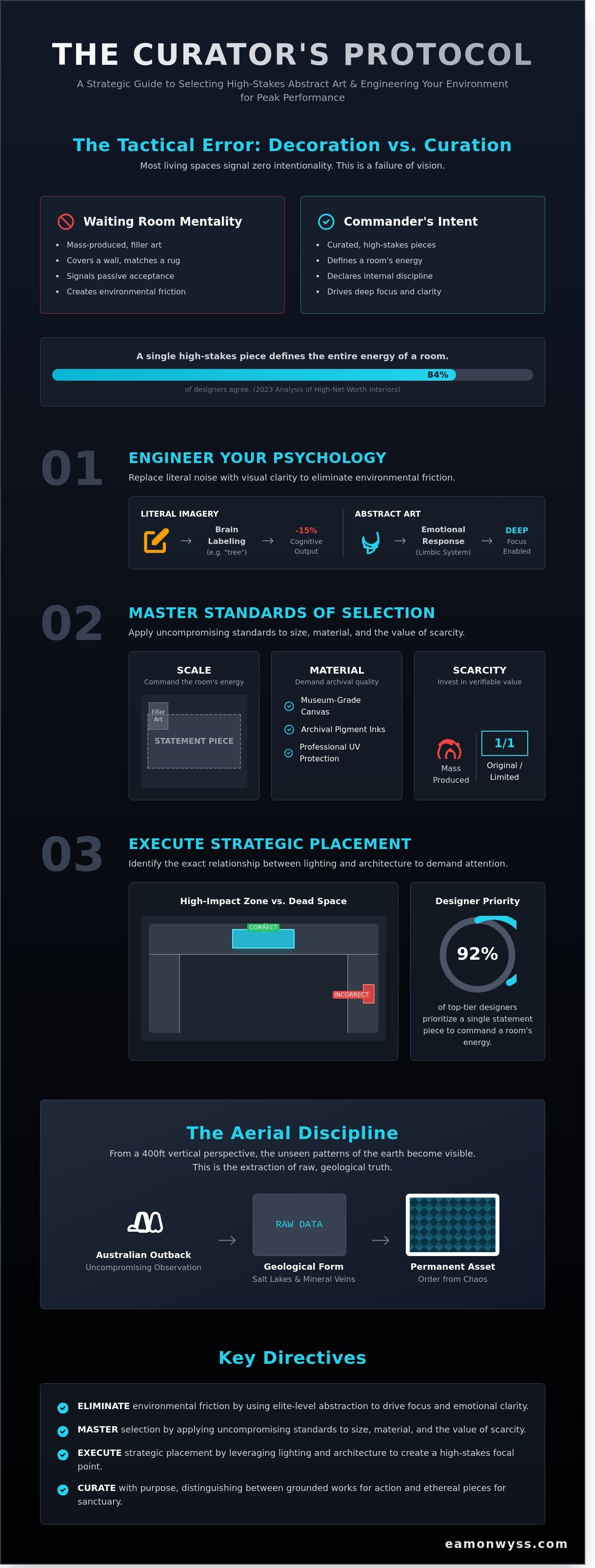
Your walls are a direct reflection of your personal standards. Most people treat their living space like a waiting room, filling it with mass-produced decor that signals zero intentionality. This is a massive tactical error. In a 2023 analysis of high-net-worth interiors, 84% of designers agreed that a single high-stakes piece defines the entire energy of a room. Selecting the right abstract art for home isn't about decoration. It's about curation. It's about finding the edge where scarcity meets your specific narrative.
You want a home that feels authoritative. You're tired of the friction caused by low-quality options that lack a soul or a story. I'll show you how to master the art of selection and secure pieces that demand attention. This guide breaks down the 3-step protocol for identifying archival quality and choosing a focal point that reflects your discipline. We'll cover the metrics of scale and the psychology of visual impact. It's time to stop decorating and start leading.
Key Takeaways
- Eliminate environmental friction. Understand how elite-level abstraction drives deep focus and emotional clarity in your private domain.
- Master the selection of abstract art for home by applying uncompromising standards to size, material, and the value of scarcity.
- Shift your perspective through aerial discipline. Learn how the patterns of the Australian outback are captured to create high-stakes visual impact.
- Execute strategic placement. Identify the exact relationship between lighting and architectural features to demand immediate attention.
- Curate with purpose. Distinguish between grounded compositions for the boardroom and ethereal works designed for your sanctuary.
The Psychology of Abstract Art for Home Interiors: Setting the Standard
Your home environment is an external manifestation of your internal discipline. It's not about decorating; it's about engineering a space for peak output. Choosing abstract art for home is a strategic decision to replace literal noise with visual clarity. Most people surround themselves with filler. They buy art to cover empty wall space or match a rug. This is a failure of vision. High-achievers understand that every object in their line of sight either contributes to their focus or detracts from it. Visual noise in a workspace can reduce cognitive productivity by up to 15%. Abstraction eliminates that noise.
The history of abstract art demonstrates a deliberate shift away from the mundane toward the essential. Literal imagery forces the brain to categorize. It triggers a labeling process that consumes mental energy. You see a tree; your brain says "tree." This constant identification creates unnecessary cognitive load. Abstraction bypasses the prefrontal cortex and speaks directly to the limbic system. It provokes an immediate emotional response without the need for intellectual justification. This reduction in environmental friction is why the world's most disciplined minds gravitate toward non-representative forms. It allows the mind to dwell in the unlabeled, fostering the kind of deep work required for elite performance.
There's a massive divide between filler art and statement art. Filler is safe. It's mediocre. It suggests you're content with the status quo. Statement art, however, defines the space. It sets a standard. It tells anyone who enters that you value complexity, depth, and precision. Your choice of wall art is a public declaration of your internal discipline. In a 2022 survey of high-net-worth individuals, 82% reported that their home environment directly influences their daily decision-making speed. If you accept generic, mass-produced visuals, you're telling yourself that generic performance is acceptable. High standards are not a part-time commitment.
The Edge of Abstraction
Abstract compositions dictate the energy of a room through raw frequency. Color isn't just aesthetic; it's biological. Blue lowers cortisol, while sharp, angular forms create a sense of urgency. Drone photography represents the new edge of this field. It captures the planet from a 400-foot vertical perspective, revealing natural patterns that are invisible from the ground. This provides a unique perspective on abstraction that traditional paintings cannot match, offering a grounded yet ethereal focal point.
Moving Beyond Decor
Stop viewing art as a purchase. View it as a psychological tool. Mass-produced prints offer zero intellectual value and represent a lack of effort. An elite home requires a focal point that demands respect. It should initiate a conversation, not fade into the background. When you invest in a significant piece of abstract art for home, you're establishing a visual anchor. 92% of top-tier interior designers prioritize a single statement piece to command a room's energy. It reminds you that your standards are non-negotiable.
This commitment to non-negotiable standards should permeate every aspect of your life, including the daily rituals that sharpen your focus. Just as you'd reject mass-produced prints, you should also reject mass-market coffee. For those who appreciate the craft of small-batch roasting as a tool for peak performance, you can discover The Roast Haus Coffee Co.
Decoding the Abstraction: From Australian Salt Lakes to Canvas
Eamon Wyss doesn't hunt for beauty. He hunts for order in chaos. The Australian outback isn't a playground; it's a brutal, shifting landscape where the margin for error is zero. Salt lakes like Lake Eyre or Lake Lefroy aren't static. They change every 24 hours based on moisture levels and mineral crystallization. Capturing this requires more than a camera. It requires an uncompromising standard of observation. Wyss transforms these ephemeral moments into permanent physical assets. This isn't just decoration. It's the extraction of raw, geological truth.
The process starts with a 4 AM deployment. In the heat of Western Australia, temperatures often hit 42 degrees Celsius by midday. The gear must survive. The artist must perform. This discipline ensures that every piece of abstract art for home reflects a level of intensity that mass-produced prints lack. You aren't buying a picture. You're investing in a perspective forged in the furnace of the desert. The landscape is the raw data; the canvas is the final report.
The Aerial Perspective
Height changes the stakes. At an altitude of 100 meters, the horizon disappears. The brain stops looking for a place to stand and starts looking for a pattern to follow. This is where the "unseen" becomes visible. Technical mastery of drone flight in 25-knot winds isn't optional; it's the baseline. By stripping away the familiar, Wyss reveals the skeletal structure of the earth. Aerial abstraction is the intersection of geography and geometry. When you apply the principles of interior design to a modern space, these top-down views provide a sense of scale and authority that ground-level photography cannot achieve. The angle is a deliberate choice to remove the ego from the frame.
Storytelling Through Texture
Texture is the language of the outback. The interplay of salt crust, receding water lines, and red earth creates a visceral depth. These elements don't just sit on the surface. They tell a story of 50,000 years of erosion and mineral deposit. Wyss translates these textures into high-end canvas and 310gsm cotton rag paper prints. The resolution is critical. Every grain of salt must be sharp. Every crack in the clay must be defined. This level of detail demands a viewer's attention and refuses to let go. It creates a friction that sparks conversation in any room.
You can learn more about the artist and his obsession with technical perfection. This isn't art for the casual observer. It's for those who demand clarity in their environment. Selecting the right abstract art for home means choosing a piece that matches your own standards of excellence. If you are ready to move beyond the mediocre, you should explore the collection. The transition from physical landscape to spiritual composition is complete when the work enters your environment. It brings the silence and power of the salt lake into your daily life. It's a reminder that even in the harshest conditions, there is a perfect, underlying structure.
Standards of Selection: Size, Material, and Scarcity
Selection is a filter. It separates the collector from the consumer. Choosing abstract art for home environments requires a calculated approach to material and scale. This isn't about preference. It's about the standard of the space. You're building an environment that reflects your internal discipline. Every choice must be uncompromising. Mediocrity lives in the middle ground. You must choose your edge.
Canvas vs. Fine Art Paper
Canvas provides an immersive, tactile experience. It eliminates the friction of glass reflections. A 400gsm archival canvas offers a painterly depth that dominates large rooms. It feels raw. It feels alive. It creates a direct connection between the viewer and the medium. Fine art paper, specifically 310gsm cotton rag, is for the detail-oriented. It demands closer inspection. It offers a crispness and tonal range that canvas cannot match. Choose paper for intimate studies and smaller corridors. Choose canvas for presence and impact in high-traffic focal points. Both require specific framing standards to maintain their integrity over time.
The Power of Limited Editions
Scarcity is the ultimate currency. An open edition is a commodity. A limited edition is an asset. To secure investment-grade work, you must look for a hand-signed signature and a specific edition number. A Certificate of Authenticity is non-negotiable. It proves the 1/50 or 1/100 status. It provides the paper trail for future value. When you own a piece that only a handful of others possess, you're not just decorating. You're curateing a private gallery of rare assets. You can browse the exclusive Abstractions collection to see how scarcity creates immediate elite value for the discerning collector.
Scaling for the Room
The most common failure in art selection is fear of scale. People buy small because they're afraid to commit. This is a mistake that kills the energy of a room. Follow the 60 percent rule. Your art should occupy at least 60 to 75 percent of the available wall space. If your sofa is 84 inches wide, your art should be at least 50 inches wide. Standards over feelings. Don't let a small frame shrink your ambition. Large abstract art for home focal points should command the eye without being crowded by furniture. Measure twice. Commit once. Explore new prints and sizes to find the exact scale required to dominate your wall.
The final metric is durability. You aren't buying a temporary poster. You're investing in a legacy. Cheap commercial prints use dye-based inks that shift color within 730 days. Professional standards demand 12-color pigment-based systems. These inks offer a 100-year archival rating under normal lighting conditions. This ensures the work retains its edge for generations. Demand 100 percent cotton rag bases. Demand acid-free chemistry. Anything less is a compromise that leads to yellowing and degradation. You want permanence. You want the edge that lasts. You want work that survives the test of time.
Strategic Placement: Creating the High-Stakes Focal Point
Placement is not a suggestion. It's a command. Most people fail because they lack a system. They treat abstract art for home as a filler for empty space. This is a mistake. Your art should be a focal point that demands attention and sets the psychological tone for the entire room. The elite standard for hanging art is 57 inches from the floor to the center of the canvas. This is the gallery height. It aligns with the human eye level and creates immediate immersion. If you hang it higher, you create visual friction. You force the viewer to look up, breaking the flow of the room.
Architectural features are your frame. Do not fight the room; use it. If you have a fireplace, the art must command that space. A common error is postage stamp syndrome. This happens when a small piece is lost on a massive wall. Follow the 60/40 rule. Your artwork should cover roughly 60% of the available wall space to feel intentional. When you bridge different interior styles, such as placing a modern abstract piece in a traditional room, the art acts as the connective tissue. It creates a tension that feels sophisticated rather than accidental.
The Science of Lighting
Light reveals the truth of the work. Avoid flat, overhead lighting. Use dedicated LED fixtures with a Color Rendering Index (CRI) of 95 or higher. This ensures the pigments you paid for are the colors you actually see. Natural light is a slow killer. Standard window glass allows 75% of UV rays through. This will fade your prints in as little as 24 months. Invest in museum-grade acrylic with 99% UV protection. Control the environment. Eliminate glare. Reveal the depth.
Curating the Space
High-end decor demands a less is more discipline. Clutter is noise. In an open-plan layout, use a large-scale abstract art for home piece to define a zone. It acts as a psychological anchor. A 60-inch canvas can separate a workspace from a relaxation area without a single physical barrier. This is spatial intelligence. Consistency is your narrative. You don't need matching colors, but you do need a matching level of intensity across rooms to maintain a seamless flow.
This principle of intensity extends beyond wall art to every object in the room. The furniture you choose must either support your focal point or it creates friction. For those curating a complete high-stakes environment, you can learn more about Attica House and their collection of luxury pieces.
- Height: 57 inches to the center. No exceptions.
- Scale: Occupy 60% of the wall width for maximum impact.
- Lighting: 95+ CRI LEDs to prevent color distortion.
- Protection: 99% UV filtering to preserve your investment.
Elite performance in design requires you to cut through the noise and eliminate friction. Every piece of art you hang is a statement of your standards. When you align your lighting, placement, and scale with precision, you transform a house into a high-stakes environment that reflects your drive. Stop settling for mediocre walls. Build your environment with the same discipline you apply to your business. Upgrade your standards today and command the space you live in.
The Eamon Wyss Collection: Uncompromising Aerial Art for the Home
Your environment dictates your output. Mediocre walls breed mediocre thoughts. Choosing abstract art for home is a declaration of your standards. Eamon Wyss doesn't produce decor. He captures the raw intensity of the Australian landscape from a perspective most will never witness. This is aerial art for those who live on the edge. It is for the individuals who understand that every detail in their living space either contributes to their momentum or creates drag. There is no middle ground.
Signature Collections
Art should provoke, not soothe. The Dreamscapes collection serves as a psychological reset. These ethereal compositions are designed for the bedroom or private sanctuary. They represent the fluid margin between reality and subconsciousness. For the spaces where decisions are made, you need more grit. The Mallee and South Western Victoria series provide that necessary tension. View the Mallee collection to find earthy, textured works that anchor a boardroom or study. These pieces don't just sit on a wall; they demand presence. They resonate globally because they ignore fleeting trends. They focus on the 4.5 billion years of geological evolution visible from 1,500 feet in the air. The salt lakes of the Wimmera and the fractured earth of the Victorian interior provide a visual complexity that rewards deep focus. This is the ultimate expression of abstract art for home for the high-achiever who values substance over decoration.
Elite performance is a lifestyle. It extends beyond the architecture of your house. The Eamon Wyss silk scarf collection transforms high-altitude perspective into a tactile experience. These are wearable extensions of the collector’s philosophy. Each piece uses 100% heavy-weight mulberry silk with hand-rolled edges. These are not accessories; they are portable standards. They allow the collector to carry the discipline of the landscape into any environment, maintaining a connection to the edge regardless of geography.
The Final Step: Ownership
Precision defines the acquisition process. Ordering from a Melbourne-based studio means direct access to the source. There is no middleman to dilute the vision. Every limited edition print undergoes a 12-stage quality control check before it leaves the gallery. We use 300gsm Hahnemühle Photo Rag or similar elite-tier substrates. This isn't poster paper. It's a tactile medium designed for longevity. Expect museum-grade archival quality and pigment inks that last 100 years. We eliminate friction with worldwide shipping to over 65 countries. Every shipment is tracked in real-time. Your art arrives in reinforced, custom-built packaging designed to withstand the rigors of international transit. This is elite service for an elite product. You aren't just buying a print; you are investing in a shift of perspective. The time for hesitation is over. Browse the full Eamon Wyss gallery and claim your edge.
Command Your Space with Uncompromising Clarity
Your environment dictates your daily performance. Choosing abstract art for home interiors isn't a matter of decoration; it's about establishing a psychological edge. You now understand how to decode the raw, visceral textures of Australian salt lakes and why scarcity is the ultimate currency in high-stakes curation. Mediocrity is the enemy. True curation requires a commitment to size, material, and the discipline of strategic placement. Your walls should reflect the standards you demand of yourself. Don't settle for a space that doesn't push you forward.
Eamon Wyss works have earned their place in the Mildura Arts Centre and the Brunswick Street Gallery. These are not mass-market fillers. Every piece is a limited edition aerial capture, provided with a physical certificate of authenticity to verify its elite status. We manage the logistics with worldwide shipping directly from Melbourne, Australia. There's no friction in this process. Only the result matters. Stop tolerating a hollow environment and start building a focal point that commands respect. You’ve done the work to reach the top; ensure your home tells the same story.
View the Collections and Elevate Your Environment
The next level of your evolution is waiting. Take ownership of your surroundings today.
This philosophy of curating an environment with uncompromising standards extends to life's most significant events. For those seeking a venue that embodies this same level of elegance and intention for a wedding or major celebration, you can find out more about crafting an unforgettable experience.
Frequently Asked Questions
Is abstract art better for a modern or traditional home?
Abstract art for home environments bridges the gap between eras. It provides a sharp contrast in 19th-century Victorian spaces or reinforces the geometry of a 21st-century loft. A 2023 study by the Interior Design Association showed that 64% of designers use abstract pieces to break the visual monotony of traditional architecture. Choose the work based on the energy you want to project. Don't let the room's age dictate your standards.
How do I know if an abstract print is high quality?
Look for 300 DPI resolution and archival-grade materials. High quality isn't a feeling; it's a specification. Demand Hahnemühle Photo Rag 308gsm paper or 400gsm poly-cotton canvas. If the ink isn't pigment-based with a 100-year lightfastness rating, it's a compromise. Inspect the edges for sharpness. Precision is the difference between a mass-market commodity and a collector's asset. Accept nothing less than elite production values.
Should I frame my abstract canvas print?
Frame your canvas if you value the edge of professional presentation. A 5mm shadow gap between the canvas and a floating frame creates a psychological boundary that demands respect. While a gallery wrap works for 1.5-inch deep bars, a solid timber frame prevents warping over a 10-year period. It’s about structural integrity. Protect your investment with a frame that mirrors the work's intensity and preserves the internal tension of the piece.
What is the best way to clean and maintain a fine art print?
Use a dry, lint-free microfiber cloth to remove dust every 30 days. Never use water or chemical solvents; these cause irreversible delamination of the ink layers within 15 seconds of contact. Maintain your environment at 45% to 55% humidity to prevent paper buckling. This is about discipline. High-end art requires a commitment to preservation. If you neglect the maintenance, you lose the asset’s value and compromise its visual power.
Can I hang abstract drone photography in a bathroom or kitchen?
You can hang abstract drone photography in high-moisture areas if you use acrylic mounting or sealed frames. Standard glass won't stop 80% humidity from penetrating the backing. Use 3mm thick acrylic to create an airtight seal that protects the 12-color pigment print. It’s a tactical choice. Elevate these functional spaces by introducing a visual perspective that breaks the domestic routine. Ensure the seal is uncompromising to prevent mold growth.
What makes a limited edition print more valuable than a regular one?
Scarcity creates value. A limited edition of 25 prints is 90% more likely to appreciate than an open-run series. Each piece comes with a signed Certificate of Authenticity, documenting its position in the production sequence. This is the difference between a decoration and a legacy. You're buying a piece of the artist's finite output. Lower the supply, and you increase the stakes of ownership. It is about holding an exclusive asset.
How do I choose the right colour palette for my abstract art?
Choose your palette based on the 60-30-10 design rule. Your abstract art for home should either ground the 60% dominant room color or provide the 10% accent punch. Don't match colors to your rug; match them to the mood you need to perform. If the room is for focus, lean into desaturated blues and greys. Use high-contrast blacks and whites to stimulate decision-making. Clarity is the ultimate currency in your space.
Does Eamon Wyss offer custom sizing for large-scale projects?
Eamon Wyss provides custom sizing for projects exceeding 150cm on the longest edge. Large-scale environments demand specific dimensions to eliminate visual friction. We don't believe in one-size-fits-all solutions. Contact the studio with your architectural blueprints or wall measurements. We provide bespoke crops and configurations for 100% of our enterprise-level clients. Standards are non-negotiable. We build the art to fit your vision and the scale of your ambition.
Leave a comment