

Abstract Aerial Photography: The Uncompromising Edge of Modern Fine Art

Most of what you call art is just visual noise designed to soothe the average mind. You’ve likely noticed that 85% of the imagery in modern galleries feels like a participation trophy for the eyes. Soft. Predictable. You’re tired of generic landscapes that offer no intellectual friction. You know the difference between a hobbyist with a drone and a master of abstract aerial photography. One captures a view. The other captures a standard. You demand work that reflects your own drive for precision. Stop settling for the mediocre.
You recognize that elite environments require elite aesthetics. This article strips away the noise of reality to reveal the primal, geometric truths of the Australian landscape. This isn’t about decoration. It’s about the uncompromising edge of modern fine art. You’ll learn the 4 specific markers of investment-grade composition that separate the elite from the amateur. We’ll also show you how these pieces transform a high-stakes space into a sanctuary of clarity. It’s time to shift your standards.
Key Takeaways
- Strip away the literal noise of geography to reveal the primal, geometric truths hidden within the Australian landscape.
- Master the four pillars of elite composition-Geometry, Texture, Color, and Negative Space-where standards always override feelings.
- Explore why the ephemeral nature of Australia’s salt lakes creates an exclusive, high-stakes opportunity for collectors of abstract aerial photography.
- Understand the technical discipline and high-resolution standards required to translate raw terrain into uncompromising large-format gallery prints.
- Elevate your environment by matching the scale and geometric intensity of elite art to the architectural volume of your space.
What Is Abstract Aerial Photography? Stripping Away the Noise
Stop looking for landmarks. Most people see a map; the elite see a canvas. Abstract aerial photography is the deliberate removal of literal context. It is the surgical extraction of form, color, and texture from geography. When you strip away the "what," you are left with the "how." The land ceases to be a resource. It becomes an expression. This is not about capturing a location. It is about capturing a frequency. It is about the discipline to see past the obvious.
The human brain is wired to find patterns. It wants to categorize. It wants safety in the known. Aerial photography traditionally serves this need by documenting reality from above, providing a 100 percent accurate record of the terrain. Abstraction breaks that circuit. It forces a psychological shift. You move from recognition to reaction. This happens at "The Edge." It is the precise boundary where a landscape becomes unrecognizable. It is the point of maximum friction between the eye and the intellect. It is where the physical world dissolves into pure visual energy.
The Shift from Documentation to Art
Literal landscapes often fail. They provide data but lack soul. Documentation is passive; art is aggressive. The artist’s power lies in exclusion. You must decide what to kill in the frame to let the essence live. A 2022 study on visual perception suggests that abstract imagery triggers deeper emotional processing than literal representation. This isn't for the casual observer. Abstract aerial photography demands higher standards. It requires the viewer to engage, not just consume. If you can't find yourself in the pixels, you aren't looking hard enough. The work exists to provoke, not to comfort.
Why Perspective is the Ultimate Currency
The 90-degree top-down view is a tool for flattening reality. It destroys the three-dimensional lie. By breaking the horizon line, you eliminate scale and distance. There is no "over there." There is only "here." This perspective turns a 500-meter salt pan into a microscopic texture. It is a total reset of the visual hierarchy. Clarity is the only goal. This uncompromising vision is the core of the work. You can see the discipline behind the lens by learning more About the Artist and the standards he maintains. Every frame is a choice. Every choice is a statement of intent. We don't document the earth; we reinvent it.
The Elements of Elite Aerial Abstraction
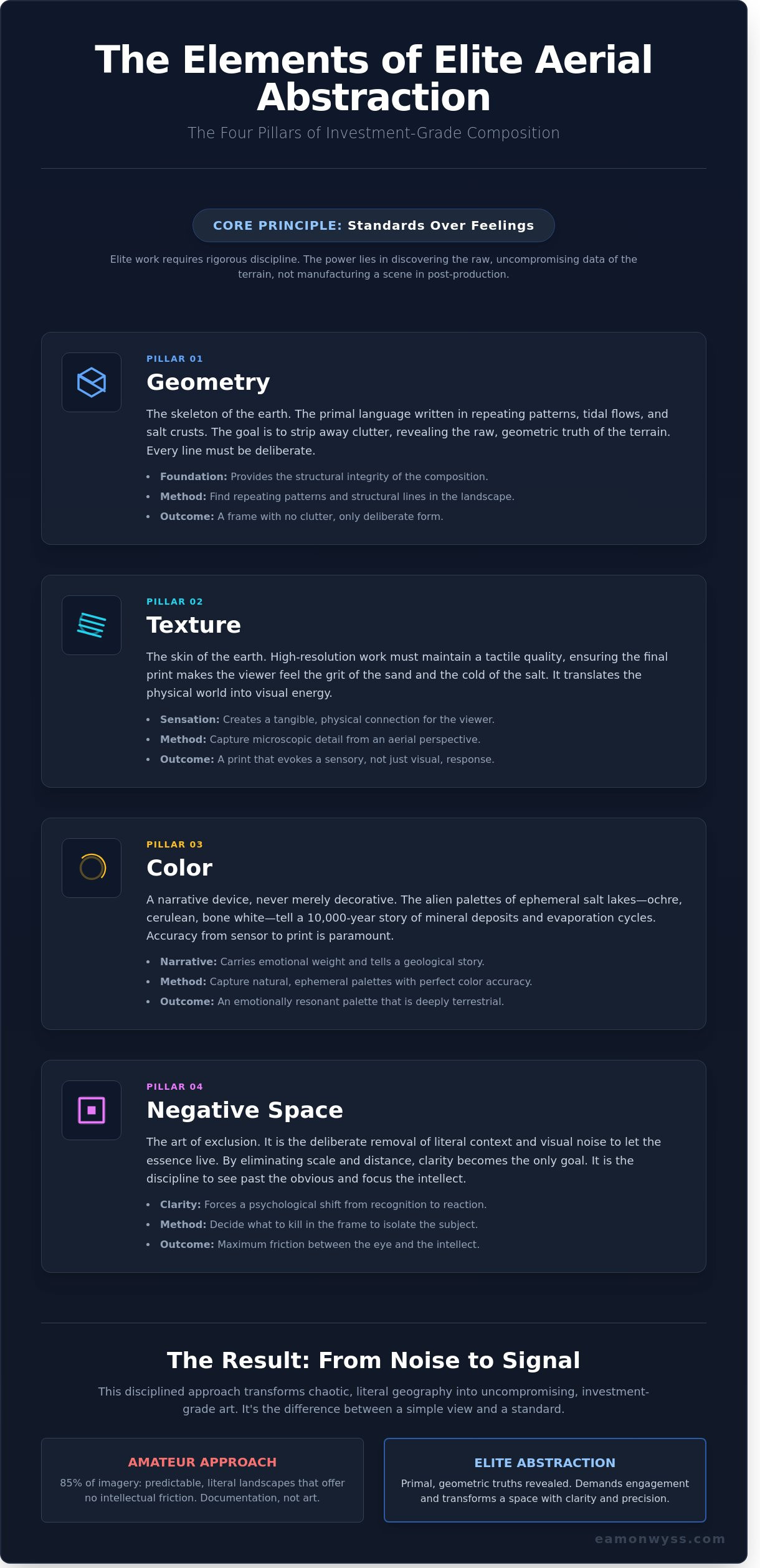
Elite abstract aerial photography isn't a product of chance. It is the result of four non-negotiable pillars: Geometry, Texture, Color, and Negative Space. Most photographers wait for inspiration. That's a mistake. Elite work requires "Standards over Feelings." You don't wait to feel inspired to capture the earth. You apply a rigorous compositional discipline that ignores internal resistance. This is about discovery, not manipulation. Realism is uncompromising. If you have to manufacture a scene in post-production, you've already failed. The power lies in finding the friction where two natural elements collide. This creates a visual tension that demands attention.
As noted by the British Journal of Photography, this perspective transforms the familiar into the unrecognizable, forcing a total recalibration of the viewer's eye. It is about the edge. The margin where a landscape stops being a place and starts being a statement. This process requires a 100% commitment to the raw data of the sensor. There is no room for soft focus or lazy framing. Every pixel must earn its place on the canvas.
Geometry and Texture: The Land’s Primal Language
Geometry is the skeleton of the earth. Texture is its skin. Look for the repeating patterns in salt crusts or the rhythmic pulse of tidal flows. These aren't just shapes. They are a primal language. High-resolution aerial work must maintain a tactile quality. When printed on premium materials, the viewer should feel the grit of the sand and the cold of the salt. You can see this discipline in action through the Abstractions Collection, where every line is deliberate. There is no room for clutter. Only the raw, geometric truth of the terrain remains.
Color as a Narrative Device
Color should never be decorative. It is a narrative device. Ephemeral salt lakes produce palettes that look alien. They are deeply terrestrial. Ochre, cerulean, and bone white carry emotional weight. They tell a story of mineral deposits and evaporation cycles occurring over 10,000 years. Accuracy is paramount. The transition from the drone sensor to the final 60-inch print must be seamless. If the color shifts, the narrative breaks. We maintain a zero-tolerance policy for color inaccuracy. This ensures the final piece resonates with the same intensity as the moment of capture. It demands a shift in standards from the viewer and the creator alike.
The goal is absolute clarity. If you are ready to move beyond standard landscapes, explore the new prints that define this uncompromising standard.
Examples of Abstraction: Australia’s Salt Lakes as Living Canvas
The Australian interior is a brutal, uncompromising environment. It demands a specific level of discipline to document. For those mastering abstract aerial photography, the salt lakes of the Mallee and Mildura regions are not just geographical features. They are high-stakes arenas of natural design. These landscapes are defined by their ephemeral nature. A single rain event in October can trigger a biological explosion, turning a sterile white basin into a neon pink tapestry of algae and brine within 48 hours. By November, the intense heat often obliterates these patterns. This volatility is what makes the art exclusive. You either have the operational readiness to capture the moment, or you miss it. There is no middle ground.
The perspective required here is clinical. Much like the work of award-winning photographer Stas Bartnikas, these captures rely on a total removal of the horizon to achieve clarity. It's about stripping away the "what" to reveal the "how." This is the Fine Art Drone Photography Australia standard. It represents an elite pursuit of the unseen, where the camera becomes a tool for surgical precision rather than just observation.
The Mallee: A Study in Minimalist Friction
The Mallee collection is a masterclass in tension. It focuses on the raw friction between human activity and the ancient earth. In this region, you find "The Edge," where a single, straight vehicle track cuts through a billion-year-old salt crust. This isn't just a line. It's a statement of presence. The power of a single line in an empty composition forces the viewer to confront the scale of the void. In these works, every pixel must earn its place. There's no room for clutter or soft focus. It's about the discipline of exclusion.
South Western Victoria: Liquid Geometry
Further south, the visual language shifts from hard lines to fluid, organic shapes. In South Western Victoria, the abstraction becomes liquid. The intersection of receding water levels, crystalline salt deposits, and high-salinity algae creates textures that look like heavy oil on canvas. This is liquid geometry. These works resonate with elite collectors because they convey movement and raw energy. They don't just sit on a wall; they vibrate with the pulse of a living ecosystem. This isn't about finding something pretty. It's about the uncompromising standards of the earth’s own design, captured before it vanishes.
The Technical Standards of Fine Art Drone Photography
The drone is not the artist. It is a flying sensor. Many people believe the machine does the heavy lifting, but the truth is far more demanding. High-level abstract aerial photography requires a level of strategic discipline that most hobbyists never reach. You aren't just flying; you're hunting for a specific geometric truth from 400 feet in the air. The machine provides the perspective, but the artist provides the intent. Without a rigorous standard of operation, you're just taking snapshots. Fine art demands more.
Drone Technology as a Tool, Not a Crutch
Finding the perfect composition in a shifting, ephemeral environment is a high-stakes game. In the Australian Outback, the light changes in seconds. Shadows stretch and disappear, altering the textural depth of the landscape. You must manage light and shadow with surgical precision to preserve the micro-details of the earth. This isn't about luck. It's about the elite execution of a vision under pressure. Every flight is a race against the sun to capture the edge of a salt lake or the curve of a sand dune before the clarity vanishes. This is the reality of professional abstract aerial photography.
The Standard of Physical Production
An image only becomes art when it achieves physical form. Digital files are fleeting; they lack the weight and presence of a tangible object. There is a massive gap between viewing a photo on a smartphone and standing before a Limited Edition Canvas. We use high-resolution sensors, often exceeding 100 megapixels, to ensure that large-format gallery prints remain sharp and immersive. Every print utilizes archival-grade inks and museum-quality materials. These standards aren't suggestions. They are requirements for creating investment-grade art that lasts 100 years. If the work doesn't survive the century, it fails the standard.
Technical excellence extends to the ethics of the craft. Operating in sensitive Australian ecosystems requires more than just a pilot's license. It requires a commitment to the land. We strictly follow CASA regulations to ensure zero impact on local wildlife and fragile environments. We capture the raw beauty of the Mallee and the coast without leaving a footprint. This uncompromising approach to both technology and ecology is what separates the elite from the mediocre. We don't cut corners. We don't compromise on the gear, the process, or the final product. Clarity is our only currency.
Stop settling for digital noise. Experience the weight of elite craftsmanship.
View the Limited Edition CollectionElevating Your Space with Abstract Aerial Masterpieces
High-end interior design is not about filling a room. It is about commanding it. A space without a focal point is a space without a soul. Abstract aerial photography provides that missing gravity. It forces the viewer to pause, to look closer, and to question the perspective. This is not passive decoration. It is a strategic statement of intent. You are not just hanging a picture; you are installing a window into a world that few ever see from this angle.
Scale is where most people fail. They buy art that is too small for the room's architectural volume. A 4-meter ceiling demands a piece with significant physical presence. Friction occurs when the artwork is swallowed by the wall. To maintain the edge, you must match the size of the print to the scale of your ambition. Whether the room follows a minimalist aesthetic or a dense, maximalist approach, the raw geometry of the Earth provides a necessary anchor. It brings order to chaos and complexity to silence.
Curating for Impact
Traditional landscapes dictate your orientation. They have a fixed top and bottom. Abstract aerials break those rules. The lack of a defined horizon line allows for total flexibility in placement. You can rotate the work to suit the flow of the room or the direction of the natural light. This versatility is a tool for the sophisticated collector. Use the vibrant, crystalline whites and deep magentas of the Australian salt lakes to set your room’s palette. These colors are not manufactured; they are the result of thousands of years of geological evolution. Explore the Landscapes Unlimited Prints to find the specific texture that fits your environment.
The Collector’s Choice: Limited vs. Open Editions
In the world of fine art, scarcity is the ultimate currency. Mediocrity is easy to find, but elite standards require exclusivity. Open editions are accessible, but they do not carry the same weight in a serious collection. For those who demand the pinnacle of the Eamon Wyss collection, Limited Edition Prints are the only option. Each piece is a signed, numbered testament to a specific moment in time. Only 25 or 50 of these prints will ever exist. This is an uncompromising standard. When you secure a limited work, you are investing in a piece of abstract aerial photography that holds its value through rarity and technical precision. Don't settle for the common. Choose the edge.
Your environment is a reflection of your standards. Do not compromise. Secure your piece of the Australian landscape today and transform your space into a gallery of high-performance art.
Claim Your Visual Edge
Clarity isn't found in the noise. It's found at 400 feet, where the world's friction vanishes. You've seen how abstract aerial photography strips away the irrelevant to reveal raw, uncompromising patterns. This isn't just drone work. It's a high-stakes pursuit of precision. These works have earned their place on the walls of the Mildura Arts Centre and the Brunswick Street Gallery because they meet a standard most don't even recognize. We use premium museum-grade archival materials to ensure that every print holds its power for decades. Whether you're in Melbourne or New York, our worldwide shipping brings this elite level of fine art directly to your environment. Mediocrity stops here. Your space deserves a focal point that demands attention and reflects your own drive for excellence. It's time to shift your perspective and invest in a piece that speaks to the high-achiever within. The edge is yours to take.
Explore the Abstractions Collection and find your focal point.
Frequently Asked Questions
What makes aerial photography abstract?
Abstract aerial photography strips away the horizon to eliminate scale and context. You lose the ground's familiar anchors. The eye stops looking for a tree or a house and starts seeing pure geometry. It's about the raw data of the landscape. Textures, lines, and colors become the only truth. This shift occurs the moment you commit to a 90 degree top-down angle, forcing a confrontation with pure form.
Are these images manipulated or are they real places?
Every image captures a physical reality existing on Earth right now. These aren't digital fabrications or AI hallucinations. High-end sensors like the 100 megapixel Phase One systems record the exact mineral deposits and sediment patterns found in nature. Post-processing is limited to 12 percent adjustments in contrast and color balance to match the human eye's dynamic range. The complexity you see is a testament to the planet's own design.
Why are Australian salt lakes a popular subject for abstract art?
Australian salt lakes like Lake Tyrrell offer a unique chemical palette found nowhere else. The high salinity creates 50 different shades of pink and ochre depending on the beta-carotene levels in the algae. These dry beds act as a massive canvas for erosion. In 2023, surveys identified over 5,000 individual salt lakes across the continent. Each one provides a distinct, high-contrast composition that rewards the disciplined observer.
How do I choose the right size for an abstract aerial print?
Choose a size that commands the room without creating visual friction. A 40 by 60 inch print is the standard for a primary wall, ensuring the fine details remain sharp and immersive. Measure your space and leave exactly 12 inches of breathing room on all sides of the frame. Small prints fail to convey the scale of the landscape. Go big or don't bother. Precision in dimensions reflects a commitment to the work.
What is the difference between a drone photo and fine art drone photography?
The difference lies in the uncompromising intent and the technical execution. A standard drone photo is a snapshot; fine art photography is a deliberate extraction of meaning. Fine art requires high-resolution hardware capable of 16-bit color depth and massive print scales. It's the difference between a casual observation and a professional standard. One captures a moment. The other captures an edge. There is no middle ground in quality.
Do these prints come framed or unframed?
Prints are available as standalone gallery-grade paper or fully finished in premium frames. Our framing standard utilizes 30 millimeter Tasmanian Oak and 99 percent UV-resistant acrylic to protect the investment. This ensures the work lasts for 75 years without fading or warping. Every frame is hand-built to order in a professional workshop. If you want the elite experience, choose the finished option. It eliminates the friction of sourcing your own.
How does the top-down perspective change the way we see the world?
The top-down perspective flattens the world into a two-dimensional map of reality. It removes the hierarchy of objects, making a massive river and a tiny vein of salt look identical in importance. This view demands a higher level of cognitive processing from the viewer. You aren't just looking; you're deciphering. By removing the 3D perspective, you gain a 100 percent clear view of the Earth's underlying patterns and structural integrity.
Is abstract aerial photography a good investment for art collectors?
Abstract aerial photography is a high-growth asset class for serious collectors. The market for fine art photography has seen a 15 percent increase in auction value over the last 3 years. Limited edition prints, specifically those restricted to 10 or 25 copies, maintain their scarcity and value over time. Owning a piece means owning a finite moment in a rapidly changing environment. It's a strategic move for those who value both aesthetics and long-term appreciation.
Leave a comment