

100% Silk Scarves: The Uncompromising Guide to Luxury Wearable Art (2026)

Most people think they're wearing luxury when they're actually draped in high-priced friction. It's a harsh truth. If you can't distinguish between a mass-produced weave and a genuine masterpiece, you're playing a losing game. Investing in 100% silk scarves isn't about following a trend; it's about holding a standard. In 2026, the margin between elite wearable art and disposable fashion has never been thinner. You've likely felt the frustration of a scarf that loses its shape after three wears or carries the hollow sheen of a synthetic blend.
You know the feeling of a garment that looks right in the store but fails the test of the real world. You've seen designs that lack the weight to hold a knot or the soul to tell a story. This guide will eliminate the noise and give you the tactical edge. You'll learn why 16 momme is the absolute floor for quality and how to identify the chemical signature of synthetic imposters. We're breaking down technical markers and the styling methods used by the top 1% to turn fabric into a weapon of personal branding.
Key Takeaways
- Decode the technical metrics of 100% silk scarves to distinguish elite mulberry fiber from inferior synthetic blends.
- Master the relationship between momme weight and weave density to select accessories that command respect in high-stakes environments.
- Reject mass-market logos and embrace the scarcity of artist-led collections that prioritize material excellence over corporate marketing.
- Implement strategic folding techniques to elevate basic silhouettes and maintain a frictionless, high-performance wardrobe.
- Discover how raw Australian landscapes are translated into precision silk, providing a unique edge in luxury styling.
Defining the Standard: What Makes 100% Silk Scarves the Ultimate Luxury?
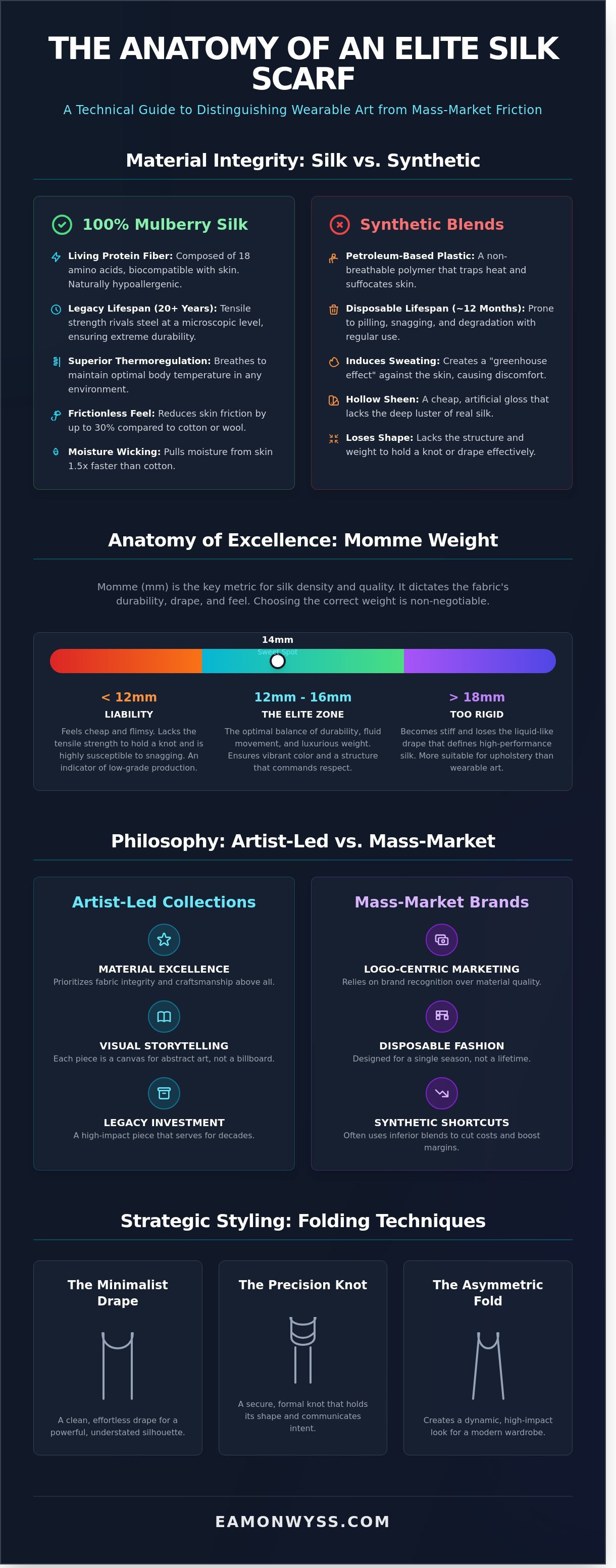
Excellence is a binary choice. You either meet the standard or you don't. In the world of textiles, 100% silk scarves represent the absolute ceiling of performance and aesthetics. Most people settle for the illusion of luxury. They buy synthetic blends that mimic the look but fail the test of utility. This is a mistake. High-achievers understand that every detail matters. Choosing pure silk is about eliminating friction. It's about a Standards over Feelings approach to your environment. You don't buy silk because it feels soft. You buy it because it is the most efficient, durable, and biologically compatible material on the planet.
The biological precision of mulberry silk is unmatched. While polyester is a petroleum-based plastic that traps heat and suffocates the skin, silk is a living, breathing protein structure. It offers a level of thermoregulation that no laboratory can replicate. It keeps the body at a steady state. This is why elite performers choose natural fibers. They need gear that works in a 35-degree boardroom or a sub-zero airport terminal. There is no room for the discomfort of synthetic sweat. There is only room for precision.
The Science of Pure Silk
Silk is composed of 18 essential amino acids. These proteins are nearly identical to those found in human skin, which is why silk is naturally hypoallergenic. This chemical makeup reduces skin friction by up to 30% compared to traditional cotton or wool. To understand the technical foundation of this fiber, one should investigate What is Silk? at its core. It is a protein fiber produced by the Bombyx mori silkworm, refined through centuries of biological evolution.
The durability of 100% silk scarves is often underestimated. While a polyester "silk-feel" alternative will begin to pill and degrade after 12 months of use, a high-grade silk scarf can easily last 20 years. It has a tensile strength that rivals steel on a microscopic level. It wicks moisture away from the body at a rate 1.5 times faster than cotton, ensuring you remain dry and composed regardless of the pressure you're under. This is the edge that pure material provides.
Wearable Art vs. Fashion Accessories
The market is saturated with brand-chasing. Most people wear logos because they lack a personal philosophy. They want the world to know what they spent, not what they value. We are seeing a necessary shift toward artist-led collecting. A scarf shouldn't be an afterthought or a mere accessory. It must be a focal point. In a minimalist wardrobe, one high-impact piece of silk does the work of ten mediocre items. It cuts through the noise.
This follows the Eamon Wyss philosophy, where art and nature are not separate entities but a unified force. We use 100% silk as a canvas for abstract storytelling and ephemeral landscapes. These designs aren't meant to match an outfit; they are meant to provoke a reaction. You aren't just wearing a fabric. You are wearing a captured moment of intensity. It is a visual representation of a high-standard life. When you choose pure silk, you are choosing to invest in a legacy piece that serves as a constant reminder of the discipline required to reach the top.
The Anatomy of Excellence: Momme, Weave, and Print Precision
Elite performance starts with raw specifications. You don't invest in luxury for the label. You invest for the engineering. The anatomy of a scarf determines its lifespan, its drape, and its impact on your silhouette. When you evaluate 100% silk scarves, you are looking at a technical achievement. Every choice in the construction process either adds to the edge or creates unnecessary friction. Mediocrity hides in the details. Excellence is exposed there. There is no middle ground in high-stakes craftsmanship.
Measuring Density: Why Momme Matters
Momme is the grams per square metre equivalent for silk density. It's the standard of measurement that separates the elite from the mass-produced. For a scarf to command attention, it needs the right weight. 12mm to 16mm is the objective strike zone for durability and movement. If the weight drops below 12mm, the fabric feels cheap. It lacks the tensile strength to hold a knot and will likely snag within the first 90 days of use. It's a liability, not an asset.
Weights exceeding 18mm present a different problem. They become rigid. They lose the fluid, liquid-like motion that defines high-level silk. A 14mm specification is the sweet spot. It provides enough density to ensure the colors remain vibrant while maintaining a weightless feel against the skin. Scientific analysis of the properties of silk fibers confirms that molecular alignment dictates how the fabric handles stress. If the density is off, the performance fails. You need a material that survives 500 wears without losing its structural integrity.
The weave is the architecture of the garment. Twill is the choice for those who value discipline. Its diagonal ribbing creates a sturdy, textured surface that holds its shape under pressure. Satin offers a high-gloss finish for maximum visibility and a smooth, reflective surface. Crepe de Chine provides a matte, sophisticated texture with a slight pebble. Each weave interacts with light differently. Your choice of weave reflects your standard of operation. If you want a scarf that stays in place during a high-velocity day, twill is your primary tool.
Capturing the raw detail of aerial photography on silk requires uncompromising precision. Traditional screen printing is a legacy method that often results in blurred edges and a limited color palette. It can't handle the complexity of the earth's natural textures. Digital printing is the modern solution. It allows for 1200 DPI resolution and a spectrum of 16.7 million colors. This technology captures the sharp lines of a coastline or the deep shadows of a mountain range with absolute clarity. It eliminates the margin for error.
The Finish: Hand-Rolled vs. Machine-Stitched
A machine-stitched hem is a shortcut. It's a sign of mass production and lowered standards. A machine creates a hard, flat edge that resists movement. This creates friction in a luxury silhouette. In elite fashion, friction is the enemy of elegance. It disrupts the natural flow of the fabric and creates a visible, stiff border that looks industrial. It’s a compromise you shouldn’t be willing to make.
A genuine hand-rolled edge is a 30-minute commitment to excellence for every single scarf. An artisan rolls the silk between their fingers and secures it with approximately 10 invisible stitches per inch. This process creates the "purl," a subtle, rounded ridge. This ridge provides the necessary weight for the scarf to drape perfectly every time it's worn. It's a mark of uncompromising craftsmanship that a machine cannot replicate. You can see the latest collection to witness how these technical standards translate into a superior product. High achievers don't settle for "good enough." They demand the edge that only hand-finished precision provides.
Artist-Led vs. Mass-Market: Finding The Edge in Luxury Accessories
Stop buying logos. You're paying for the 2024 marketing budget of a multi-billion dollar conglomerate. You aren't paying for the material. Most 100% silk scarves found in high-end department stores are the result of compromised standards. These brands prioritize volume over texture. They choose reach over rarity. This is where the elite separate themselves from the crowd. You don't find the edge in a mass-produced item. You find it in the uncompromising vision of an artist who refuses to dilute the work for a global supply chain.
The mass-market model is built on friction. There are distributors, wholesalers, and retail landlords all taking a cut. By the time a scarf reaches the shelf, the markup is often 2.5 times the actual value of the item. To maintain these margins, brands cut corners. They use thinner silk. They use cheaper dyes. They rely on the prestige of a name to mask a mediocre product. Direct-to-consumer art eliminates this noise. It puts the resources back where they belong: in the weight of the fabric and the precision of the print. When you remove the middleman, you restore the standard.
There is a visceral power in the narrative connection. When you wear a piece of abstract art, you're wearing a specific moment in time. You're wearing the artist's discipline. Mass-market accessories are anonymous. They're designed by committees to be "safe" for a global audience. They lack soul. An artist-led piece carries a signature. It represents a refusal to be common. It's a statement of extreme ownership over your aesthetic.
The Myth of the 'Designer' Label
Don't be fooled by the price tag. Many "luxury" labels have quietly dropped their silk weight to 12-momme or lower to increase profits. It's a play for the average consumer who doesn't know the difference. You aren't average. Elite 100% silk scarves should feel substantial. They should have a 16-momme weight that drapes with authority. Artist-led production offers a level of transparency that corporate fashion can't match. When a piece is "Designed in Melbourne" or "Made in Australia," it carries a verifiable provenance. You know exactly where the standards were set. You're buying into a local legacy of craftsmanship rather than a faceless factory output. This clarity is the ultimate currency in a world of imitation.
Investing in Scarcity
Seasonal fashion is designed to die. It's a cycle of planned obsolescence that forces you to buy again next year. Limited Edition Prints operate on a different timeline. They are assets. When a run is capped at 50 or 100 pieces, the value isn't just in the silk. It's in the scarcity. An artist's signature on a scarf transforms it from a garment into a collectible composition. There is a psychological edge to wearing something few others possess. It signals that you don't follow the herd. You set the pace. While 95% of the market wears the same three logos, the elite choose the 1% of products that can't be replicated. Scarcity isn't just about price. It's about the refusal to be part of the mass production machine. It's about holding a standard that others can't reach.
Strategic Styling: How to Integrate Wearable Art into a High-Performance Wardrobe
Style is a tactical decision. It’s about removing friction from your daily operations. A high-performance wardrobe doesn't waste time on complexity; it relies on elite foundations that deliver maximum impact with minimal effort. Integrate 100% silk scarves to transform a standard silhouette into a statement of intent. This isn't decoration. It's leverage. You are building a frictionless wardrobe. You are elevating basic silhouettes to eliminate decision fatigue. Every piece must serve a purpose. Every fold must be intentional.
The elite professional understands that clothing is an external representation of internal standards. When you pair a high-grade silk piece with a minimalist charcoal suit or a crisp white shirt, you aren't just getting dressed. You are curate a visual identity that signals precision. Silk provides a unique texture that contrasts against wool and cotton, creating a depth that commands attention without shouting. It is the edge you need in a world of mediocre aesthetics.
Professional Precision
The 'Power Knot' is a psychological weapon. It projects authority before you utter a single word. Data from the 2023 Executive Presence Study suggests that visual cues account for over 50% of an initial professional assessment. Use that window. Execute tactical folds like the Ascot or the Drape to define your space. The Ascot provides structural density at the neck, suggesting a fortress-like discipline. The Drape offers vertical lines that elongate the frame, adding a sense of height and dominance to your stature.
Color theory is a strategic asset. Use abstract salt lake hues to complement neutral suiting. These organic, high-contrast patterns break the monotony of corporate grey and navy. They introduce a level of sophistication that suggests a mind capable of complex, non-linear thought. To maintain the elite look, you must prevent silk from bunching. Use a double-loop technique to ensure the fabric stays flat against the collar. Silk should remain sharp. It must remain uncompromising. If the fabric loses its line, you lose the edge.
The Artist’s Casual
Melbourne’s climate is volatile. Temperatures can shift by 12 degrees Celsius in a single 60-minute window. A loose wrap provides immediate thermal regulation and effortless sophistication. It is the ultimate tool for the high-achiever who moves between environments. This is off-duty elegance. It pairs perfectly with heavy leather jackets or raw 14oz denim. The silk softens the ruggedness of the leather, creating a balance of power and refinement. It signals that you are versatile. You are adaptable.
Modern versatility requires you to think beyond the neck. Use the scarf as a headband to manage hair during high-intensity movement, or wrap it around a bag handle to add a layer of texture to your equipment. It breaks the friction of a monochromatic kit. Your style is an extension of your intellectual assets. Link your visual identity to your art collection to create a unified identity. This creates a narrative of curation that spans your home and your person. It is a visual manifesto of your taste.
The scarf is your primary transition tool. Move from a 9 AM boardroom strategy session to a 7 PM exhibition opening without a full wardrobe change. One adjustment to the knot is all that is required. The transformation is instant. By 6 PM, the Ascot becomes a loose Drape. You aren't just wearing fabric. You are wearing a high-performance asset that adapts to the stakes of the room. Stop settling for basic. Demand more from your wardrobe.
Take control of your visual narrative. Explore the Eamon Wyss collection.
The Eamon Wyss Collection: From Australian Salt Lakes to 100% Silk
Mediocrity is a choice. Most people accept generic patterns and mass-produced accessories because they don't know any better. You aren't most people. You demand a higher standard. The Eamon Wyss collection isn't just fashion; it's a calculated translation of the raw Australian wilderness into a high-performance wardrobe staple. This process begins 500 feet in the air. It ends with a piece of fabric that demands respect.
Translating drone photography into silk presents a significant technical challenge. We aren't just printing a photo. We're scaling a massive landscape into a wearable format without losing the edge. When you capture a salt lake from a vertical perspective, you're looking at miles of geological history. Shrinking that data down to a 90x90cm canvas requires surgical precision. Every crystalline structure and mineral vein must remain sharp. If the resolution drops, the standard fails. We don't allow that. We use high-grade digital printing technology to ensure the transition from 100-megapixel raw files to fabric is seamless and uncompromising.
The journey from an ephemeral landscape to a permanent staple is about durability and legacy. A salt lake changes with the wind and the rain. It's fleeting. By fixing these textures onto 100% silk, we make the temporary permanent. This is elite craftsmanship for the discerning collector who values substance over trends. You're wearing the earth's architecture. It's a statement of power and clarity.
The Salt Lakes in Silk Collection
The Salt Lakes in Silk range focuses on the brutal, abstract beauty of the Australian interior. These aren't traditional landscapes. They are textures of salt, clay, and iron oxide. The fluid nature of silk provides the perfect medium for these geological patterns. The fabric moves. The landscape breathes. The transformation of a 500ft aerial view into a 90x90cm silk square captures the raw, geological pulse of the Australian outback. These 100% silk scarves represent the intersection of high-altitude exploration and textile mastery. We've eliminated the friction between art and utility.
Secure Your Piece of Wearable Art
Ownership is about the experience. When your Eamon Wyss scarf arrives, you'll feel the weight of the standards we keep. Every piece comes in premium packaging designed to protect the integrity of the silk. Expect hand-finished edges and a luster that only comes from 100% pure silk. We don't do mass production. These are limited runs for those who understand that exclusivity is a marker of taste. We offer worldwide shipping via tracked couriers because speed and reliability are non-negotiable. Your acquisition is a commitment to quality that lasts decades, not seasons. Don't settle for the middle ground. Secure the edge. Shop the 100% Silk Scarf Collection today and elevate your standard of dress.
- Material: 100% Grade 6A Mulberry Silk.
- Dimensions: 90cm x 90cm for maximum versatility.
- Finish: Hand-rolled hems for a superior tactile edge.
- Origin: Designed in Australia, inspired by the 500ft vertical perspective.
Own the Edge in 2026
Luxury is a discipline. Not a decoration. You've identified the technical requirements that separate elite wearable art from mass-market noise. True excellence relies on the 100% mulberry silk standard. It demands the structural integrity of hand-rolled edges. These details eliminate the friction of mediocrity. Your wardrobe is a high-stakes environment. Every component must perform. By choosing 100% silk scarves from the 2026 collection, you're investing in limited edition artist designs. These pieces capture the raw geometry of Australian salt lakes. They don't just sit on the skin. They signal a commitment to uncompromising quality. Most people settle for the average. You aren't most people. You understand that the margin between good and elite is razor thin. It's time to close that gap. Secure the gear that reflects your internal standards. You've earned the right to wear art that works as hard as you do.
Secure your 100% silk wearable art from the Eamon Wyss collection
Step into the next level of performance and let your presence command the room.
Frequently Asked Questions
Is 100% silk better than silk blends for scarves?
Pure silk is superior because it eliminates the friction caused by synthetic additives. Blends often contain 30 percent or more polyester, which compromises breathability. 100% silk is a natural protein fiber that adapts to your body heat. It represents a commitment to material purity. Choosing pure silk is about maintaining a standard. Cheap blends pill and lose their luster after 90 days. Invest in the real thing.
What does 'momme' mean and why should I care?
Momme is the standard unit used to measure silk weight and density. One momme equals 4.340 grams per square meter of fabric. For high-performance scarves, look for a range between 12 and 19 momme. This weight ensures the scarf has enough substance to drape correctly while remaining breathable. Lower momme counts feel flimsy and lack the structural integrity required for a sharp, professional appearance.
How can I tell if a scarf is real 100% silk?
The burn test is the most reliable way to verify the authenticity of 100% silk scarves. Real silk smells like burning human hair and leaves a brittle black ash that crumbles under your touch. Synthetic fibers like polyester will melt into a hard, plastic bead within 2 seconds of heat exposure. Don't settle for ambiguity. Test your fabric to ensure you are wearing the elite standard you paid for.
How do I care for my 100% silk scarf without ruining it?
Hand wash your silk in cold water using a pH-neutral detergent to prevent fiber degradation. Never use a washing machine; even a gentle cycle can reduce silk's tensile strength by 15 percent in a single wash. Submerge the fabric for 3 minutes, rinse, and lay it flat on a towel. Avoid direct sunlight during the drying process to prevent the fibers from becoming brittle and fading.
Are hand-rolled edges on a silk scarf worth the extra cost?
Hand-rolled edges are worth the investment because they signify elite craftsmanship and durability. A master artisan spends 45 minutes hand-stitching the hem of a single 90cm scarf. This creates a unique, padded border that machine-stitched hems lack. Machine hems are flat, rigid, and prone to unraveling. A hand-rolled edge provides the subtle, three-dimensional detail that separates high-level luxury from mass-produced mediocrity.
Can men wear 100% silk scarves?
Men wear silk to project authority and strategic sophistication. It is a tool for the high-achiever who understands the power of visual standards. Historical data from the 17th century shows that elite soldiers used silk neckwear to signal rank and discipline. Today, a silk scarf provides a functional edge in temperature control. It is a calculated addition to a wardrobe built for performance rather than just fashion.
What is the best size for a 100% silk square scarf?
The 90x90cm square is the definitive size for 100% silk scarves. This dimension provides 8,100 square centimeters of fabric, offering the surface area needed for 12 distinct knot styles. Smaller squares lack the versatility required for professional environments. A 90cm square allows you to create a substantial knot that holds its shape throughout a 12-hour day. It is the tactical choice for those who value both form and function.
Why are artist-designed silk scarves more expensive than high-street options?
Artist-designed scarves command a premium because they are limited-edition assets rather than disposable goods. Most high-street retailers produce 10,000 units of a single design, leading to market saturation. Artist collaborations often limit production to 500 numbered pieces. You are paying for the 200 hours of design work and the exclusivity of the print. This scarcity ensures your scarf remains a unique marker of your personal standards.
Leave a comment